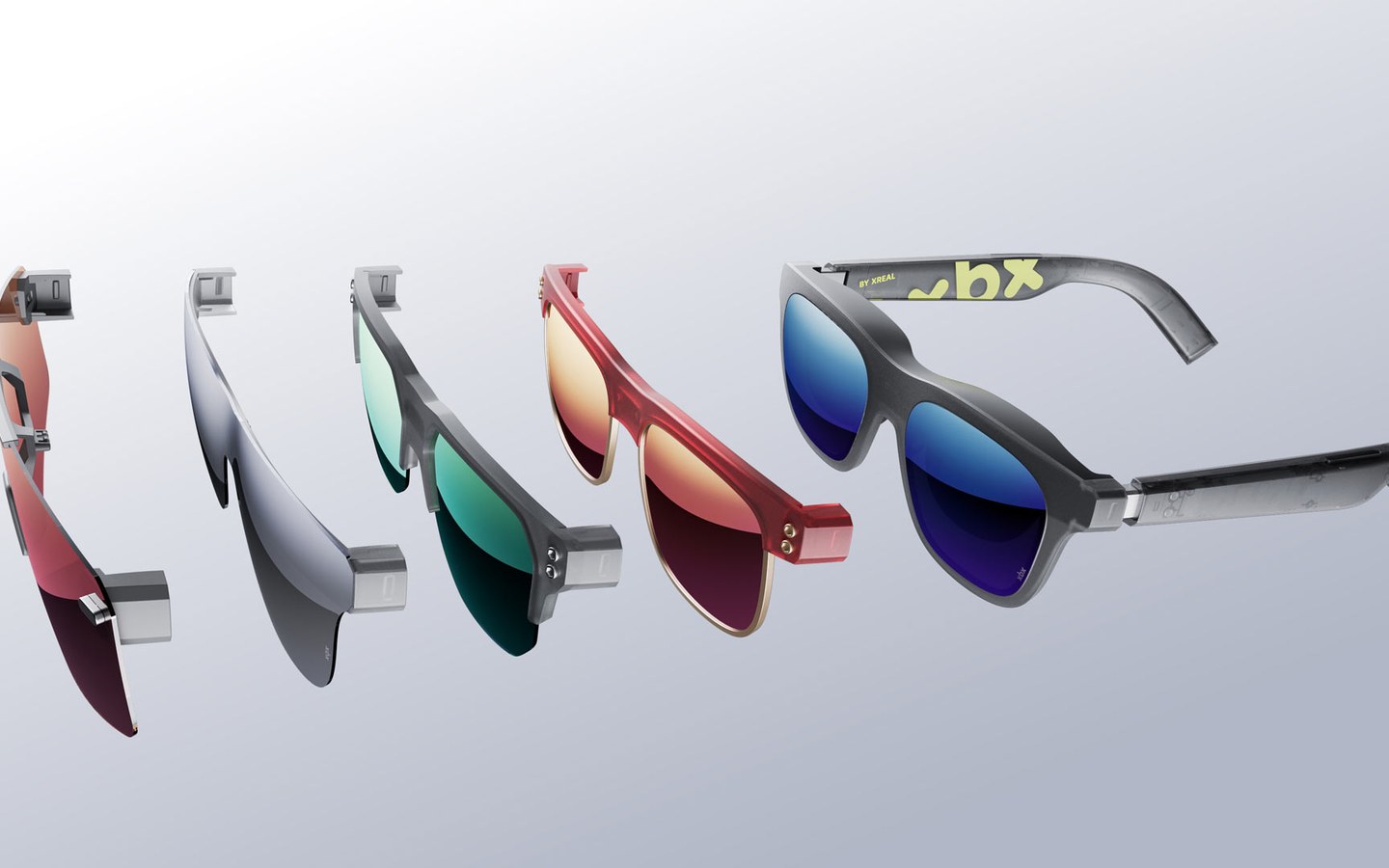
XREAL has made a decisive move toward the budget end of the augmented reality market by launching a new sub-brand in China. As Road to VR reports, the freshly minted XBX label debuted its first product today: the XBX A01 glasses, priced at a competitive CN¥1,799—roughly $265. That undercuts the company’s existing lineup and puts lightweight, media-centric AR within reach of a much wider audience.
The numbers tell a story of careful compromise. In a 62-gram package, the A01 packs Sony micro-OLED displays capable of pumping out up to 1,600 nits of brightness, a meaningful figure for outdoor visibility. The optics follow the birdbath design common to XREAL’s main family, delivering a 50° field of view with HDR10 support and real-time SDR-to-HDR conversion. An onboard anti-shake algorithm aims to keep the virtual screen steady when you’re on a moving bus or train—a practical touch that acknowledges how these glasses will actually be used.
What’s missing is as telling as what’s kept. There’s no camera, no electrochromic dimming, and notably, no “Sound by Bose” audio system that graces higher-end XREAL models. Instead, the A01 relies on more basic open-ear drivers. It’s a straightforward trade-off: strip away the premium frills while preserving core display quality, then rely on sheer price to pull in customers who’d otherwise settle for watching videos on their phone. The glasses are designed to tether to smartphones, tablets, handheld game consoles, and laptops—exactly the kind of passive content consumption that casual AR users seem to want most.
But the launch comes with an awkward branding question that could complicate any ambition beyond China. The name XBX is dangerously close to Microsoft’s Xbox, a trademark the gaming giant has guarded fiercely for over two decades. It’s not hard to imagine legal friction if XBX glasses ever hit Western retailers. XREAL knows this territory intimately. Before adopting its current name, the company operated as Nreal until 2023, when a trademark dispute with Epic Games forced an expensive rebrand—Epic argued Nreal sounded too similar to Unreal Engine. A repeat scenario with Microsoft would be an unforced error for a company trying to gain momentum.
For now, XREAL appears to be hedging. An English-language XBX website exists, but it conspicuously lacks any purchase links, suggesting a cautious toe in the water rather than a full global rollout. The mainland Chinese market may serve as a test bed where trademark pressure is less immediate, giving the company room to gauge demand and iterate before tackling the international arena—or deciding on a more distinct name.
This budget thrust arrives at a pivotal moment. XREAL is simultaneously prepping Project Aura, a flagship AR device built in partnership with Google that will run Android XR, positioning XREAL as Google’s exclusive hardware partner for the operating system. Project Aura is slated for release this year and represents the high-end, feature-rich counterpoint to the stripped-down XBX line. By covering both extremes, XREAL is placing a bet that the AR glasses market will stratify much like smartphones, with customers choosing between premium all-in-one devices and affordable tethered displays. Whether the XBX name survives that global climb remains an open question, but the hardware itself suggests a company willing to experiment boldly to capture the low-cost segment before rivals do.