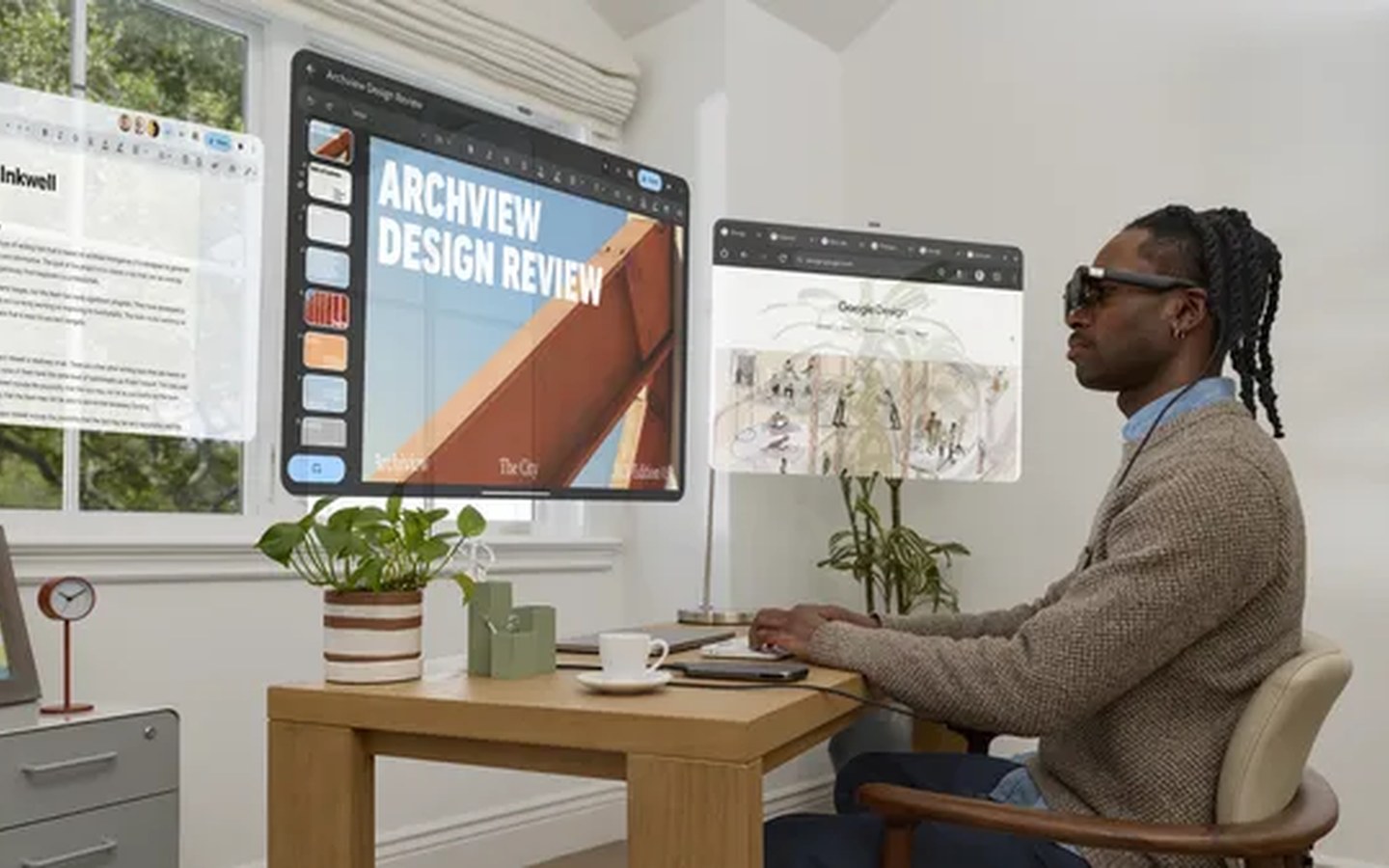
Google and XREAL have started taking orders for XREAL AURA, the first wired XR glasses built on Android XR. Instead of a bulky headset, AURA splits the system into two parts: a pair of transparent-lens glasses under 95 grams, and a pocketable compute puck that handles the heavy lifting. The announcement positions AURA as a private, unbounded canvas for work, watching, and play, with Gemini available as a context-aware assistant across whatever appears in your view.
Why the wired split matters
The cable between glasses and puck is the key design tradeoff. By moving processing and battery out of the frames, XREAL keeps the head-worn part light enough for long sessions. The puck debuts Qualcomm's Snapdragon Reality Elite platform, which promises high-performance spatial computing without strapping a hot CPU to your face.
The glasses themselves carry the visual load. AURA offers a 70-degree field of view, dual Sony micro-OLED displays at 1920×1200 per eye, electrochromic dimming to fade the outside world when you want a theater experience, and Bose spatial audio. A four-microphone array supports voice input for Gemini, and there's a touchpad, fingerprint sensor, and dual USB-C ports. The glasses come in Medium and Large fits, with prescription lens inserts available.
- 70-degree field of view with transparent lenses
- Under 95 grams on the head; processing in the tethered puck
- Snapdragon Reality Elite platform from Qualcomm debuts on AURA
- Dual Sony micro-OLED displays at 1920×1200 per eye
- Electrochromic dimming, Bose spatial audio, 4-microphone array
Work and play without a traditional monitor
Android XR brings Google Play apps and more than 150 made-for-XR experiences to AURA. Users can open a browser, documents, and music side-by-side, resizing windows anywhere around them. Pair a Bluetooth keyboard and mouse, or use the puck itself as a trackpad, and the glasses become a portable multi-monitor setup for a couch, hotel desk, or airplane tray table.
Wired Mirroring is the bridge for laptops: plug in any USB-C video-out source, and the laptop screen appears as a resizable window without installing software. Gemini can then work across both Android XR apps and the mirrored laptop window. The announcement highlights privacy as a bonus—because the display is visible only to the wearer, confidential documents stay out of sight in public spaces. Gemini can also highlight parts of the real world or screen when you share your view, moving beyond voice answers to visual pointers.
For entertainment, AURA turns any seat into a private screen. YouTube, Google TV, and other streaming apps can float wherever comfortable. The lenses dim to block the room and become transparent again when someone is in view. Immersive content includes 180- and 360-degree videos, 3D movies, and new XR films like Nevatars, Galapagos: the Last Eden, and the San Francisco Ballet's Nutcracker. Spatial view converts almost any video, photo, or game to 3D, and window follow mode keeps an app centered or tucks it into a mini view while walking. Google Photos will add a spatial gallery later this year.
Gaming gets a larger screen from Google Play titles or mirrored handhelds and PCs. New made-for-XR games include Fallout Factions and Project Hail Mary: Journey Among the Stars.
Pricing, availability, and the early-adopter tradeoff
Orders opened immediately in the U.S., Canada, and Korea, with Japan following on November 2. Launch pricing starts at $1,099 through the end of the year; the 16GB/512GB model is $1,299. Shipments begin in mid-November through xreal.com and BestBuy.com in the U.S. For businesses, Google points to the Android Enterprise Blog for scaled deployment options.
AURA is not trying to replace your phone or laptop yet. It's a wired, premium accessory for people who want a giant virtual display without sacrificing awareness of the real room. The appeal hinges on whether Android XR's app library and Gemini's cross-window assistance justify carrying another compute puck. The hardware foundation—light glasses, a capable puck, and transparent lenses—is there. Now the software and content need to catch up.