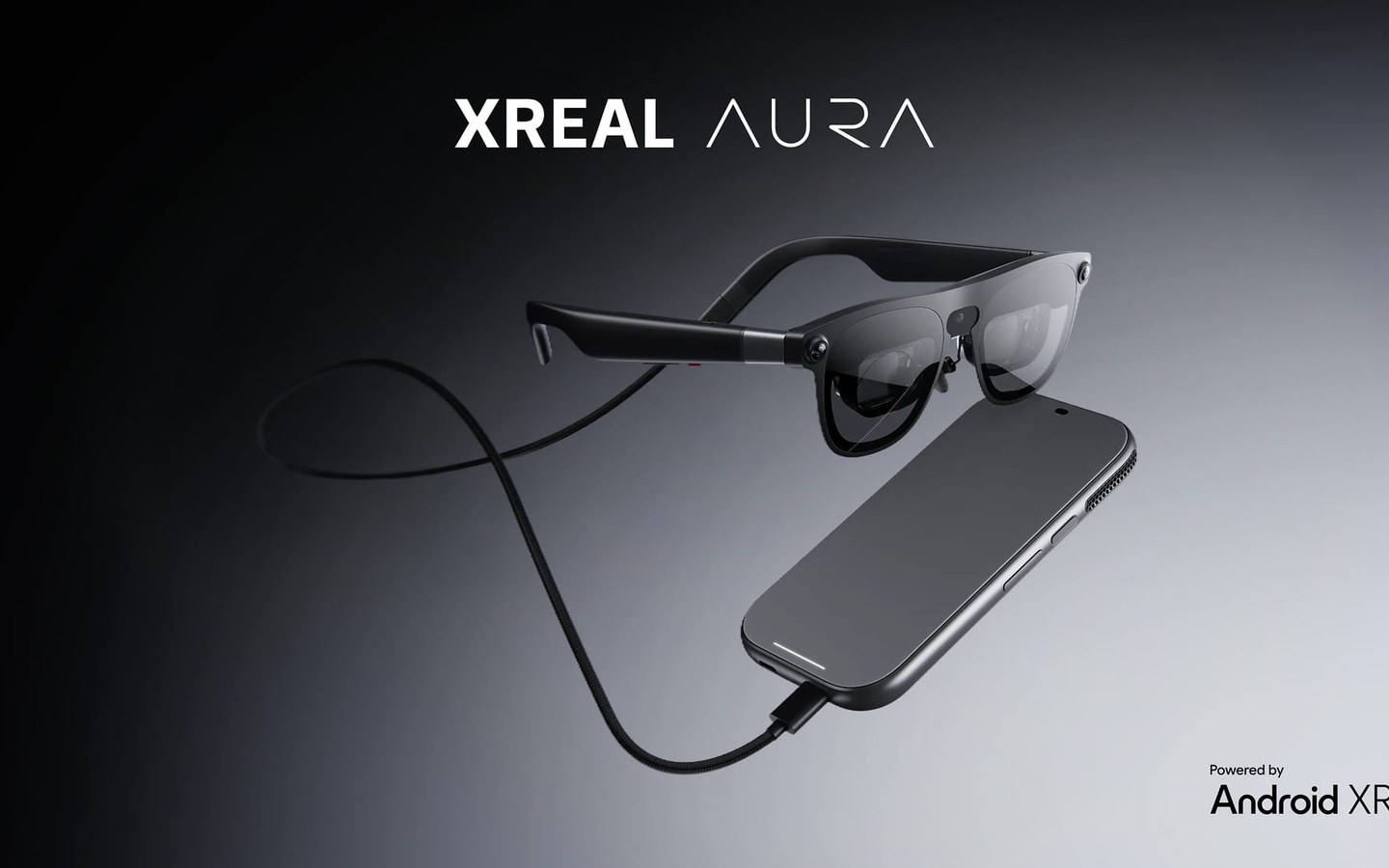
Xreal is taking preorders for its new Android XR headset, Aura, promising a fall release but shrouding the actual cost in mystery. This marks the second device to run Google’s spatial OS, and the first to ship with Qualcomm’s freshly announced Snapdragon Reality Elite chipset. Yet despite the fanfare, prospective buyers are met with an opaque reservation system and a price ceiling of $1,500—and that’s all we know.
A Familiar Design, Upgraded Guts
At a glance, Aura mimics Xreal’s existing sunglass-style aesthetic, but it’s not true eyewear. The headset uses prism-lens optics that sit noticeably further from the eyes than regular glasses, and it blocks most ambient light, so you can’t wear it indoors like prescription frames. The glasses portion alone weighs 95 grams. The design hides a critical upgrade: a compute puck tethered by a cable, running Android XR on Qualcomm’s Snapdragon Reality Elite. That’s a shift from earlier reports that pointed to the XR2+ Gen 2, confirming Xreal is going all-in on the newer silicon.
Aura’s puck isn’t the only silicon story. Inside the headset, Xreal’s own X1S chip handles computer vision tasks locally, sidestepping the bandwidth nightmare of streaming raw camera feeds to the puck. The result is head and hand tracking without extra latency. The field of view reaches 70 degrees diagonal—Xreal’s widest yet—and the device supports most Android XR apps that run on Samsung Galaxy XR, with the notable exception of face-tracked Likeness avatars, since Aura lacks face tracking.
The Opaque Preorder Strategy
Instead of a straightforward preorder with a set price, Xreal has invented two tiers of refundable reservations, both applied toward the final purchase:
- Founder Priority Pass ($299): Guarantees earliest-batch delivery in supported regions, plus a unique limited-edition number printed on the device. You pay only the difference when the price is revealed.
- Launch Credit ($99): Still offers earlier shipping than general sale, and the credit doubles to a net $100 discount on the total price.
Both are fully refundable, but neither tells you what you’ll actually pay. The only promise: the final sticker won’t exceed $1,500. It’s a bold move that seems designed to gauge demand while keeping manufacturing flexibility.
Where It Fits in the XR Landscape
Aura is neither a true AR glasses competitor like Snap Spectacles (which uses slim waveguides) nor a fully standalone VR headset. Instead, it’s a lightweight alternative to Samsung Galaxy XR, trading off the Galaxy’s wider field of view and opacity for a sleeker profile. The opaque lenses and bulkier optics mean it’s closer to a spatially aware virtual monitor than a pair of everyday glasses. For portable AI and spatial computing enthusiasts, Aura represents an intriguing middle ground: enough compute for hand-tracking interactions, a familiar Android app ecosystem, and a form factor that’s easier to toss in a bag than a full visor—once you get past the price roulette.