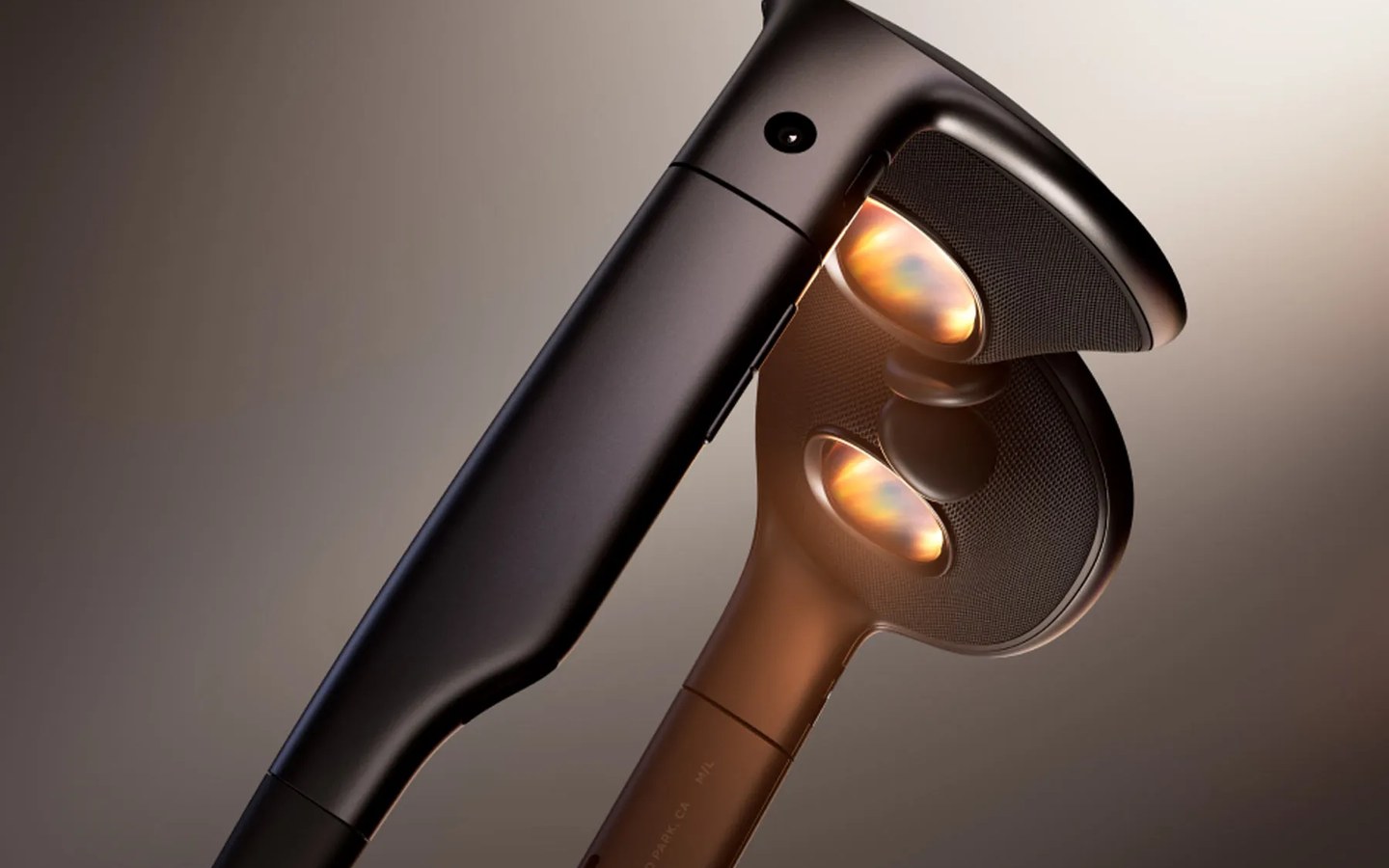
Meta is drawing a bright line between its past and its future, and the line runs straight through the Quest brand. Road to VR reports that the company has unveiled a new $1,300 mixed reality headset called VR Glasses, due in Spring 2027. It’s not a Quest 4, not a Quest Pro 2, and not a Quest Air—Meta insists it belongs to a different product family entirely.
A $1,300 Glasses-First Bet
VR Glasses are sleek, light, and tethered to a compute puck. They run the same operating system as Quest, so the full Quest 3 game library should be compatible, and they can pair with Touch Plus motion controllers for traditional VR titles. But the experience is hand-tracking-first, with a narrower field-of-view than Quest and a positioning centered on productivity, communication, and casual media rather than hardcore gaming.
Meta’s Vice President of VR Ryan Cairns explained that VR Glasses sit inside a “glasses continuum” that stretches from audio glasses to full immersive VR. In practice, that makes the headset feel like what Apple Vision Pro might have been—lighter, more wearable, and less focused on raw immersion. It’s also a bridge toward Meta’s Orion AR glasses prototype, which the company teased alongside Quest 3S in 2024.
The Quiet Retreat from VR Games
The hardware shift is only one part of the story. Meta has been systematically pulling back from the VR games it once bankrolled. Earlier this year, the company shut down three of its most important internal studios:
- Armature Studio (Resident Evil 4 VR)
- Twisted Pixel (Deadpool VR)
- Sanzaru Games (Asgard’s Wrath)
It also pulled funding from partner projects, reportedly cancelling a Harry Potter Quest game from Skydance, a VR title from Cloudhead Games, and a major Moss developer Polyarc project. Polyarc later shut down entirely.
The fallout has rippled through the ecosystem. Schell Games, known for Until You Fall and Among Us VR, held its first layoff in 24 years. CEO Jesse Schell said headset VR had dropped from 80% to 30% of the studio’s work. Mighty Coconut, creator of Walkabout Mini Golf, cut 10 people in its second round of layoffs.
Meta CTO Andrew Bosworth summed up the strategy bluntly: “The gravy train has come to a stop.” The company also shuttered Horizon Workrooms and separated Horizon Worlds from Quest, turning it into a purely non-VR social platform.
What Quest Becomes Next
Road to VR notes that none of this means Quest is dead—at least not yet. Quest 3 is now three years old, the same age Quest 2 was when it was replaced, and Meta has not announced a direct gaming successor. When asked about a future gaming-focused Quest, a spokesperson offered only: “We are continuing to explore a robust roadmap of VR devices tailored to different audience segments as the market grows and matures.” Notably, that doesn’t promise a gaming-focused headset.
Quest may remain a relatively affordable gaming platform with a large install base and an established ecosystem, enough for Meta to keep the lights on while it pursues a much bigger bet. Reality Labs is pivoting toward wearables and AI, and VR Glasses look like a deliberate stepping stone to AR glasses that will be lighter, less gaming-centric, and built around agentic AI. The glasses aren’t replacing Quest today, but they reveal where Meta is placing its long-term faith—and it’s not in the metaverse of old.