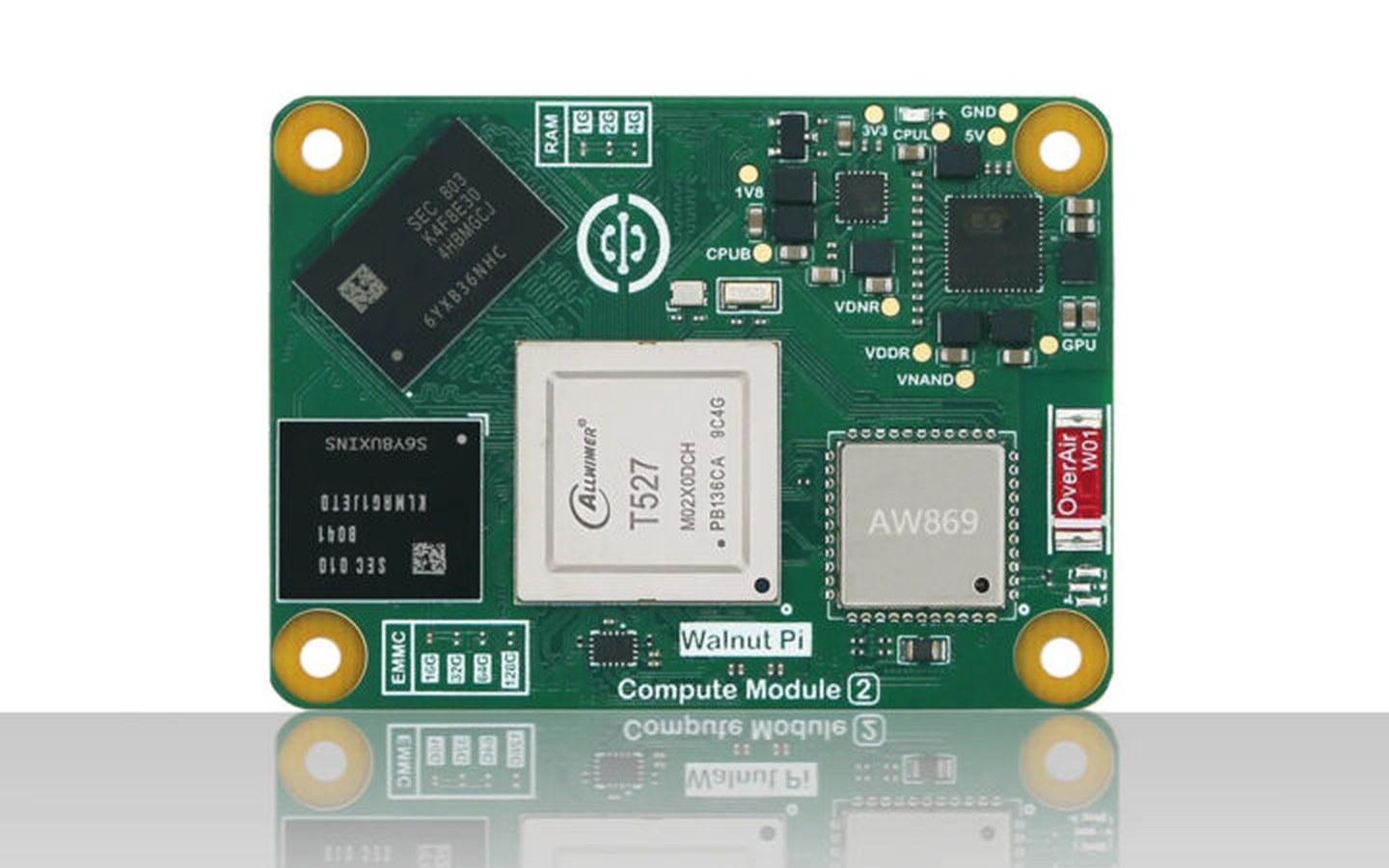
Walnut Pi has taken its Walnut Pi 2B single-board computer and squeezed it into a Raspberry Pi CM5-compatible Compute Module. The Walnut Pi CM2 keeps the same two 100-pin high-density connectors, but swaps Broadcom's silicon for an Allwinner T527 system-on-chip. CNX Software first reported the module, which is now listed on AliExpress.
A Lower-Cost Entry into the CM5 Ecosystem
The headline number is hard to ignore. The 2GB LPDDR4 / 16GB eMMC / wireless version of the Walnut Pi CM2 sells for $49, while an equivalent Raspberry Pi CM5 (CM5102016) costs $97.50. Configurations range from $28 to $49, and bundles with the company's IO board start at $37.80.
Under the metal lid, the Allwinner T527 combines:
- Four Cortex-A55 cores at 1.80 GHz
- Four Cortex-A55 cores at 1.42 GHz
- A 200 MHz E906 RISC-V core and a 600 MHz HIFI4 audio DSP
- A Mali-G57 MC1 GPU with OpenGL ES 3.2, OpenCL 2.2, and Vulkan 1.3 support
Memory options are 1 GB, 2 GB, or 4 GB of LPDDR4, and eMMC is optional at 16 GB, with 32 GB, 64 GB, and 128 GB variants selectable by resistor strapping. There's also 8 MB of SPI flash for boot code.
On-Module Networking and Edge AI
What makes the Walnut Pi CM2 feel more like a system-on-module than a bare compute chip is its integrated connectivity. An on-module Gigabit Ethernet PHY means carrier boards don't need to add their own controller, and an AW869 module provides dual-band WiFi 6 and Bluetooth 5.0.
For edge workloads, the T527 includes a 2 TOPS NPU, which is modest compared to newer Rockchip parts but useful for lightweight local inference. The module also exposes:
- HDMI 2.0 up to 4Kp60
- A four-lane MIPI DSI interface up to 1080p60
- A four-lane MIPI CSI camera input
- One USB 3.0 port and three USB 2.0 ports
- PCIe Gen2 x1, multiplexed with USB 3.0
Walnut Pi does not offer Raspberry Pi OS. Instead, the company supports Debian 12-based Walnut Pi OS, Ubuntu, Android, and Home Assistant images, with documentation on its T527 wiki.
Compatibility Caveats and the IO Board
Calling the CM2 "CM5-compatible" is accurate only in terms of the connector footprint. The electrical interface differs in important ways. There is only one HDMI output, not the CM5's two. MIPI cameras and displays designed for Raspberry Pi usually won't work. And the PCIe lane is shared with USB 3.0, so a carrier board must choose one or the other unless it supports the multiplexer configuration.
For evaluation, Walnut Pi offers an IO board that includes a 3.5mm audio jack, two USB Type-A ports, a color-coded 40-pin GPIO header, a coin cell battery holder for RTC, and an M.2 Key-M socket that fits 2230, 2242, 2260, or 2280 NVMe SSDs. A fan connector and power/user buttons round out the board.
For developers who need a CM5-shaped module with integrated networking and a low-cost NPU, the Walnut Pi CM2 is an interesting option. Just read the pinout carefully before assuming a Raspberry Pi carrier board will work unchanged.