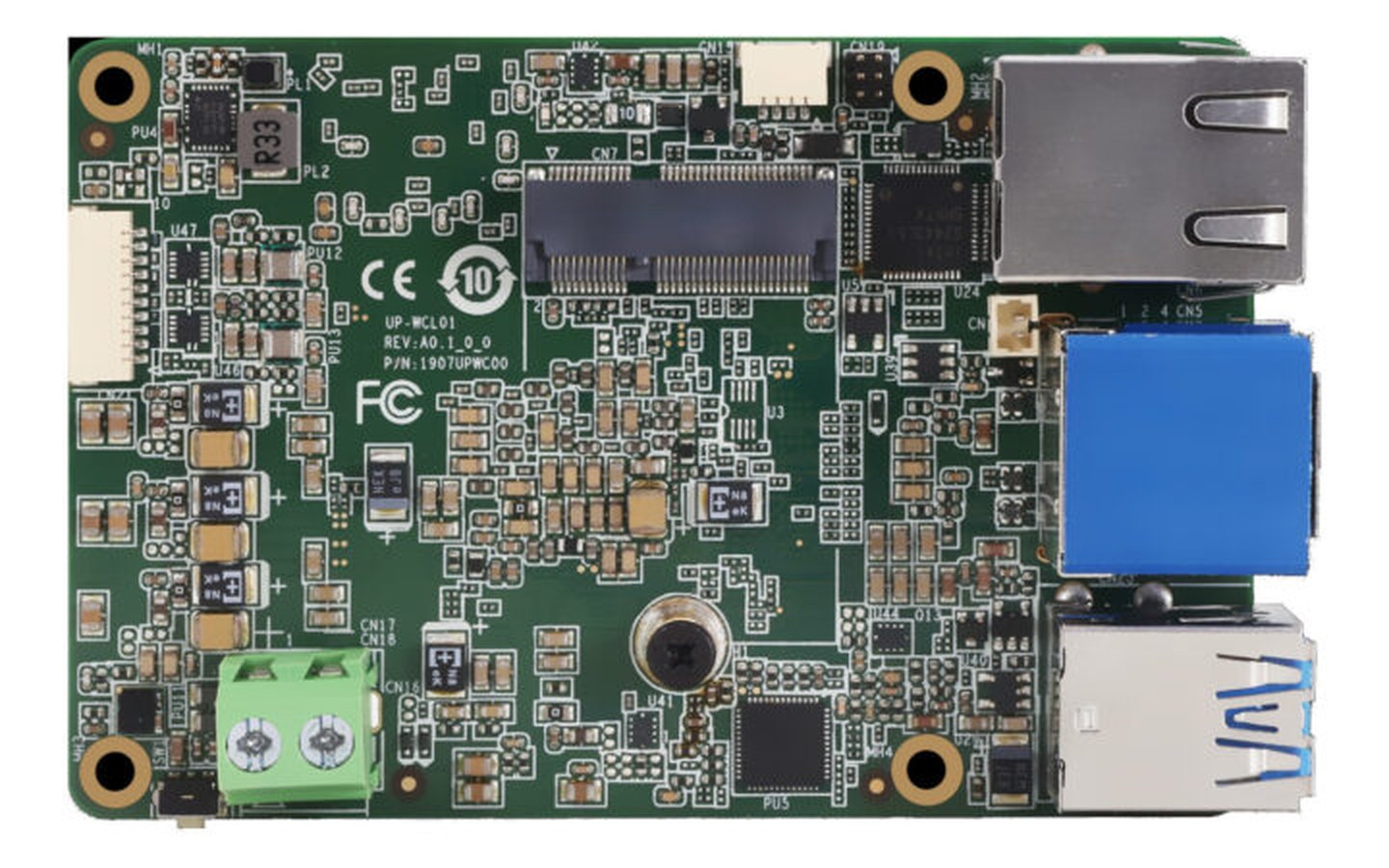
Tiny footprint, serious AI muscle
AAEON has announced the UP WCL—a credit card‑sized single‑board computer that puts Intel’s latest Wildcat Lake processors into a truly portable package. Measuring just 85.6 × 56.5 mm, the board is aimed at hobbyists, edge‑AI developers, and anyone who needs a compact x86 platform that doesn’t sacrifice modern AI acceleration. Alongside the core CPU, it offers up to 24 GB LPDDR5 RAM and 256 GB UFS storage, making it far more capable than typical Raspberry Pi‑alikes for memory‑hungry workloads.
What’s under the heat spreader: Wildcat Lake silicon
The UP WCL will ship with a choice of three Wildcat Lake SoCs, all running at a 15 W processor base power (PBP) and sharing 6 MB Intel Smart Cache. Each chip pairs Intel’s hybrid architecture—a mix of high‑performance P‑cores and low‑power E‑cores—with integrated Intel Xe3 graphics and a dedicated NPU for AI inference. The NPU alone delivers between 15 and 17 TOPS, and when combined with the GPU’s compute, the system can reach up to 40 TOPS for AI workloads.
- Intel Core 3 304: 5 cores (1 P‑core + 4 LPE‑cores), 1‑core Xe3 GPU @ 2.3 GHz (9 TOPS), NPU: 15 TOPS
- Intel Core 5 320: 6 cores (2 P‑cores + 4 LPE‑cores), 2‑core Xe3 GPU @ 2.5 GHz (20 TOPS), NPU: 16 TOPS
- Intel Core 7 350: 6 cores (2 P‑cores + 4 LPE‑cores), 2‑core Xe3 GPU @ 2.6 GHz (21 TOPS), NPU: 17 TOPS
That spread means the board can tackle real‑time computer vision, on‑device speech recognition, or even lightweight LLMs right on the edge, without a fan—though an active cooler extends the operating temperature to -20 °C to +60 °C.
Connectivity in a tight space
Despite its diminutive size, the UP WCL includes a robust set of I/O. A single 2.5 GbE RJ45 port handles wired networking, while an M.2 2230 Key‑E socket accepts optional Wi‑Fi/Bluetooth modules. Video output runs through HDMI 2.1, enabling 4K high‑refresh displays. On the USB front, you get three USB 3.2 Gen 2 Type‑A ports plus two more USB 2.0 lanes exposed via a wafer header. Additional expansion comes through a trio of small connectors:
- 10‑pin wafer (3.3 V) with 2× I²C, 2× PWM, 2× SPI
- 10‑pin wafer with 8× GPIO
- 10‑pin header with 2× USB 2.0 and 1× UART
Notably absent is the 40‑pin Raspberry Pi GPIO header found on earlier UP models, but the available wafer interfaces still leave plenty of room for custom sensors and peripherals. Power is supplied via a 12 V DC‑in (5 A) jack, with typical load consumption in the 30–36 W range. Software support covers Windows 11 LTSC and Ubuntu 24.04 LTS, and AAEON expects the board to be available in late Q3 2026.
Source: CNX Software.