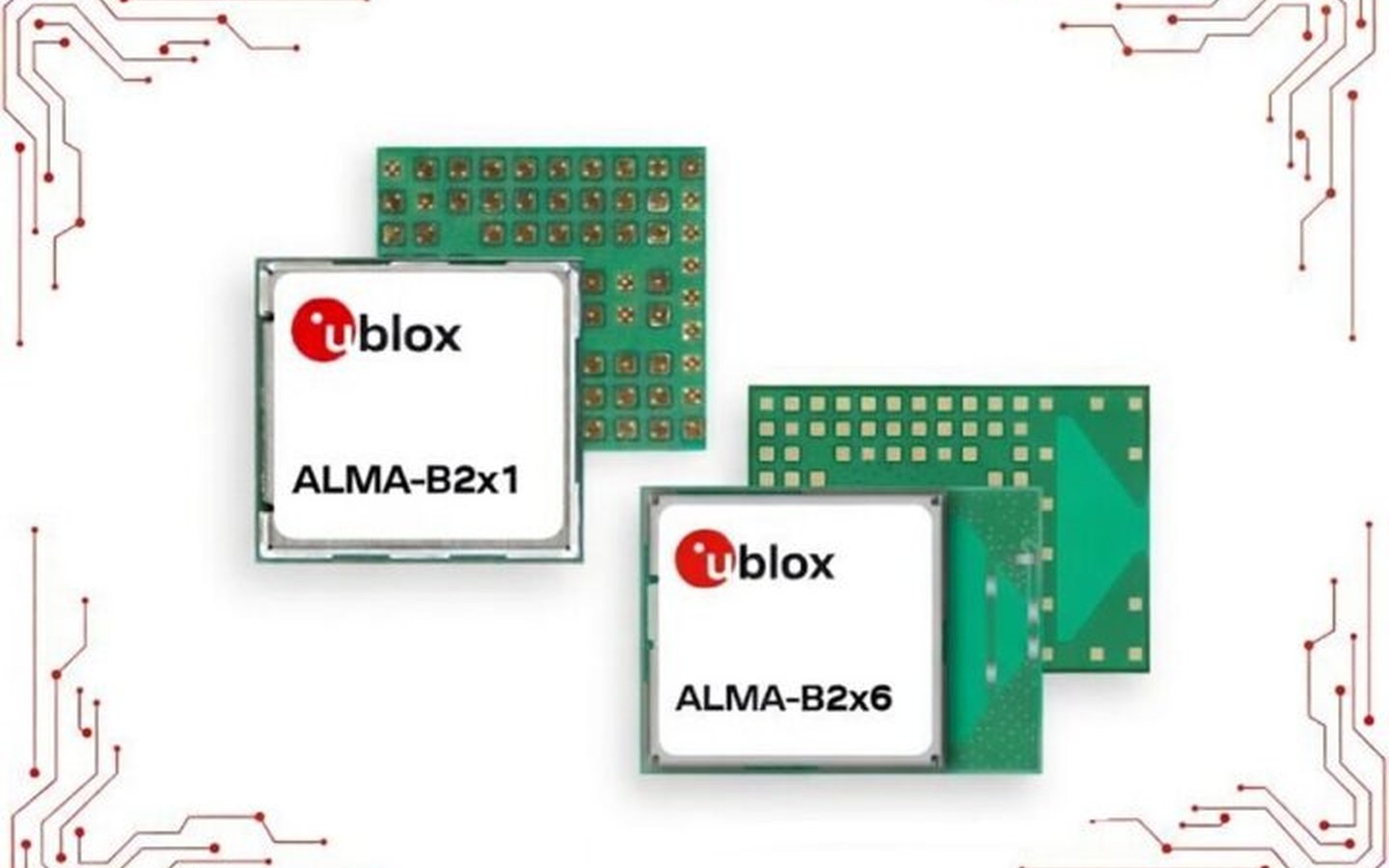
u-blox is expanding its Bluetooth module portfolio with the ALMA‑B2 family, a line of self‑contained wireless modules built around Nordic Semiconductor’s nRF54LM20 system‑on‑chip. What sets two of the four variants apart is an integrated Axon neural processing unit (NPU) that brings edge AI inference directly onto a coin‑cell‑friendly form factor.
The series splits along two axes: antenna type and NPU inclusion. The ALMA‑B201 and ALMA‑B206 use the nRF54LM20A SoC without the NPU, while the ALMA‑B211 and ALMA‑B216 step up to the nRF54LM20B and its on‑die Axon accelerator. Nordic claims the NPU can run machine learning workloads up to 15 times faster and with far better energy efficiency than the main Cortex‑M33 core. That matters for portable designs because local processing avoids the latency and power drain of shipping raw sensor streams to a cloud backend. Wake‑word detection, gesture recognition, environmental classification – the kind of always‑on sensing that wearables, asset trackers, and smart‑home nodes demand – can now happen on‑module, often in single‑digit milliwatt budgets.
Every ALMA‑B2 variant packs the same application processor (an Arm Cortex‑M33 at 128 MHz), a RISC‑V co‑processor, 512 kB of SRAM, and 2 MB of non‑volatile memory. The open‑CPU architecture means you can write your application directly onto the module without an external host MCU. Development leans on Nordic’s nRF Connect SDK, so familiarity with Zephyr‑based toolchains translates directly. The module’s radio capabilities are equally broad: Bluetooth LE 6.0 with all PHY rates from 125 kbit/s up to 2 Mbit/s, Bluetooth Channel Sounding for precise distance measurement, long‑range coded PHY, IEEE 802.15.4 (Thread, Zigbee, Matter), NFC, and Nordic’s proprietary 2.4 GHz protocol. Radiated power tops out at +10 dBm, enough for robust indoor coverage without external amplification.
Power numbers are what really catch the eye for portable AI. Active TX at 0 dBm draws just 4.8 mA; standby idles at 4 µA; and sleep mode sips 700 nA. Operate from a single 1.71–3.6 V rail. In practical terms, a small battery can sustain periodic BLE transmissions and the occasional NPU‑accelerated inference for months. The modules come in two footprints: antenna‑pin variants (B201, B211) measure 10.4 × 11.2 × 1.9 mm, while internal‑PCB‑antenna versions (B206, B216) stretch to 10.4 × 14.3 × 1.9 mm. A generous 66 GPIOs, USB HS, multiple SPI, I²C, UART instances, and a 14‑bit SAADC give designers plenty of peripheral headroom.
Security features are comprehensive for a module this size: Arm TrustZone, secure boot, hardware crypto, physical tamper detection, and debug access port protection, all designed to keep AI models and sensitive data safe.
u‑blox also announced evaluation kits – the EVK‑ALMA‑B211 (external antenna) and EVK‑ALMA‑B216 (internal PCB antenna) – though at the time of writing dedicated product pages are still pending. Early samples of the ALMA‑B2 series will start shipping in the coming weeks.
For edge‑AI practitioners, the ALMA‑B2 line is a signal that neural‑accelerated Bluetooth modules are becoming building blocks rather than niche prototypes. The NPU‑equipped variants let you deploy low‑latency inference right at the sensor while keeping the bill of materials tight and battery life long. The absence of an NPU on the lower‑end models, however, means cost‑sensitive designs that still crave a bit of on‑device intelligence will have to lean on the Cortex‑M33 alone or wait for future stepping. All together, the ALMA‑B2 family marks a notable step toward making portable, connected AI practically off‑the‑shelf.