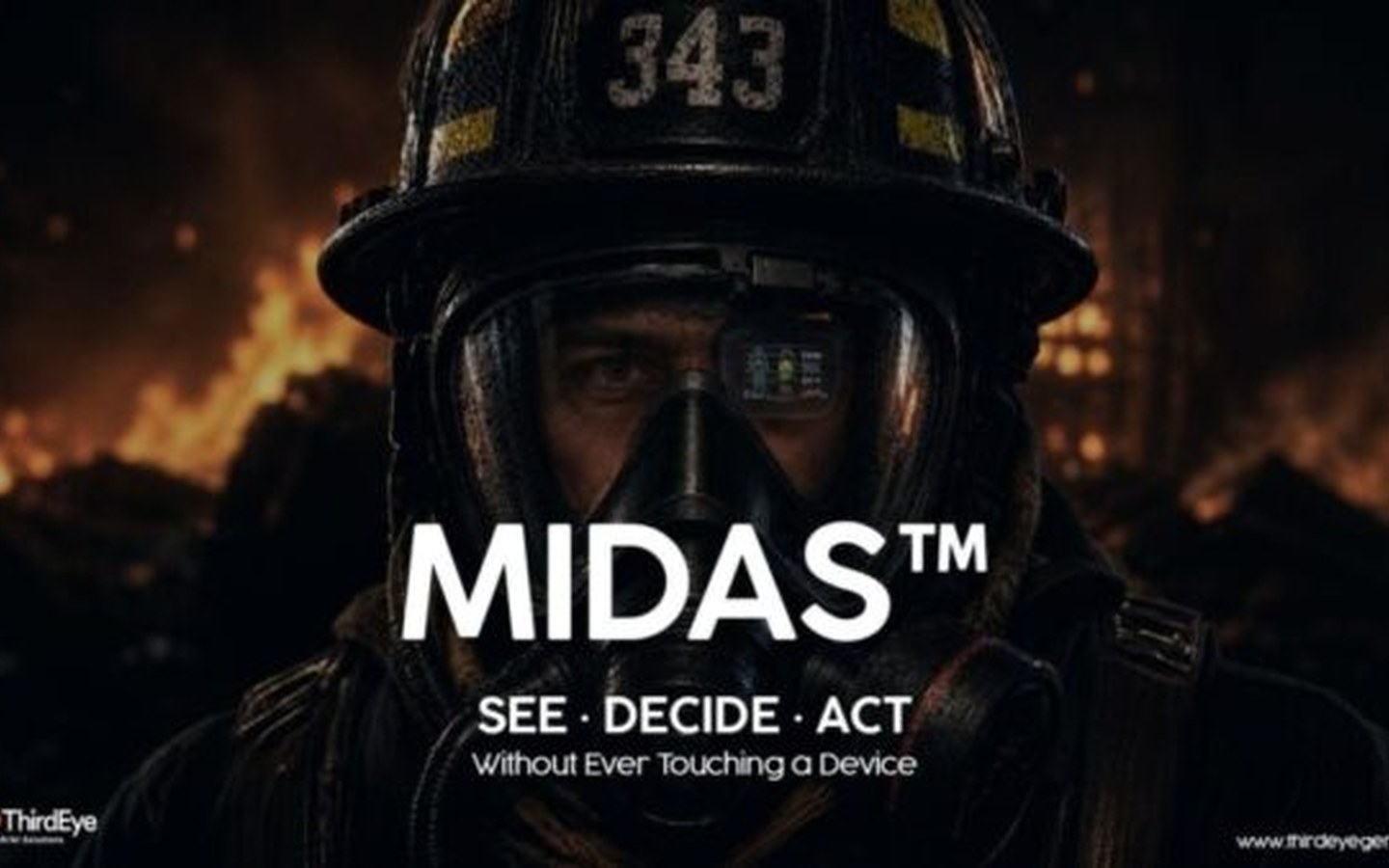
ThirdEye has expanded its MIDAS platform into Response and Industrial product lines for hands-free AR use across emergency and hazardous work environments.
For first responders and industrial workers in protective gear, MIDAS is designed to keep critical information accessible when conventional interfaces like phones and tablets are difficult to use.
ThirdEye is advancing MIDAS toward real-world pilot programs across public safety, defense, and industrial markets as the platform continues to develop.
August 14, 2026 – ThirdEye Gen , a developer of augmented reality (AR) and mixed reality (MR) hardware and software for government and enterprise deployment, has this week announced the expansion of its MIDAS platform into two dedicated product lines, MIDAS Response and MIDAS Industrial.
According to the company, MIDAS is a mask-integrated display platform designed to bring critical information directly into a user’s field of view when phones, tablets, touchscreens, and voice systems are unreliable. ThirdEye described the platform as “smart protective equipment,” as opposed to consumer AR, with the digital layer built into the gear that operators already depend on, across use cases ranging from firefighter response to industrial hazard operations.
MIDAS Response is built for first responders, including fire, hazmat, civil protection, and emergency response teams operating in smoke, low visibility, and high-stress conditions. ThirdEye noted that in high-stress emergency situations, thick gloves eliminate dexterity, smoke eliminates visibility, and critical data remains on devices operators cannot reach.
Given those conditions, the MIDAS interface is intentionally minimal, limited to a small number of reliable actions rather than a full dashboard that could add confusion or distraction. According to ThirdEye, first responders do not need 20 complex gestures, only a few reliable actions that work quickly and effectively.
ThirdEye Gen stated that MIDAS Industrial is built for oil and gas, chemical plants, utilities, refineries, critical infrastructure, and industrial safety teams operating in protective gear. Workers in these environments may be wearing gloves, respirators, protective masks, or full PPE, while also operating in poor visibility, high noise levels, and hazardous conditions.