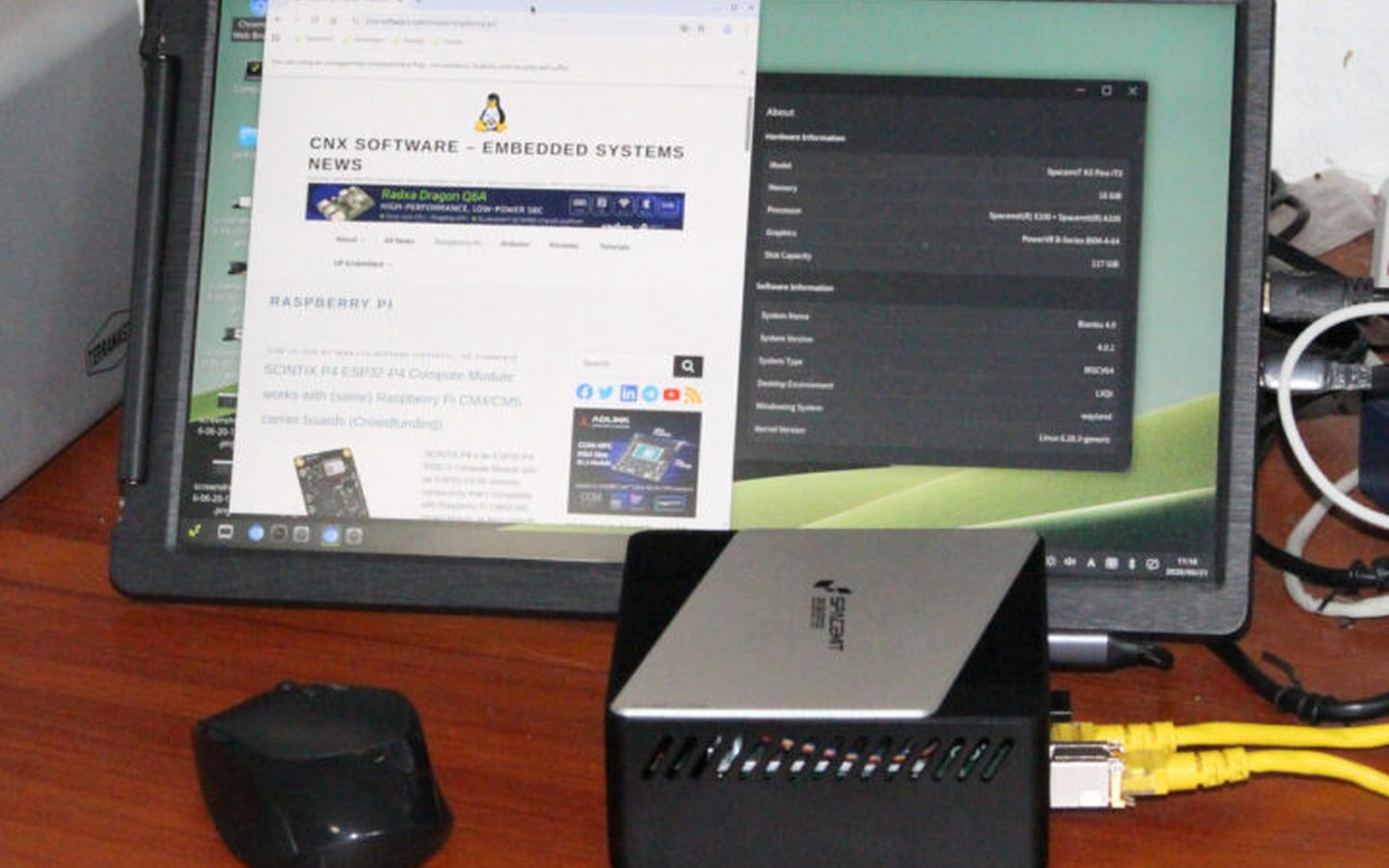
Last month, I received the SpacemiT K3 Pico-ITX Chassis Kit based on the company’s K3 16-core RISC-V SoC, and started the review with an unboxing, a teardown, and a first boot to Bianbu OS 4.0. Since the system features a 10Gbps Ethernet SFP+ cage, I also had to order a 10GbE SFP+ to Copper adapter, as my 10GbE networking gear is exclusively based on RJ45 ports.
In this review, I’ll check system information in Bianbu OS 4.0.1, run a few benchmarks, test 10GbE, GbE, and WiFi 6 networking performance, play YouTube videos at various resolutions, run AI workloads (LLM), check all/most features work as expected, and measure the power consumption of the SpacemiT K3 “Pico-ITX Chassis Kit” mini PC.
Before running anything, I updated the system:
594 packages were updated. For reference, the update also involved updating the EC (Embedded Controller) firmware:
Let’s double-check the system information after a reboot:
The system was updated to Bianbu 4.0.1 (Resolute Raccoon), which appears to be a stable release rather than the RC I got last month. The kernel is unchanged (Linux 6.18.3) and a few packages report updated versions. Total memory is now shown properly (16 GiB), and the idle CPU temperature is still fairly high.
We already ran some headless benchmarks on a remote SpacemiT K3 platform last January, but let’s run them again with sbc-bench.sh to see if anything has changed.
Let’s see. memcpy’s memory bandwidth is 6045.3 MB/s instead of 5947.7 MB/s (minor improvement), 19,680 MIPS in 7-zip against 17,530 MIPS (quite better), and AES-256-CBC has dramatically improved with 1,316,580.01k vs 869,520.73k, probably because some crypto instructions were enabled…