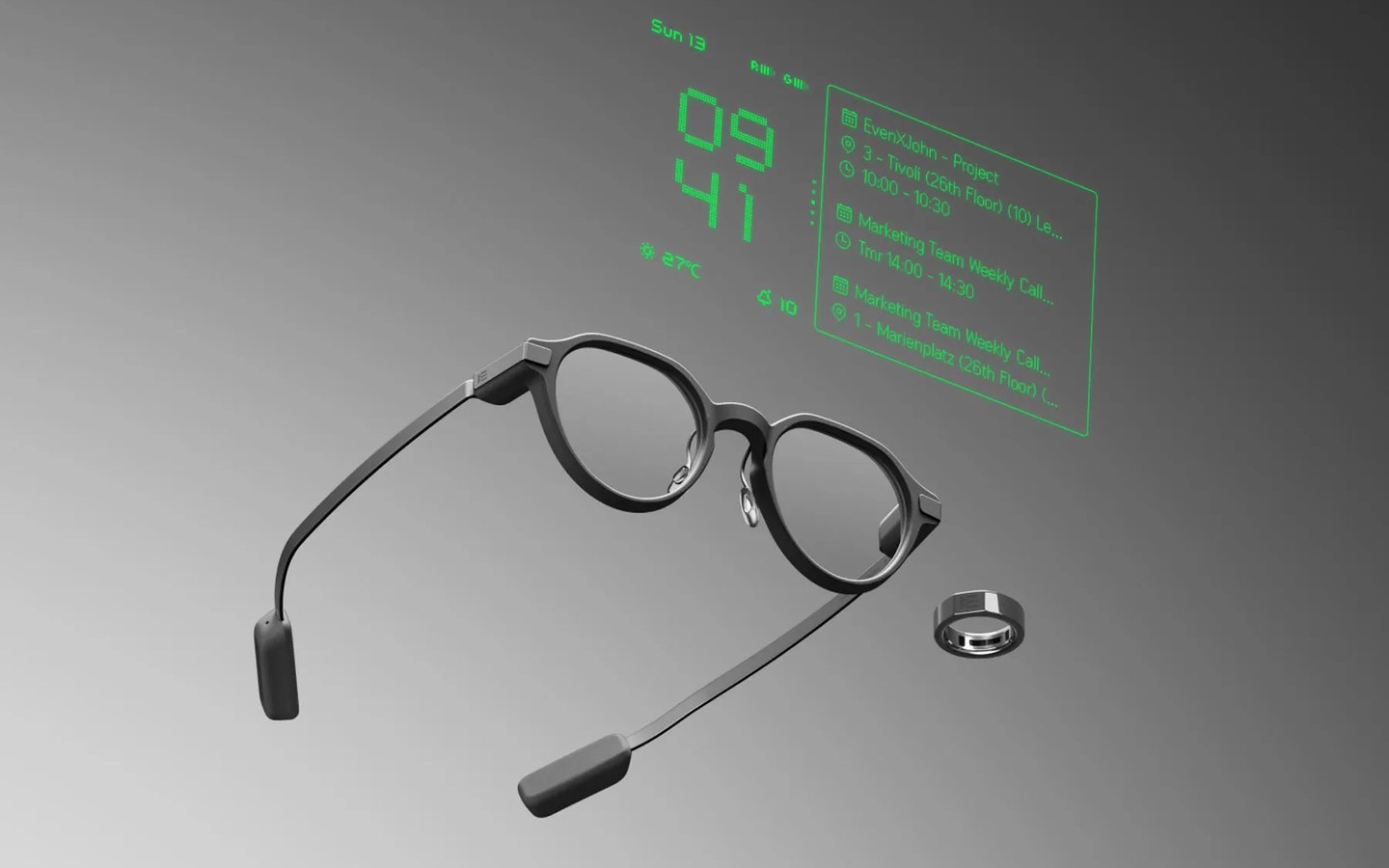
Even Realities, the Beijing startup that bets on minimalist, display-first smart glasses, just crossed into unicorn territory. A new $150 million pre-B funding round, led by Meituan and Tencent, pushes its valuation to $1 billion and brings total funding to $159 million — a sharp acceleration from its earlier $9 million Series A. The company plans to channel the capital into three streams: building its next-gen hardware platform, deepening AI integration, and scaling global operations to meet surging demand.
What Sets Even Realities Apart
Unlike the camera-studded frames from Meta or the rumored Apple glasses, Even Realities ships binocular monochrome green micro-LED displays without any camera at all. Its flagship model, the Even G2, pairs with the Even R1 smart ring, which handles health tracking and touch-free input. Founder and CEO Will Wang frames the approach as an evolution of personal computing: “Every generation of computing has brought information closer to people — from the desktop to the laptop to the smartphone. We believe smart glasses are the next step.”
The ethos is deliberate. Instead of capturing the world, the glasses overlay glanceable information — notifications, navigation prompts, real-time translation — while leaving the wearer’s attention on their surroundings. The result is a product that feels less invasive and, at 38 grams, surprisingly light for a binocular display device. It’s a category YouTubers and early adopters have started calling “display glasses,” and Even Realities is quickly becoming its poster child.
A Crowded Field Gets a Differentiated Player
The infusion arrives as the smart glasses market enters a new phase of competition. Major players are staking claims:
- Meta keeps iterating on its Ray-Ban partnership, adding cameras and AI.
- Apple is reportedly prototyping lightweight AR glasses after Vision Pro.
- Samsung has teased a mixed-reality headset and smart glasses concepts.
- Google recently acquired an eye-tracking startup, hinting at a renewed hardware push.
Even Realities sidesteps the privacy debates and battery anxiety that haunt camera-first designs. Its display-only strategy draws a line between augmented reality and heads-up info delivery — a difference that Wang says makes the technology “extend life, not interrupt it.” Investors are buying that vision. Meituan and Tencent’s backing signals confidence that a China-born brand can compete on a global stage, especially as Western giants struggle to reconcile social acceptance with feature overload.
What’s Next for the Unicorn
The new funds will accelerate a platform that’s already shipping. Even Realities says the capital will fuel deeper AI features — think proactive summaries, contextual alerts, and language translation that runs on-device — alongside a broader partner ecosystem. The company also aims to ramp up its international distribution, starting with optical retailers in Europe and North America.
With $150 million in fresh dry powder and a $1 billion sticker price, Even Realities is no longer a dark horse. It’s a genuine rival in a race where the finish line is a pair of glasses you actually want to wear every day.