Radxa’s collaboration with Qualcomm just shifted into a higher gear. At a joint developer day on May 30, 2026, the company unveiled two new single-board computers and teased a pair of network-attached storage systems built around Qualcomm silicon—extending a partnership that kicked off with the Dragon Q6A. The Dragon Q8B and Q5E target distinct ends of the edge computing spectrum, while previews of the DragonStation and DragonBay hint at ambitious plans for Arm-powered storage and local AI. A 2026 roadmap glimpsed at the event counts 22 Qualcomm-based products in the pipeline, from modules to robotic platforms.
Dragon Q8B: A Snapdragon-powered workhorse
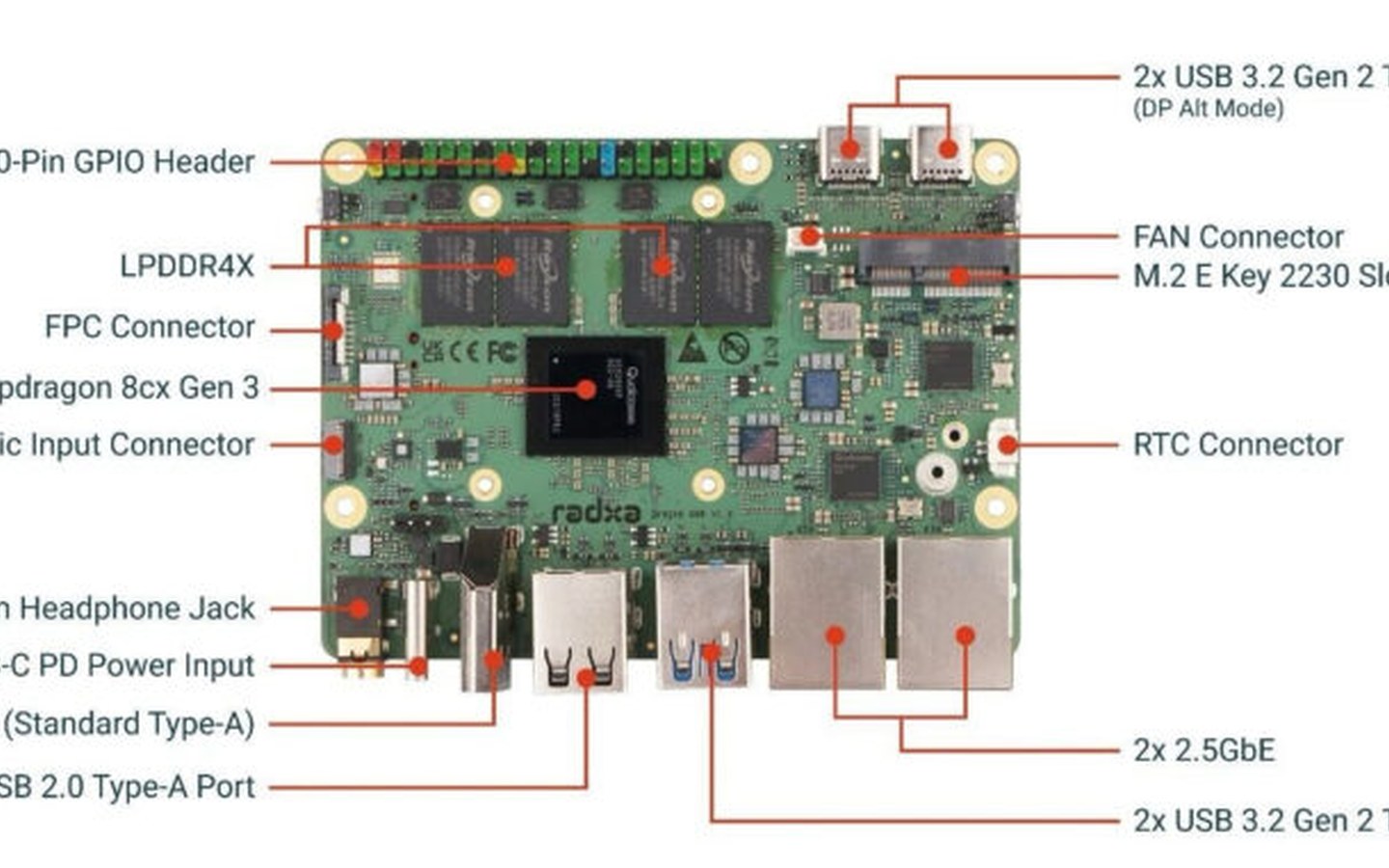
The Dragon Q8B is clearly the range-topper. At its heart sits a Qualcomm Snapdragon 8cx Gen 3 compute platform with an octa-core CPU (4× 3.0 GHz Kryo Prime, 4× 2.4 GHz Kryo Efficiency) paired with an Adreno 690 GPU. Radxa quotes up to 29+ TOPS of AI performance via the Qualcomm Neural Processing Engine SDK, positioning the board for local inference, intelligent gateways, and heavy data‑crunching.
Memory and storage options are generous:
- Up to 32 GB LPDDR4x RAM at 4266 MT/s
- MicroSD card slot and a UFS 3.1 module connector
- Two M.2 Key‑M sockets (PCIe Gen3 x4 and x2) for dual NVMe SSDs
Networking and I/O reflect its server‑room ambitions:
- Dual 2.5GbE RJ45 ports
- Two USB 3.2 Gen 2 Type‑C with DisplayPort Alt mode, two USB 3.2 Gen 2 Type‑A, two USB 2.0 Type‑A
- HDMI 2.1 and dual DisplayPort 1.4b (via USB‑C) supporting up to 4Kp120
- M.2 Key‑E slot for optional Wi‑Fi/Bluetooth
- 40‑pin color‑coded GPIO header and a 16‑pin PCIe Gen3 x1 FFC connector compatible with Raspberry Pi pinouts
OS support will concentrate on Linux with open‑source toolchains, emphasizing flexibility for developers. Expect this board to turn up in Arm NAS builds, compact edge servers, and wherever a little extra AI oomph on the network edge is welcome.
Dragon Q5E: Efficient edge AI
If the Q8B is a thoroughbred, the Dragon Q5E is the efficient pack horse. It’s built around the Qualcomm Dragonwing QCS6690, an octa‑core Kryo CPU (1× 2.0 GHz Prime, 3× 2.0 GHz Gold, 4× 1.8 GHz Silver) fabricated on a 4nm process. AI output is a more modest 6 TOPS, fed by a Hexagon DSP with HVX and HMX. Video handling is solid: encode up to 4K60 (H.264/H.265), decode up to 4K120 (H.264/HEVC) and 4K30 VP9.
Port selection scales back compared to the Q8B but still packs essential enterprise features:
- Dual 2.5GbE RJ45 (one with optional PoE)
- HDMI up to 1080p90 and a 4‑lane MIPI DSI connector
- 4‑lane MIPI CSI for up to 32 MP cameras
- MicroSD and UFS module interface
- 40‑pin GPIO header (UART, SPI, I2C, I3C)
Steady software support is promised: Radxa OS (Debian‑based) and Ubuntu will be ready at launch, with documentation landing on the Radxa site soon after. The Q5E feels purpose‑built for vision‑based edge AI, industrial gateways, and compact IoT hubs—“good enough” AI that sips power.
Pricing for both boards was teased as “pleasantly surprising” at the May 30 event, though no public figures have emerged yet.
Beyond SBCs: NAS systems and a bold roadmap
Radxa is also stepping into networked storage with two Qualcomm‑powered NAS designs, co‑developed with FeiNiu to run the fnOS operating system.
- DragonStation: a 6‑bay M.2 NVMe SSD unit with 10GbE networking. An optional AI accelerator card will let it handle up to 120B‑parameter local models and run AI agents like OpenClaw and Hermes—blurring the line between storage and edge inference.
- DragonBay: a more mainstream 4‑bay NAS built on an unannounced Qualcomm mobile platform. It targets high‑capacity storage, media libraries, photo archiving, backups, and multi‑user file collaboration.
Details remain thin beyond these sketches, but the direction is clear: Radxa wants to plant a flag in the Arm NAS space where Silent Intel boxes currently rule.