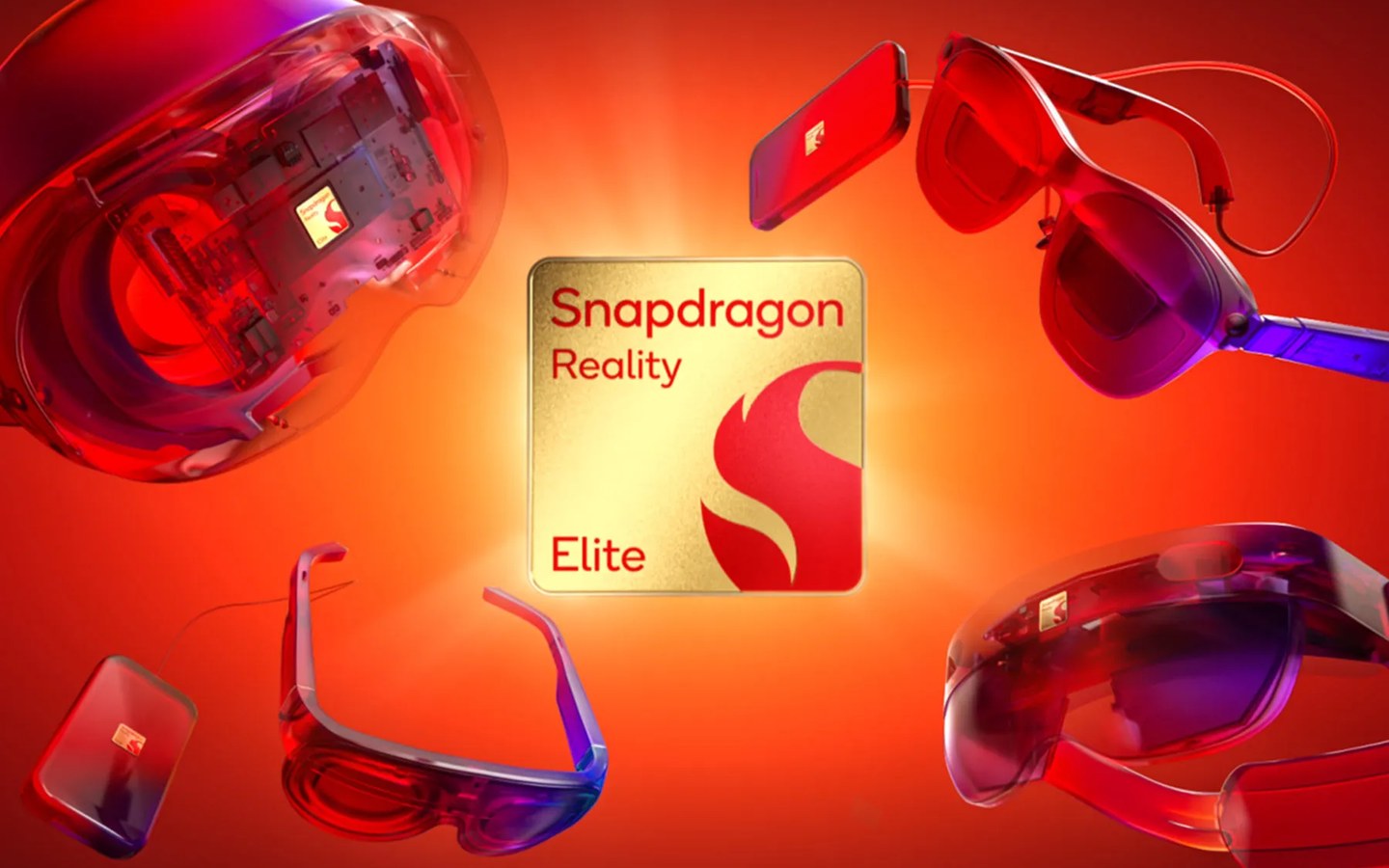
Qualcomm announced at Augmented World Expo (AWE) Snapdragon Reality Elite, a new processor which aims to slim down XR headsets and glasses of the near future.
Focusing on on-device AI, improved performance, and lower power consumption, Qualcomm says Snapdragon Reality Elite is targeting both standalone XR headsets and lightweight tethered AR glasses.
The company said this could support applications such as AI assistants, photorealistic avatars, and real-time generation of digital objects within mixed reality environments, as Snapdragon Reality Elite is quoted to deliver up to 48 TOPS (trillion operations per second) of AI performance, enabling large language models (LLMs) and large vision models (LVMs) to run directly on-device, cloud processing required.
Snapdragon Reality Elite—essentially the naming scheme for Snapdragon XR2 Gen 3—is also said to include upgrades to tracking and perception capabilities too, with improvements to hand and head tracking as well as optical passthrough designed to better integrate digital content with the physical world.
In terms of raw performance, Qualcomm says the new chipset offers up to a 60% increase in GPU performance, a 30% increase in CPU performance, and a 160% increase in neural processing performance compared with Snapdragon XR2+ Gen 2, which was released in 2024.
As for display capabilities, Snapdragon Reality Elite supports resolutions of up to 4.4K per eye at 90 frames per second. Qualcomm said it has also reduced latency and improved image quality for mixed reality experiences through additional hardware acceleration for computer vision workloads
Qualcomm says the new chipset can deliver up to 20% longer battery life under the same workload and—probably more importantly—can operate up to 12 degrees C (~53 degrees F) cooler under load, which is paving the way for lighter and more comfortable XR headsets and glasses.
“XR adoption continues to expand, with more than 60 million devices already in market and growing momentum across industries.” said Ziad Asghar, Senior Vice President and General Manager of XR, Wearables and Personal AI. “As more advanced and integrated XR platforms are developed, demand is increasing for XR technologies that deliver higher performance, greater intelligence, and improved power efficiency. Snapdragon Reality Elite is designed to meet those demands with powerful on-device AI, enabling faster, longer-lasting, and more immersive experiences, and reinforcing our leadership in VR and MR as we build purpose-built XR chipsets from the ground up.”