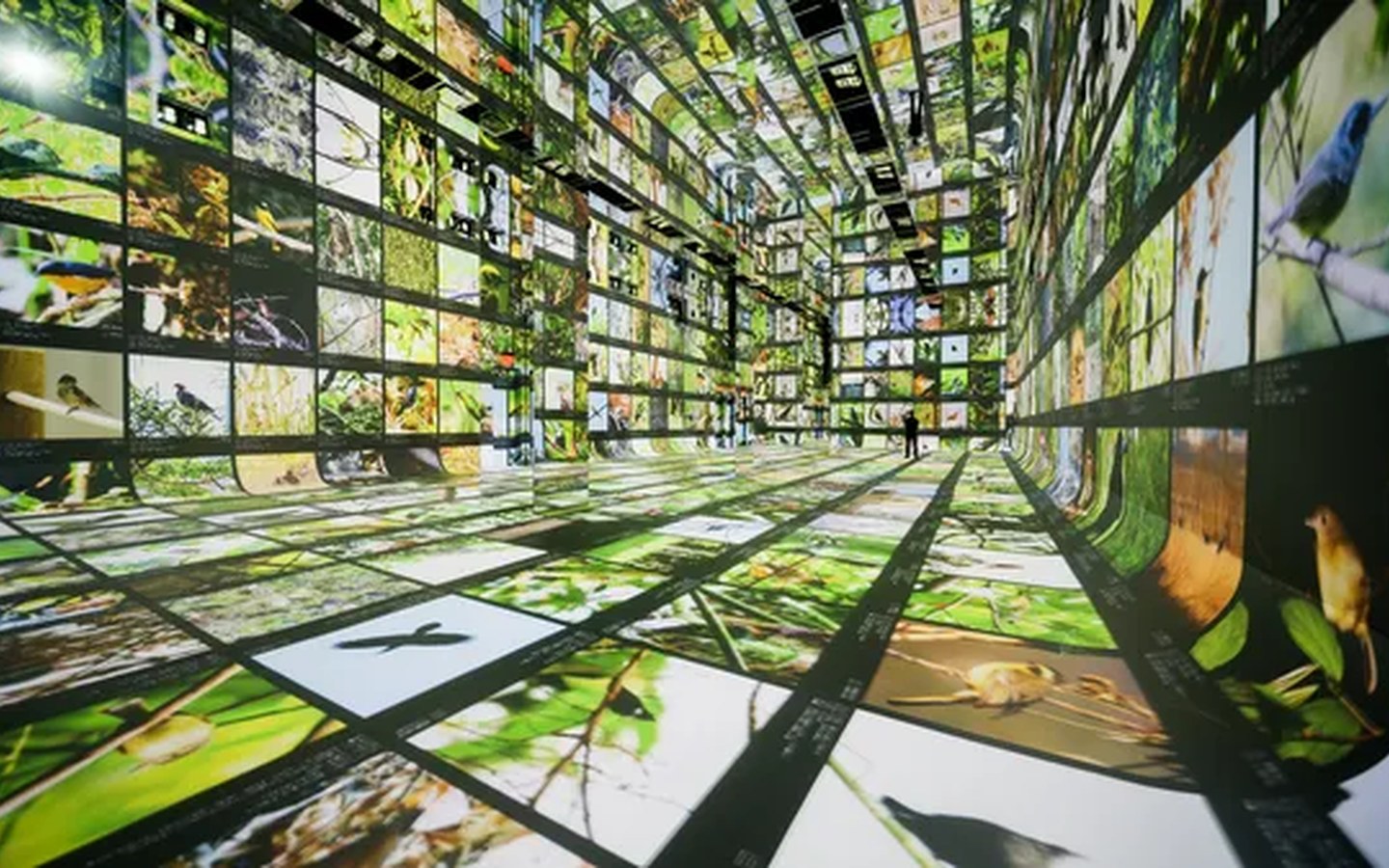
A decade ago, a handful of Google researchers asked an artist: “What happens when you give someone a neural network instead of a paintbrush?” The question sparked a collaboration with media artist and director Refik Anadol that now reaches a milestone. On June 20th, Dataland opens to the public in Los Angeles as the world’s first museum dedicated entirely to AI-generated art, with Google serving as both technology and creative partner.
The 25,000-square-foot venue sits inside The Grand LA, a Frank Gehry-designed complex, but the real architecture is computational. Every wall, soundscape, and scent is orchestrated by custom artificial intelligence models running on Google Cloud. The inaugural exhibition, Machine Dreams: Rainforest, trains a Large Nature Model on a sweeping corpus of environmental data—then renders it as an ever-morphing, omni-sensory ecosystem where data acts as pigment.
A Decade of Collaboration, from Quantum Data to Rainforests
The pipeline that now animates Dataland traces back to 2016, when Anadol joined Google’s first Artists and Machine Intelligence (AMI) cohort. Early experiments projected the LA Philharmonic’s archives onto architecture (2018) and visualized Google’s Quantum AI data (2020). By 2025, a commission for Google’s Mountain View campus had already turned the Large Nature Model and Gemini into a vast, shifting digital landscape. Dataland, in essence, is the permanent home for that vision.
The museum’s debut show pushes the technique further. The Large Nature Model ingests a deep, diverse natural dataset, then a constellation of generative adversarial networks (GANs), diffusion models, and Gemini transforms it into 1.2 billion pixels of real-time imagery. The result is not a looped video; it is a living environment that recomposes itself with every visitor’s step, mood, and gaze.
The Engine Room: Google Cloud’s Omni-Sensory Orchestration
What makes the space feel alive is a technical stack engineered for immediacy. Google Cloud tools power two critical layers:
- Omni-sensory experiences: The gallery reads the room. Infrastructure processes visitor presence, emotion, and movement to shape generative soundscapes, algorithmically augmented scents, and visuals that respond dynamically—not just display static scenes.
- Real-time generation: Behind the scenes, the Gemini Enterprise Agent Platform and Compute Engine coordinate the AI models with ultra-low latency. The compute runs on infrastructure backed by 87% carbon-free renewable energy, keeping the museum’s environmental footprint aligned with its nature-themed content.
Even the ticketing pipeline and front-door flow are threaded into the same cloud architecture, ensuring the exhibition runs smoothly from arrival to exit.
A Six-Month Incubator for the Artists Who Will Define the Medium
Alongside the opening, Google Arts & Culture is funding the Dataland AI Artist Residency, a six-month program for four artists. Each receives a $25,000 grant, direct mentorship from Rafik Anadol Studio, and hands-on access to Google Cloud tools and machine learning models. The work created during the residency will be exhibited at Dataland and on the Google Arts & Culture platform later this year, giving emerging creators a global stage and a seat at the table as the medium evolves.
When you step inside Dataland, you aren’t just looking at machine-made pictures. You’re entering a space where big data, sustainable computing, and human artistry converge—a place where the line between the natural and the synthetic dissolves in real time. To experience it firsthand, the doors open June 20th in downtown Los Angeles.