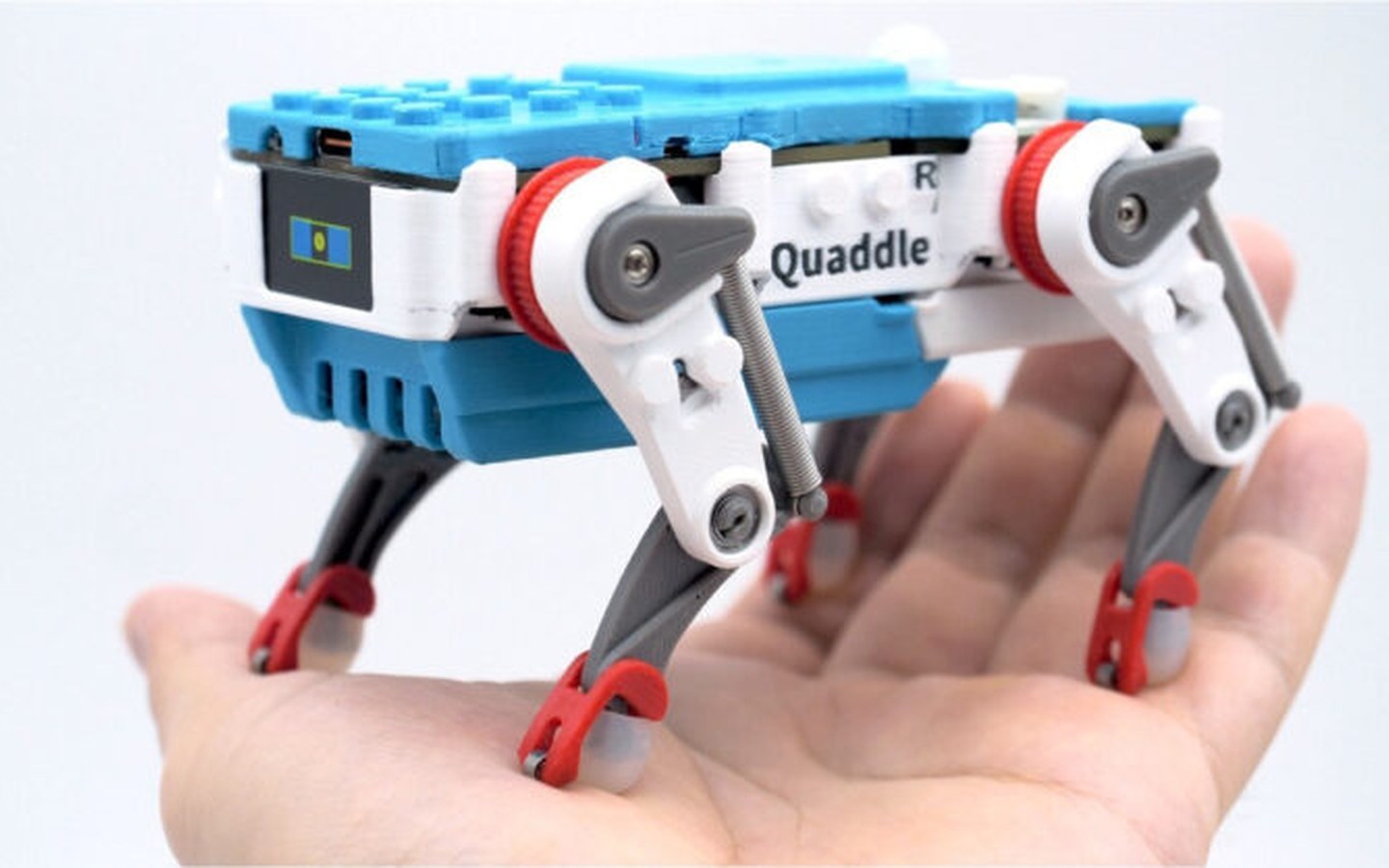
If you are not into ducks , but still would like to play around with physical AI, the Petio Quaddle is a mini robot dog equipped with 4 servos controlling its legs and is designed to help people learn robotics, coding, AI, and 3D printing.
The robot is powered by an ESP32-S3 motion core for servo control and wireless connectivity, and an optional ESP32-S3 AI core to enable voice commands and Smart Home control. The robot can walk, strafe, spin, talk back, and react to the user’s touch.
Three models are available depending on the user’s requirements: Builder, Buddy, and Scout.
Models Builder Buddy Scout Best for Curious kids/beginners Most people Makers/educators/researchers Servos 4x servos 4x feedback servos 4x feedback servos + 1x micro servo Skills Unlimited skill library Unlimited skill library Less agile with radar head Max speed 1.8 BodyLength/s trotting, 3 BodyLength/s gliding, 90°/s in-place spin 1.8 BodyLength/s trotting, 3 BodyLength/s gliding, 90°/s in-place spin 1.8 BodyLength/s trotting, 3 BodyLength/s gliding, 90°/s in-place spin Motion core ESP32-S3FN8 5x PWM for servos, PWM LED, buzzer, gyroscope (balancing, tap reaction) 5x PWM for servos, PWM LED, buzzer, gyroscope (balancing, tap reaction) 5x PWM for servos, PWM LED, buzzer, gyroscope (balancing, tap reaction) Power core Type-C (charging and programming), Power switch (click/double click) Type-C (charging and programming), Power switch (click/double click) Type-C (charging and programming), Power switch (click/double click) Extension hat 4x Touchpads, 4x RGB LEDs, 2x Mic, 2x Grove sockets, PIR sensor, Raspberry Pi UART port 4x Touchpads, 4x RGB LEDs, 2x Mic, 2x Grove sockets, PIR sensor, Raspberry Pi UART port 4x Touchpads, 4x RGB LEDs, 2x Mic, 2x Grove sockets, PIR sensor, Raspberry Pi UART port AI core ESP32-S3R8 +16M Flash — Talk and act, smart home control (optional), AI privacy slider, Type-C (programming) Talk and act, smart home control (optional), AI privacy slider, Type-C (programming) Connectivity WiFi / Bluetooth / Type-C WiFi / Bluetooth / Type-C WiFi / Bluetooth / Type-C Sense core — 2x infrared distance, 2x light, Gesture, AI vision (optional) 2x infrared distance, 2x light, Gesture, AI vision (optional) Interface Apps / controller / touch Apps / controller / touch / voice Apps / controller / touch / voice Battery Swappable BL10C (1800 mAh), compatible with BL5C for weight-sensitive experiments Swappable BL10C (1800 mAh), compatible with BL5C for weight-sensitive experiments Swappable BL10C (1800 mAh), compatible with BL5C for weight-sensitive experiments Battery life 1.5 hrs 1.3 hrs 1 hr Dimensions 11×7×7 cm 11×7×7 cm 11×7×11 cm Weight 170 grams 180 grams 198 grams Internals All parts of the Quaddle Buddy model
A Raspberry Pi Zero can also be mounted on the top in place of the ESP32-S3-based AI core. Petoi Quaddle runs OpenCat open-source firmware (Arduino) already used in the earlier Petoi Bittle robot dog , first introduced in 2020. The robot can be programmed in a visual programming IDE with drag-and-drop blocks, as well as Python, MicroPython, Arduino, C++, and ROS. A Raspberry Pi Zero (UART) or a computer (Wi-Fi or Bluetooth) is needed for the latter.