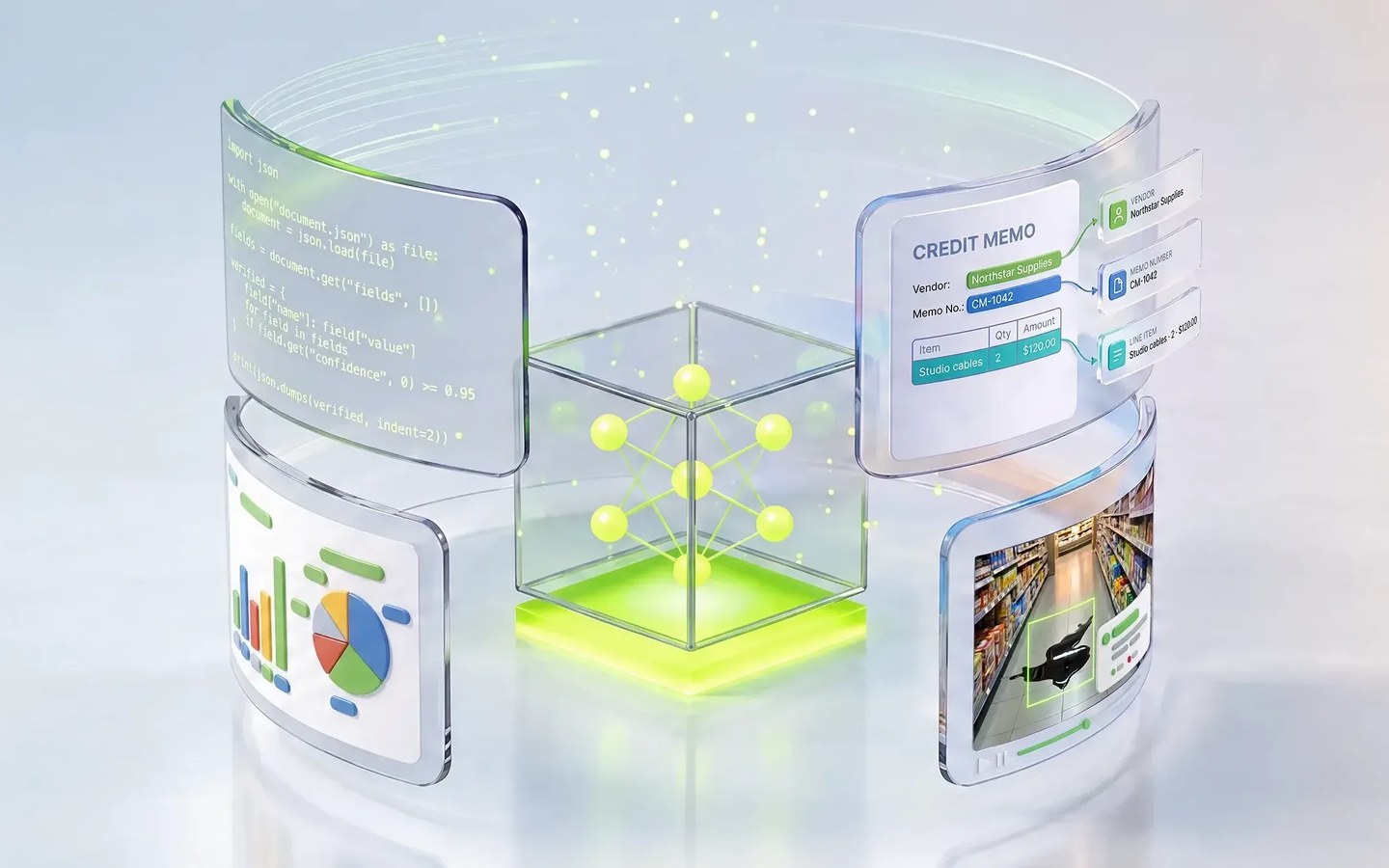
NVIDIA's developer blog introduces Nemotron 3.5 Super VL, an open, customizable multimodal model built for always-on enterprise agents. The architecture is a 120B-parameter mixture-of-experts (MoE) that activates only 12B parameters per token, balancing raw capacity with the inference efficiency needed for real-world deployments. On a single GPU, NVIDIA reports up to 5x higher throughput for agentic tasks compared to other open models in its size class.
One model, many input types
Unlike typical setups that bolt a text model to a separate vision-language model, Nemotron 3.5 Super VL combines reasoning, instruction following, tool use, and understanding of text, images, documents, and video in a single model. That simplifies pipelines where an agent must read a document, check a table, watch a video clip, and call a tool within one workflow.
NVIDIA positions the model for specialized, multistep jobs, including:
- Coding: test and validate code, analyze errors, and recommend fixes.
- Web research: search across sites, connect evidence, and verify answers.
- Document intelligence: extract information from tables, charts, and page layouts.
- Cybersecurity: identify vulnerabilities and triage threats for remediation.
- Video understanding: extract content for search, review, and incident analysis.
For chart reasoning, the model scores 80.8% on CharXiv, up from 63% for Nemotron 3 Nano Omni; with Python code interpretation it reaches 84%. It also ranks among top open models on the OCRBench v2 leaderboard.
Customizing for domain-specific agents
Organizations are not just using the base model—they are post-training it with NVIDIA NeMo using supervised fine-tuning (SFT), low-rank adaptation (LoRA), and reinforcement learning (RL). NVIDIA also released open datasets on Hugging Face covering agentic tool use, finance reasoning, instruction following, long-context tasks, fairness, and 45 vision-language datasets.
Early adopters show concrete economics:
- Scale AI post-trained Nemotron 3.5 Super VL for vendor credit processing at Skydance, expecting 40x lower inference cost and 5x lower latency.
- Ramp is converting receipt images into structured JSON, targeting up to 50% higher throughput and 10x lower latency.
- AI21 applied the model to threat intelligence for Alice, improving accuracy by 40%.
Inference optimizations include LiLiCorr speculative decoding, NVFP4 quantization with quantization-aware distillation, multi-token prediction, and context reuse. The model runs on platforms such as NVIDIA DGX Spark, and open weights allow deployment in local, data center, or cloud environments.
A shift toward portable, specialized agents
The combination of high single-GPU throughput and NeMo-based customization makes Nemotron 3.5 Super VL a foundation for on-device multimodal agents. Enterprises can keep sensitive data local, reduce token costs, and tune behavior to internal policies without routing every visual task through a general-purpose frontier model. In evaluations across Hermes Bench and LangChain behavioral tests, Nemotron 3.5 Super VL scores higher than the larger Nemotron 3 Ultra on agent harness tasks—suggesting that efficiency and specialization can beat raw scale in production workflows.