A Wi-Fi SoC that can live on a coin cell
Nordic Semiconductor has laid down a new marker in ultra-low-power wireless with the nRF71 series, first reported by CNX Software. The headline claim is up to 20 times lower standby power than the previous nRF70 family—a jump that moves Wi-Fi 6 from “gateway only” territory into the realm of battery-powered sensors, wearables, and industrial tags that might run for years without a charger.
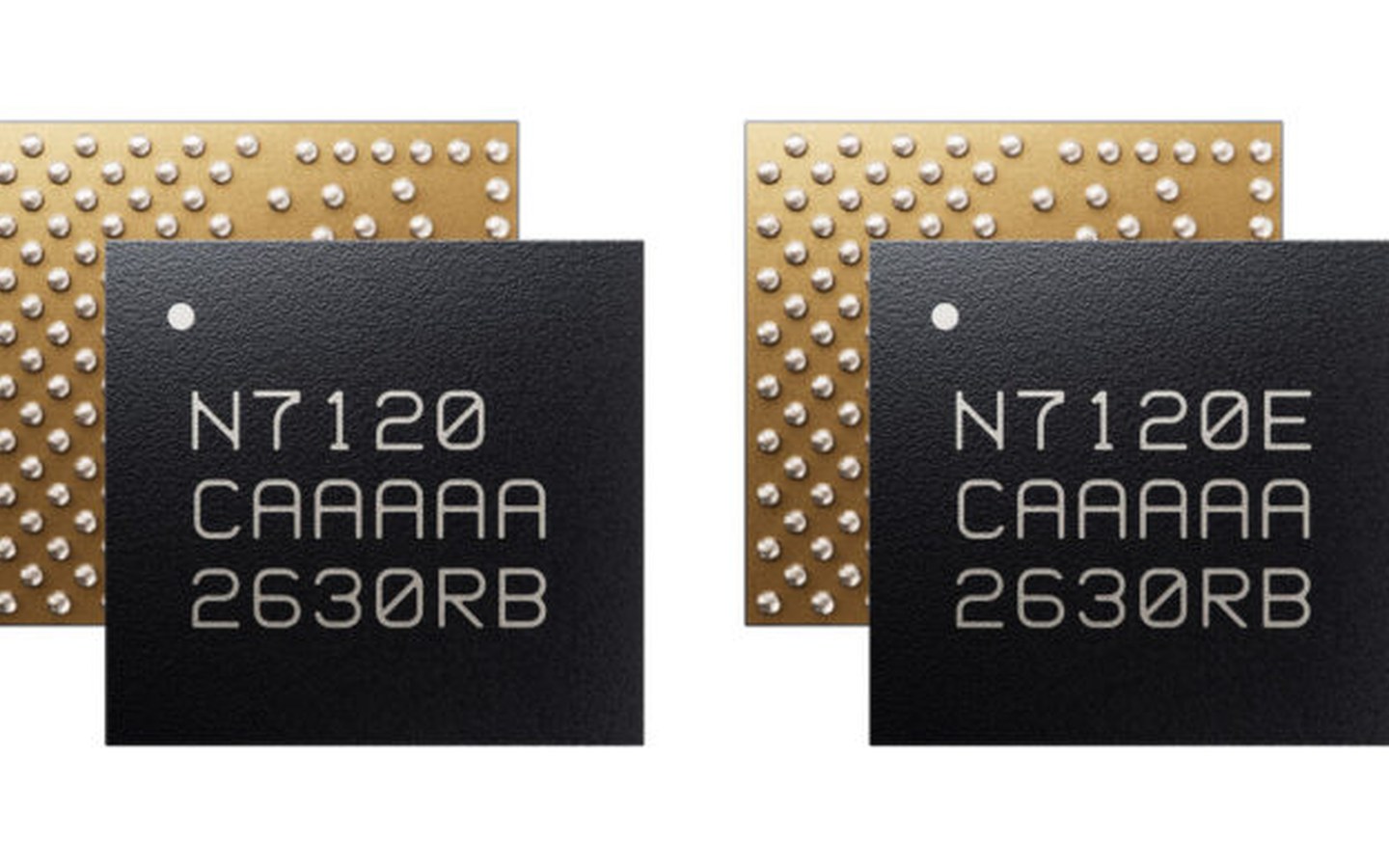
The first two chips in the family are the nRF7120 and nRF7120E. The base part is a dual-band Wi-Fi 6 device covering 2.4 GHz and 5 GHz; the E variant steps up to tri-band Wi-Fi 6E by adding the 6 GHz band. Both parts also integrate a multiprotocol radio for Bluetooth Low Energy and Thread, plus an NFC tag—so a single die can handle the Wi-Fi link, the mesh network, and the commissioning path.
Connected power numbers are striking because the 5 GHz band actually draws less current than 2.4 GHz in Nordic's spec: at DTIM 10, average connected current is 14 µA at 2.4 GHz and 8 µA at 5 GHz. That inversion matters in dense environments where 5 GHz is often cleaner and less congested.
Inside the nRF71: compute, NPU, and peripherals
Both SoCs pair an Arm Cortex-M33 at up to 256 MHz with a RISC-V coprocessor at the same clock. The RISC-V core is there for SoftPeripherals, with Nordic listing CAN 2.0B and SDIO among the flexible functions it can absorb. On-chip memory is 1 MB of user-accessible low-leakage RAM. Wi-Fi transmit power reaches +22 dBm, while Bluetooth LE transmits at +10 dBm with -99 dBm receive sensitivity. The radio supports station and SoftAP roles, plus Target Wake Time and a low-power receive path for Wi-Fi power save.
The nRF7120E adds an Axon NPU for edge AI, and Nordic says it runs machine learning models 10x to 17x faster than the Cortex-M33 alone. That's a meaningful difference for sensor fusion or anomaly detection that would otherwise chew through CPU cycles and battery headroom.
On the peripheral side, the chips lean hard on high-speed serial interfaces:
- 2x high-speed MSPI up to 64 MHz
- 2x high-speed SPI up to 64 MHz
- 1x high-speed UART up to 4 Mbps
- 6x SPI/TWI/UART up to 8 MHz
There are also up to 65 GPIOs, ADC, TDM, PDM, PWM, and QDEC. Security includes TrustZone isolation, tamper detection, and a CRACEN cryptographic accelerator, aimed at PSA Certified Level 3.
Developer reality: SDK support, modules, and a long wait
Both chips are fully supported in the nRF Connect SDK, which should ease migration for teams already on Nordic's toolchain. Module maker u-blox has already listed an ALMA-W1 module based on either the nRF7120 or nRF7120E, though it is still flagged as under development.
Availability is the catch. CNX Software notes that the nRF71 series is currently sampling only to selected customers. The nRF7120-DK development kit is listed at $72.38 on DigiKey with a 35-unit minimum, and stock is estimated for April 2027. That 18-month runway gives early adopters time to prototype, but it also means the 20x standby-power claim will face real-world scrutiny later than many designers would like.