From warehouse kitting to edge AI
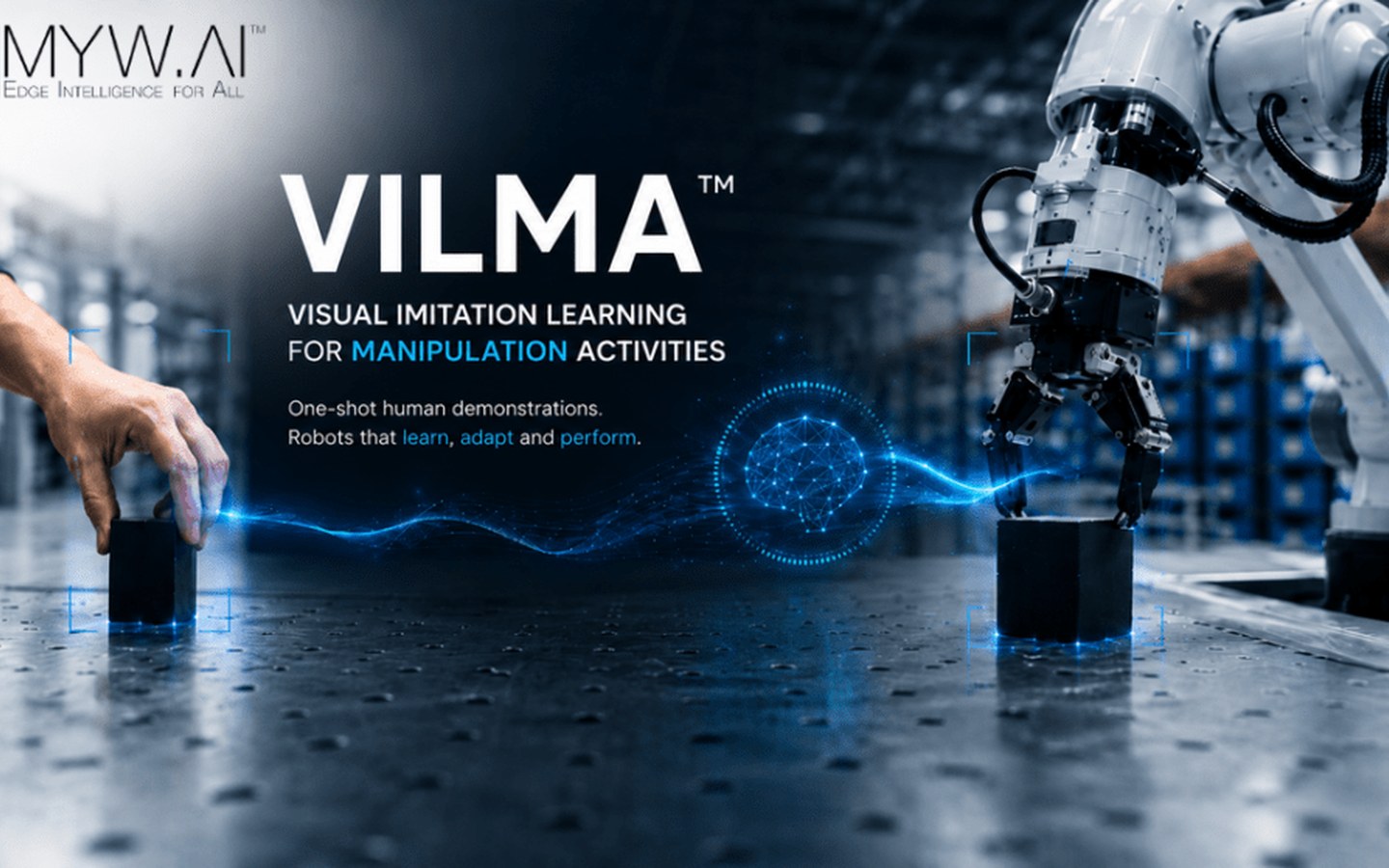
In automotive logistics, thousands of kits are still assembled by hand before parts ever reach the production line. The I-GENIUS project, coordinated by MYWAI within the European ARISE initiative alongside Centro Ricerche FIAT and the University of Genoa’s DIME department, set out to change that. The goal: let robots learn repetitive pick-and-place tasks the way humans do—by watching one demonstration.
The project’s key outcome is VILMA (Visual Imitation Learning for Manipulation Activities), an AI-powered toolkit integrated into MYWAI’s EDGE AI middleware platform. VILMA was validated in a large-scale automotive warehouse scenario and reproduced in DIME’s robotics labs. Now MYWAI is porting the toolkit to two new Arduino boards powered by Qualcomm Dragonwing processors: the Arduino UNO Q and VENTUNO Q. The port aims to bring edge-native imitation learning to developers, makers, and robotics innovators who need compact form factors and efficient power consumption.
Inside the VILMA pipeline
VILMA processes RGB-D recordings or MP4 videos to extract hand and object trajectories, then turns them into reusable robot skills. The workflow stages are:
- Demonstration capture: Records a human performing the task, stages video, RGB frames, depth data, and camera parameters, and lets the user select the target object.
- Hand tracking: Uses MediaPipe to detect 21 hand landmarks in each RGB frame, combines 2D positions with depth to calculate 3D camera coordinates, and applies Kalman smoothing plus previous-position retention for robustness.
- Object tracking: A YOLO model detects or tracks the selected object, computes its 3D position from the bounding-box center and depth, and smooths the trajectory.
- Segmentation: Estimates the grasp point from hand-object proximity and the release point from object movement, then splits the hand path into reach, grasp, move, release, and post-release phases.
- DMP generation: Trains separate Dynamic Movement Primitive models for the reach and move phases, evaluating different regularization values to pick the best accuracy-smoothness trade-off.
- Demonstration and adaptation: Converts the DMP trajectory into Cartesian robot positions using scale, offset, and rotation, applies inverse kinematics, and previews motion in the MYWAI 3D Viewer. For new goal positions, the system calculates the 3D offset between original and new objects and redirects the trajectory while preserving demonstrated motion characteristics.
All pipeline artifacts are packaged as MYWAI event data, a time-and-space fusion format geared toward multimodal AI and, next, World Action Models.
Live deployment on Arduino Q boards
The live stream phase moves from learning to real-time inference. The architecture splits into an Edge AI Layer for intelligence and a Communication Layer for hardware interfacing. On VENTUNO Q, the VILMA Control Loop orchestrates object detection and DMP adaptation, while a Video Object Detection Brick manages the inference flow. A containerized YOLOv8 inference service runs a quantized model that can be fine-tuned and deployed via the Edge Impulse “Bring Your Own Model” feature.
MYWAI founder and CEO Fabrizio Cardinali calls the boards’ dual-brain architecture “an ideal foundation for MYWAI’s next generation of Edge AI robotics.” The company is pairing one-shot video imitation learning with its EdgeAI Management Platform and HEDGELOG mobile tracker to bring World Action Models closer to the edge. The Arduino Blog post does not disclose benchmarks, pricing, or release timing—but the port itself signals a meaningful step toward robots that can be re-tasked on a factory floor without a full reprogramming cycle.