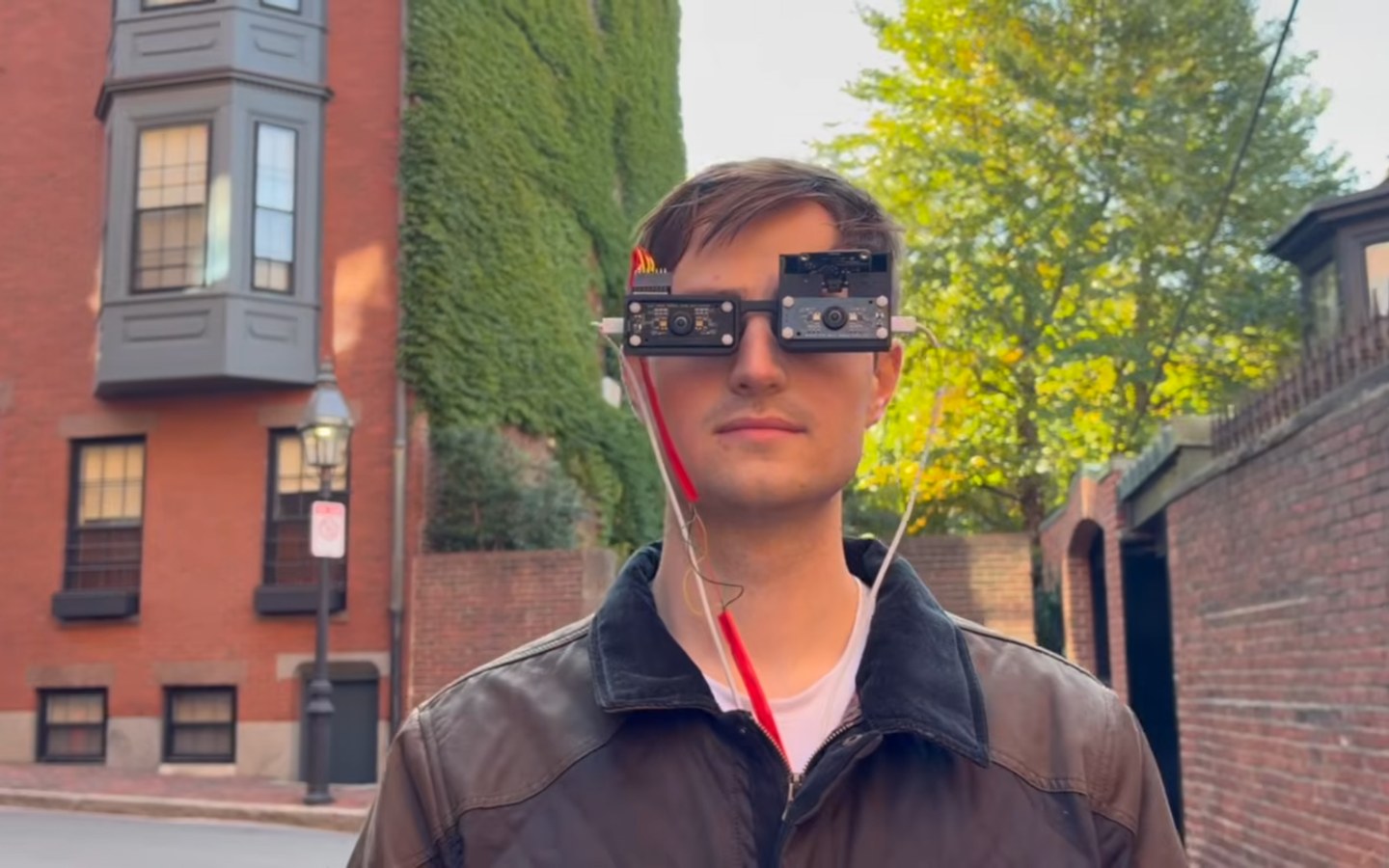
Hackaday recently featured a prototype from [DebackTech] that skips the usual audio channel entirely. It's a pair of LiDAR-equipped glasses wired to a shirt studded with vibration motors. The LiDAR sensors scan the environment and feed distance and direction data to a small computer, which then drives an array of motors against the wearer's torso. With practice, the brain's cross-modal plasticity can remap those touch patterns into a usable spatial picture.
The tactile pipeline
The system is refreshingly direct. There is no machine learning model, no cloud round-trip, no latency budget in the traditional AI sense. LiDAR scans the scene; the computer maps each detected obstacle to a corresponding vibration on the shirt. The wearer learns to read that vibration map as a low-resolution "image" of nearby space, much as visually impaired people can learn to interpret sonified depth. The core idea leans on cross-modal plasticity — the brain's ability to remap one sense onto another. Audio sonification uses hearing, but this prototype turns depth into skin input. That leaves the ears free for conversations, traffic, and other acoustic cues that a visually impaired person already depends on.
Hackaday notes the builder, [DebackTech], has already demonstrated the gear in three real-world scenarios:
- Walking around without a guide or cane
- Riding an electric scooter
- Catching a large, slow-moving ball
These aren't just lab demos. Catching a ball requires continuous depth updates and fast enough feedback to react. The scooter test is especially telling: balancing and steering while decoding a torso vibration map demands a tight sensor-to-motor loop.
The limits are physical, not algorithmic
The prototype is bulky. Hackaday points out the current build would draw some attention — though in a place like Boston with so many universities, a wearable experiment might blend in more than in other settings. The article also suggests future versions could be streamlined. But the real constraint isn't processing power; it's motor density and skin resolution. The torso can distinguish a limited number of vibration points, so the system is meant for obstacle avoidance and coarse navigation, not reading fine detail.
That's the interesting part for portable AI watchers. This LiDAR-to-vibration system contains zero machine learning. It is a fully deterministic mapping from depth to haptic output. That makes it a useful baseline when comparing more complex AI-driven assistive glasses that use computer vision, object recognition, and audio narration. A pair of AI glasses might identify a "chair" or "door"; this vibration shirt simply tells you something is there and roughly where. Sometimes that's enough. And because it requires no cloud connection and no model updates, it can be more private, more predictable, and less power-hungry than a device running neural networks.
The Hackaday piece closes by noting there are other methods for visual disabilities, sometimes without any technology at all. White canes, guide dogs, and human assistance remain essential tools. But this prototype proves a concept: a silent, hands-free spatial channel that doesn't overload hearing. As motor arrays get smaller and LiDAR sensors get cheaper, expect more haptic navigation wearables to follow.