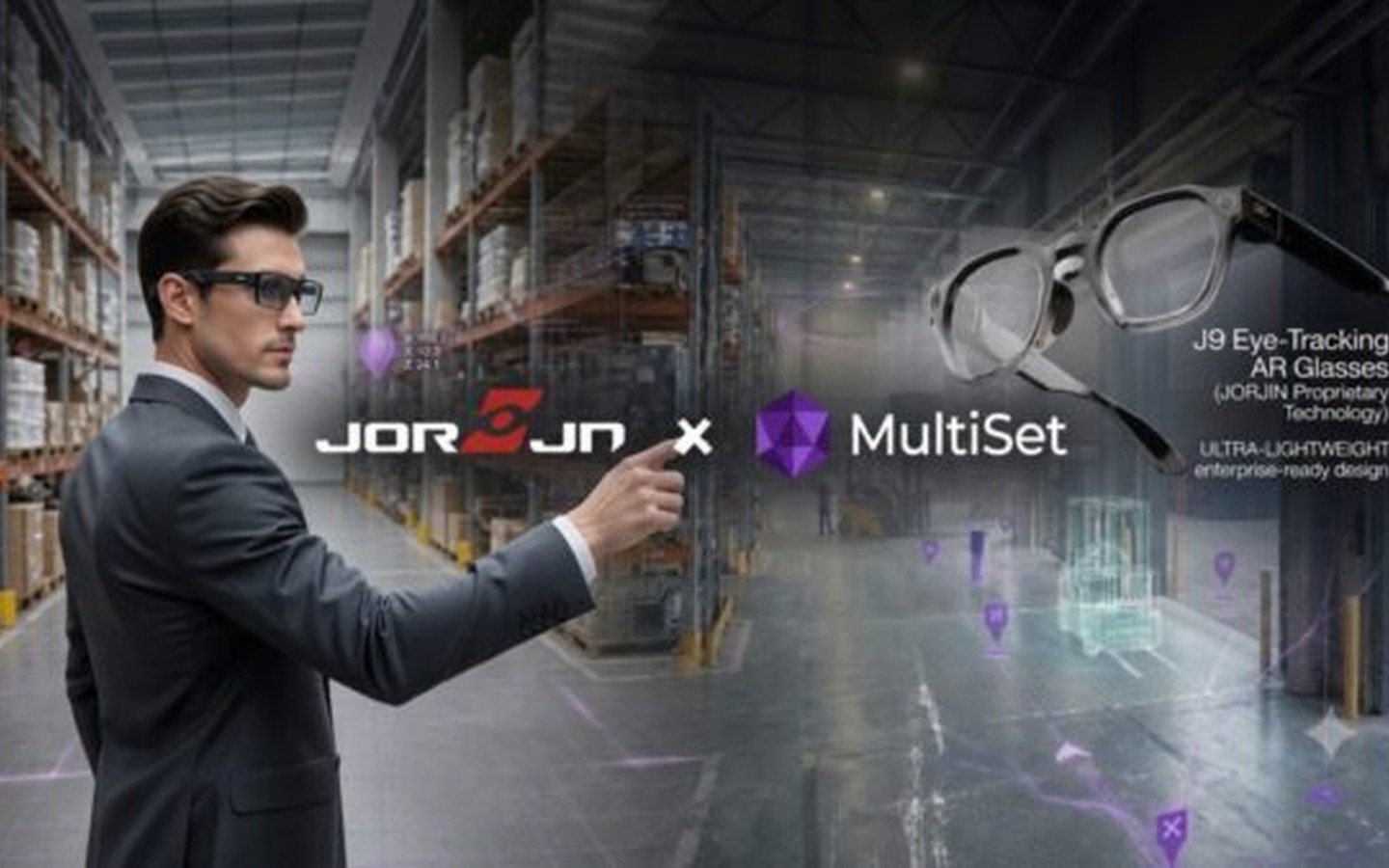
A new partnership between Taiwan’s Jorjin Technologies and enterprise spatial mapping company MultiSet AI aims to turn ultra-lightweight AR glasses into context‑aware tools for industry. The collaboration, announced in July 2026, combines Jorjin’s J9 Eye-Tracking AR Glasses with MultiSet’s visual positioning system (VPS) and spatial mapping platform. The goal is practical: give frontline workers hands‑free access to navigation, work guidance, and location‑specific information inside large indoor sites where GPS can’t reach—factories, logistics hubs, hospitals, museums, and even smart restaurants.
A Marriage of Lightweight Hardware and Spatial Intelligence
The J9 glasses are the hardware core of the project. Key specifications include:
- Sub-50g total weight, making them wearable throughout a shift
- Optional full‑color near‑eye display for visual overlays
- Built‑in eye‑tracking module and camera
- Wireless connectivity and SDK support for custom applications
MultiSet’s platform provides the spatial brain. It offers:
- VPS Gen2 with on‑device Android VPS for low‑latency localization
- MapSet management and versioning, so facilities can maintain up‑to‑date digital twins
- Ingestion pipelines for 360‑degree captures and 3D Gaussian Splatting assets, turning rich visual data into reusable coordinate maps
By merging these capabilities, the system can identify not just where a wearer is, but what equipment or zone they are facing, then push guidance via visual cues, audio prompts, or gaze‑based interactions.
Inside the Spatial Layer: How It Works on the Factory Floor
Initial deployments will focus on facility‑scale scans and the creation of digital twins that serve as consistent VPS maps. MultiSet’s technology anchors those maps to physical coordinates, so the J9 glasses can constantly self‑locate without external beacons. That opens up concrete use cases:
- Hands‑free indoor navigation: A worker in a sprawling warehouse follows a blue virtual trail to find a specific pallet.
- Asset‑level work guidance: When facing a machine, the glasses overlay step‑by‑step maintenance instructions retrieved from a connected knowledge base.
- Location‑aware service workflows: In a hospital, nursing staff receive patient‑specific notifications only when they enter the correct room.
The companies are also testing how edge‑based processing and on‑premise deployment can address privacy and network reliability concerns—critical in sectors like healthcare and defense.
Toward a Shared Coordinate Layer for Humans and Robots
Perhaps the most ambitious thread in the collaboration is the plan to unify AR glasses, AI agents, and robots under a common spatial framework. MultiSet’s maps would act as a single coordinate layer that all systems can reference. In a smart restaurant, for example, a service robot and a human waiter wearing J9 glasses might both receive the same table‑specific order updates from a central AI, avoiding collisions and duplication.
Tom Liang, Chairman of Jorjin, noted, “Ultra‑lightweight AR glasses can become a practical frontline interface only when they are connected to the physical space around the user.” Shadnam Khan, Co‑Founder & COO of MultiSet AI, added that Jorjin’s hardware provides an important platform for validating how spatial intelligence can support real operations, “from navigation and work instructions to human‑robot coordination.”
While still in early collaboration stages, the Jorjin‑MultiSet effort signals a shift from AR as a gimmick to a wearable that genuinely understands its environment. For enterprise teams grappling with visibility gaps in large, GPS‑denied spaces, the combination of featherweight optics and industrial‑grade VPS could soon become an indispensable daily tool.