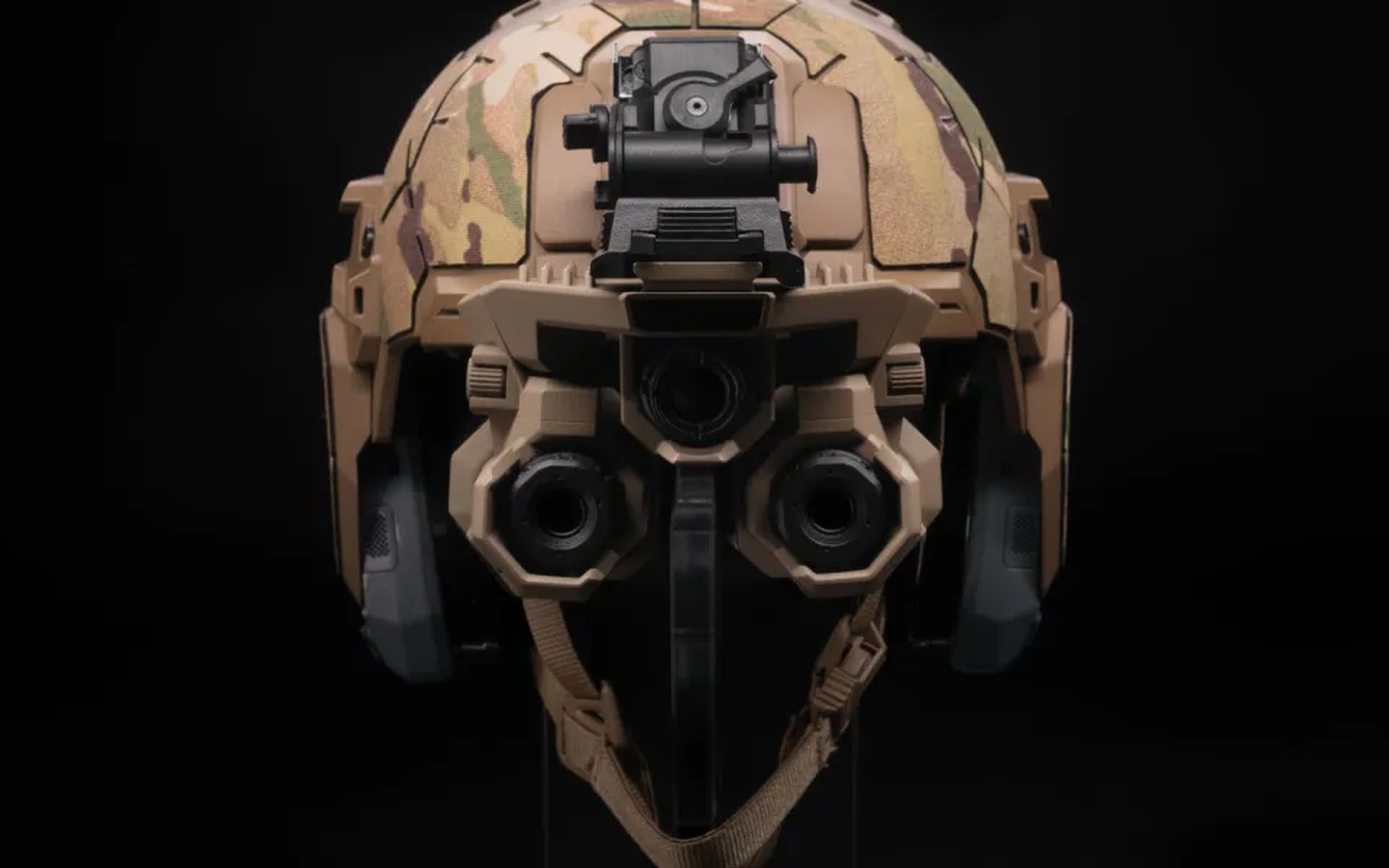
It’s been a year since the duo entered the US Army’s troubled augmented-reality contest. Here’s what it looks like so far.
The defense-tech company Anduril has shared new details about the augmented-reality headset for the military it’s prototyping with Meta, including a vision for ordering drone strikes via eye-tracking and voice commands.
Quay Barnett, who leads the efforts as a vice president at Anduril following a career in the Army’s Special Operations Command, says his fundamental goal is to optimize “the human as a weapons system.” The vision is undoubtedly cyborg-inspired: Barnett wants drones and soldiers to see together, share information seamlessly, and make decisions as one.
Anduril actually has two such projects in the works. The first is the Army’s Soldier Born Mission Command, or SBMC, for which the company won a $159 million prototyping contract last year to work with Meta on augmented-reality glasses to attach to existing military helmets. But Anduril has also embarked on a self-funded side quest, announced in October, to design its own helmet and headset combo called EagleEye. This is something the military has not asked for, but Anduril insists it will prefer it and purchase it in the end.
So far, both systems are years away. The Army isn't expected to move its top choice for the SBMC program into production until 2028, if it picks one at all (the previous lead for the effort, Microsoft, was set to receive a $22 billion production contract that was ultimately cancelled when the glasses didn't prove viable). But Barnett told MIT Technology Review about where both Anduril's prototypes are headed.
Depending on the situation, the glasses for either prototype will overlay certain information onto a soldier’s field of view. This might be as simple as a compass or as complex as an entire map of the area, information about where nearby drones are flying, or AI-driven recognition of a target like a truck.
The soldier would then speak to the interface in plain language—for example, to order an evacuation for someone who’s been injured or to plan a route taking into account which areas are off limits. A large language model—Anduril is in tests with Google’s Gemini, Meta’s Llama, and even Anthropic’s Claude, despite the company’s conflict with the Pentagon—will be used to help translate a soldier’s speech into commands the software can follow. And the engine for it all will be Anduril’s software Lattice, which incorporates data from lots of different military hardware into one picture. The Army announced in March that it would spend $20 billion to integrate Lattice with essentially its entire infrastructure.
Barnett’s team is designing the headset to carry out multi-step tasks. A soldier might send a drone to surveil an area and instruct it to come back once it’s found something that looks like an artillery unit; then the system would recommend courses of action, like sending a nearby drone to strike, that would have to be approved by the normal chain of command. Leading the system through this, if all goes to plan, might not even require speech; the soldier could instead communicate through tracked eye movements and subtle taps.