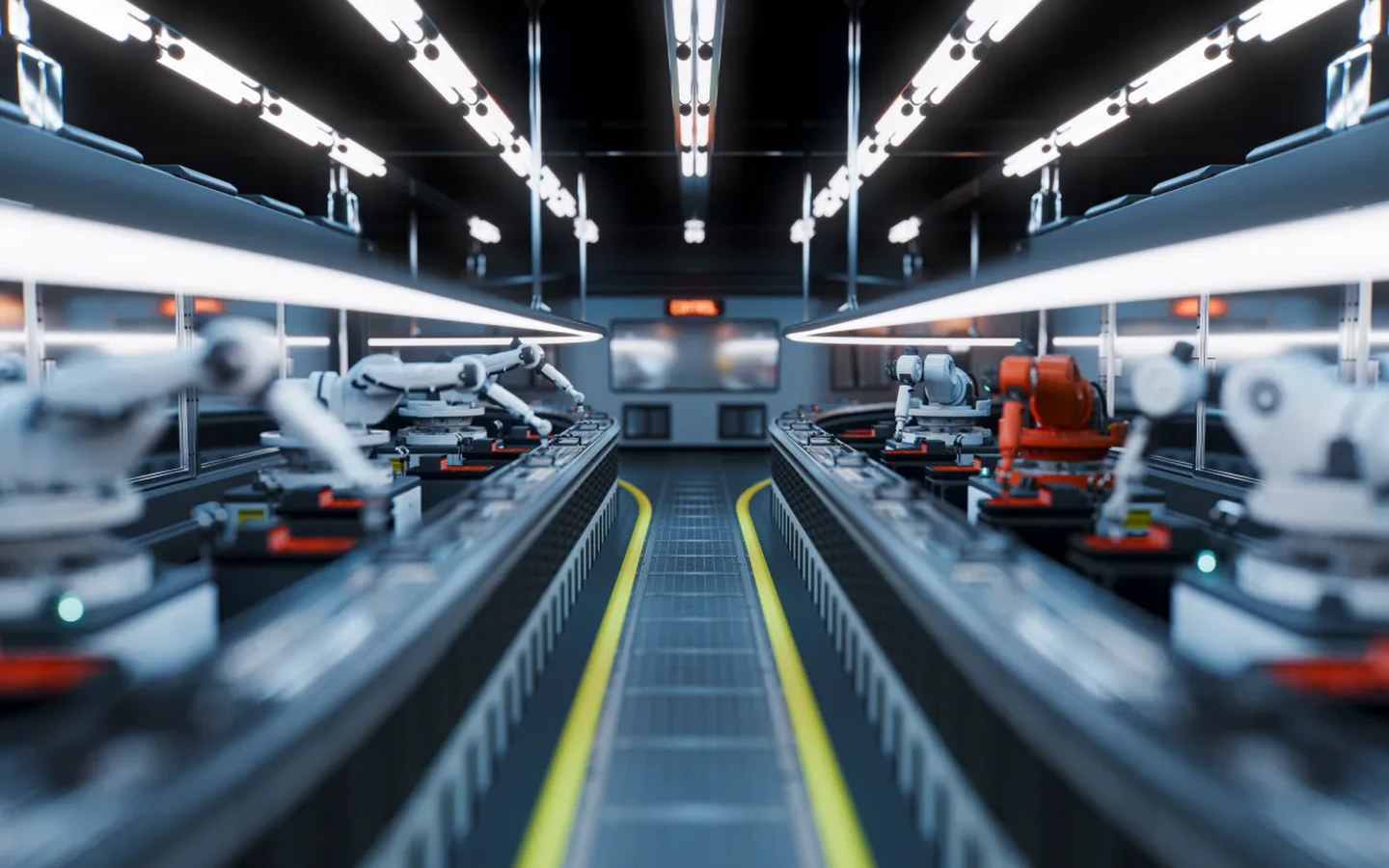
From fixed lines to flexible stations
Factory automation has traditionally been frozen at the moment of installation. A robot is programmed for one specific task and product; changing a line means reprogramming, physical retooling, or swapping equipment—a process that can drag on for weeks or months. Industrial Next, a San Francisco startup that presented on the Startup Battlefield stage at TechCrunch Disrupt 2026, argues that assumption is obsolete. The company builds AI-driven, self-contained robotic stations powered by proprietary foundation models that connect vision, task context, and motion. Instead of hard-coded scripts, new tasks are taught through simulation and demonstration, which the startup says allows a production line to be retooled in minutes rather than weeks.
Industrial Next was founded in 2021 by Lukas Pankau and Allen Pan, both Tesla veterans. Pankau was a lead electrical architect at Tesla and later worked at Waymo; Pan led Tesla’s autonomous factory efforts and later became a chief architect at Neolix, with time at self-driving developer Momenta. The founders met at Tesla—Pankau recalled literally tripping over Pan asleep on a factory catwalk after an all-nighter—and bonded over a shared frustration that cutting-edge vehicle technology was being held back by decades-old factory equipment. Pankau told TechCrunch that engineers who could run machine learning algorithms to design cars were often stumped trying to program a robot.
Simulating high-precision manipulation
The core technical challenge is data. Unlike AI models trained on internet-scale text or images, robotics lacks vast datasets for physical manipulation. “We can make robots do all these cool things like dance around, because there’s data for that, but we can’t make them assemble high-precision things,” Pankau said. Industrial Next’s answer is an extremely high-fidelity simulation engine whose dynamics closely mirror real-world physics. Robots first learn a general understanding of a process in simulation, then can perform delicate, high-precision tasks “almost without seeing the parts at all,” according to Pankau. That approach, combined with demonstration-based teaching, lets stations be reconfigured, combined, and redeployed across product lines without traditional programming.
Already working on real production lines
The company claims its workstations are not demos. Pankau said some stations already help build one of the world’s most popular smartphones, though he did not name the customer. On those lines, Industrial Next robots handle tasks that manufacturers had tried and failed to automate for years:
- Threading a delicate flex cable into place
- Snapping a tiny connector cap into position
- Stripping protective film from camera modules and buttons at or above human speed, with 100% accuracy, even when moved to a new phone model and line they have never seen
Industrial Next also announced on stage that it is partnering with BMW Group Technology Office to evaluate its AI-powered dexterous manipulation for manufacturing. The long-term goal is far more ambitious than phones. “We ultimately want to take this to building a full car end-to-end without any human touching ever,” Pankau said.