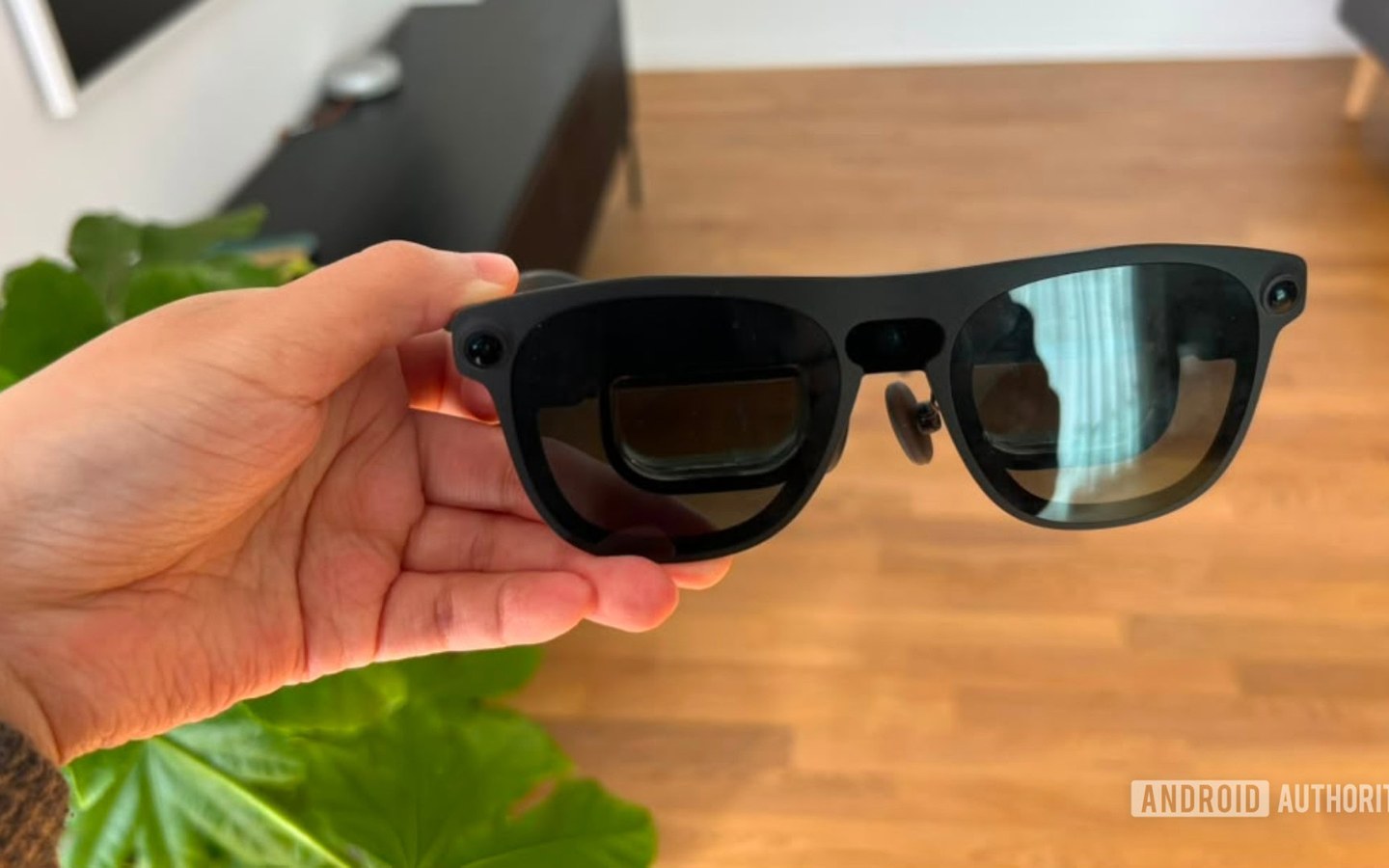
Android Authority’s recent hands-on with the upcoming XREAL Aura glasses suggests that Android XR has crossed an important line: it no longer feels like a demo. After spending time with the device at IFA, the reviewer came away counting down to launch, with a clearer timeline and a price target that keeps the hardware within reach of curious early adopters.
XREAL says the Aura will ship before the end of 2026, with pricing set at under $1,500—though the company was careful to note that “under” does not necessarily mean $1,499. The final figure remains a little mysterious, but after a hands-on session, the experience itself felt more important than the exact price.
A familiar OS, but on your face
The biggest surprise from the demo wasn’t the hardware—it was how quickly Android’s core interaction model translated to a face-worn display. The reviewer learned basic pinch, tap, drag, and scroll gestures, and after only about 10 minutes, they had largely stopped thinking about the controls. XREAL will include a more elaborate gesture-training sequence during first-time setup, but the fact that the fundamentals clicked so quickly speaks to the interface’s friendliness.
That familiarity is Android XR’s strongest asset. Anyone who has spent years using an Android phone already understands the apps, navigation concepts, and basic interactions. There is no entirely new operating system to learn. For people who have never used an XR headset before, that continuity could make the transition much easier than previous AR attempts.
Mapping and media reveal the promise
The standout moment in the demo was Google Maps. The reviewer described zooming in and out of cities and landmarks with enough clarity and precision that the experience felt almost magical, and locations that support Google’s immersive experiences allow users to enter buildings and explore interiors as if standing inside. The Aura uses electrochromic dimming, darkening the lenses during immersive moments while still allowing a view of the real world below—an important balance for anyone who wants to avoid walking into furniture.
Entertainment is another clear use case. The reviewer watched YouTube in Chrome after a standalone app crash, but the virtual display could be made absolutely enormous, more like a projector than a phone or tablet. On a long flight, the Aura could replace the tiny seatback screen with a massive floating display. At home, it could simulate a huge TV without taking up physical space.
Hardware choices that keep it portable
XREAL is not cramming everything into the frames. The main compute platform is Qualcomm’s Snapdragon Reality Elite, paired with XREAL’s own X1S Spatial Coprocessor, which the company hints may also be a TSMC product. The glasses themselves use:
- Sony Micro OLED displays at 1,920 x 1,200 pixels per eye
- Up to a 120Hz refresh rate and a 70-degree field of view
- X Prism optical system for a relatively traditional eyewear form factor
- Prescription inserts for users who need corrective lenses
The battery lives in an external compute unit rather than the glasses, with a 4,455mAh capacity that XREAL estimates will deliver four to five hours of streaming. That may not get a traveler through a full international flight, but it’s a practical trade-off for keeping the glasses themselves comfortable and light.
After years of AR prototypes that excited in short bursts but failed to feel natural, the XREAL Aura appears close to delivering an Android experience that simply works on your face. The launch window is still a little fuzzy, but the fundamentals—familiar software, intuitive gestures, and genuinely useful use cases—are already in place.