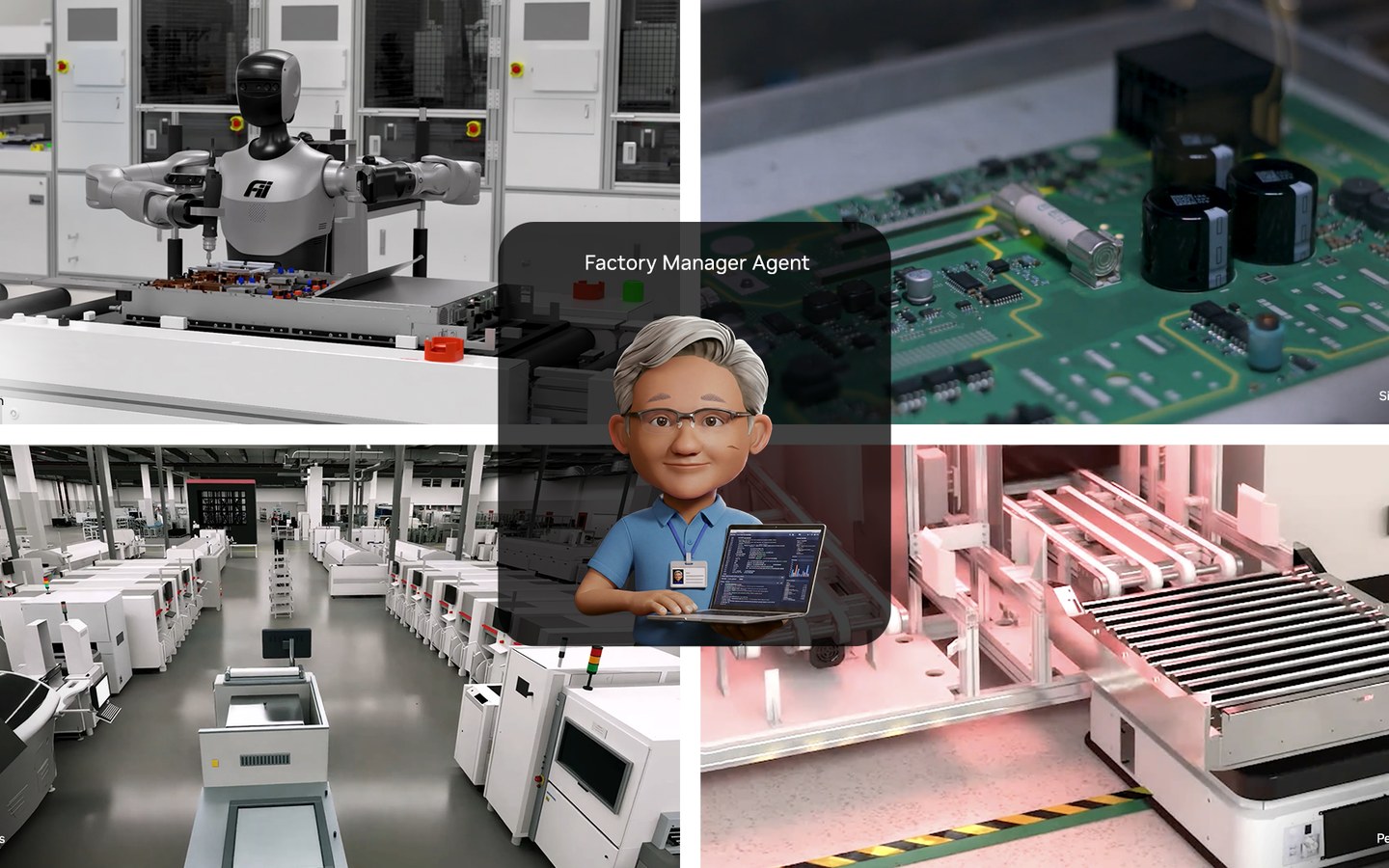
Unplanned downtime costs a large plant an average of $253 million per year, according to a Siemens report cited by NVIDIA. When a circuit board fails or a rush order lands, teams still gather evidence across separate systems, consult specialists, and decide the next move manually. NVIDIA’s answer, detailed on its Developer Blog, is the Factory Operations Blueprint (FOX) — a reference architecture for a long-running “factory manager agent” that sits on top of the data, machines, and robots a plant already runs.
FOX isn't an installable product. It's a pattern for connecting an LLM to manufacturing execution systems, ERP platforms, machine databases, and specialist tools, then defining which actions need human review.
A Tiered Agent Architecture with Local Control
The Factory Manager Agent is built from three core parts: an LLM, an agent harness, and a sandboxed execution layer. For the LLM, developers can choose NVIDIA Nemotron for an open, on-premises model or a frontier cloud model such as GPT-6 Astra. NemoClaw serves as the default harness, keeping the manager available while background and scheduled jobs run. NVIDIA OpenShell isolates execution and enforces factory policies on files, commands, and network access, including escalation rules for operators.
Beneath the manager, FOX defines focused specialists:
- Visual Inspection Agent — calls NVIDIA Cosmos to compare suspected defects against reference examples and factory handbooks.
- Fleet Management Agent — demonstrated with Isaac Sim and ROS 2 to coordinate robot transport and rework.
- Root Cause Analysis Agent — uses Kumo Anomaly for time-series analysis across production data.
Connectors reach into MES, ERP, and machine databases; manuals and standard operating procedures feed context; Elasticsearch stores retrieval data and investigation history. This keeps the manager grounded in a factory’s actual records rather than general knowledge.
From an AOI Alert to a PDF Report
The reference SMT assembly line shows how the pieces interact. An automated optical inspection (AOI) alert for a suspected solder defect triggers the manager to pull the board identifier, affected component, and inspection image. The Visual Inspection Agent requests a secondary assessment with in-context examples, avoiding a separate fine-tuning step.
If the defect is confirmed, the Fleet Management Agent arranges robot transport to rework. In parallel, the Root Cause Analysis Agent looks upstream across the board’s production history — paste printing, pick-and-place, reflow oven conditions — and produces a PDF report with evidence and a recommended corrective action. The board’s identifier links records across stations, so the system can trace a problem several steps back.
Deployment is local-first. FOX can run on an NVIDIA DGX Station, with models, data stores, and endpoints inside the factory network. That keeps production records, images, prompts, and investigation results on-site — a meaningful constraint for manufacturers that cannot send process data to a cloud tenant.
NVIDIA’s post also highlights Siemens’ Erlangen electronics plant, which produces more than 1,000 products a year. There, rush-order planning agents using Siemens Intelligence Center X simulations claim up to 20% cost savings, while virtual AOI preparation with NVIDIA Cosmos and Omniverse can cut time to market by up to 40%. FOX is the common architecture behind both examples.