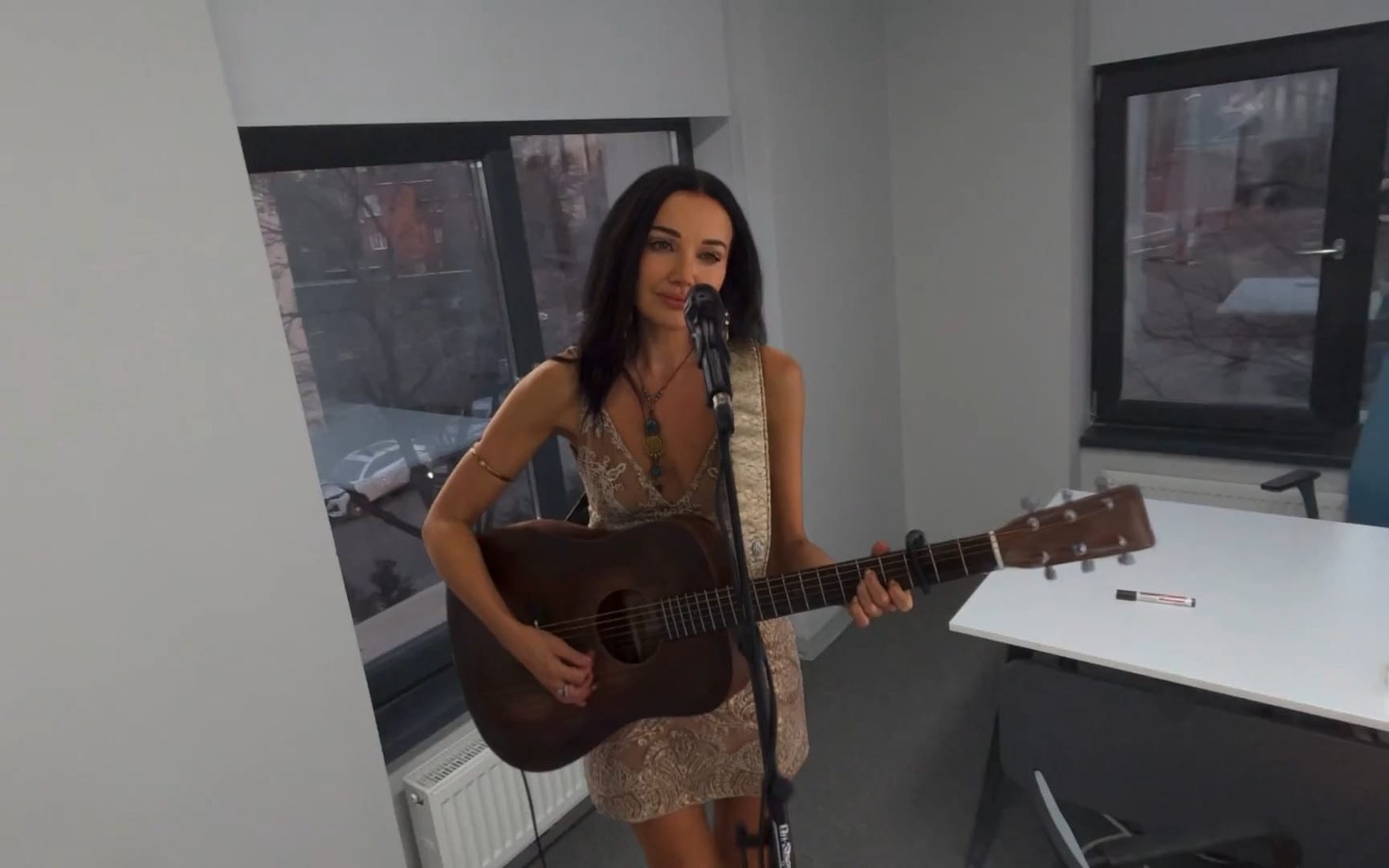
Gracia's moving fully volumetric captures can now be streamed, including to mixed reality on Quest 3, with no app or content download required — and an Apple Vision Pro app is coming soon.
Gracia first launched in 2024 as a Quest app for viewing static photorealistic objects, and, far more notably, a PC VR app for moving photorealistic scenes, otherwise describable as volumetric video.
And to be clear, this is not just simple parallax like you'd get from stereoscopic 3D video, nor limited-perspective synthetic depth like the spatial scenes of Apple's visionOS 26 . Gracia goes much further, offering fully volumetric content that you can physically walk around in VR or in your room via mixed reality.
As with almost all of the remarkable advancements in 3D reconstruction over the past few years, the technology behind Gracia is Gaussian splatting - fitting millions of semitransparent colored blobs (Gaussians) in 3D space so that arbitrary viewpoints can be rendered realistically in real-time. Moving splats are often called 4DGS, four-dimensional Gaussian splats, the fourth dimension being time.
By the end of 2024, Gracia had already launched standalone apps for Quest 3 and Pico 4, removing the requirement for a PC, with the tradeoff of some quality. But the biggest problem with this standalone flow was the need to download each scene, requiring you to stand there with the headset on watching a progress bar chart the multi-gigabyte file arriving on your device. With the company's technology at the time, streaming would have required a 2.4 gigabit internet connection, something only a tiny fraction of people have and that most standalone headsets can't even reliably hit wirelessly anyway.
This crippled Gracia's founding ambitions of being the "YouTube of truly volumetric content", because if YouTube required a multi-gigabyte download before each video played, it just wouldn't be a viable service. And so the standalone headset app focused on short 10-second clips, rather than longer content that would support more use cases.
At the time of the standalone app launch, Gracia told UploadVR that it was working on improving its compression by at least an order of magnitude. Now, a year and a half later, the startup has achieved that lofty goal.
Gracia streaming on Apple Vision Pro (note: not the original audio due to tech limitation).