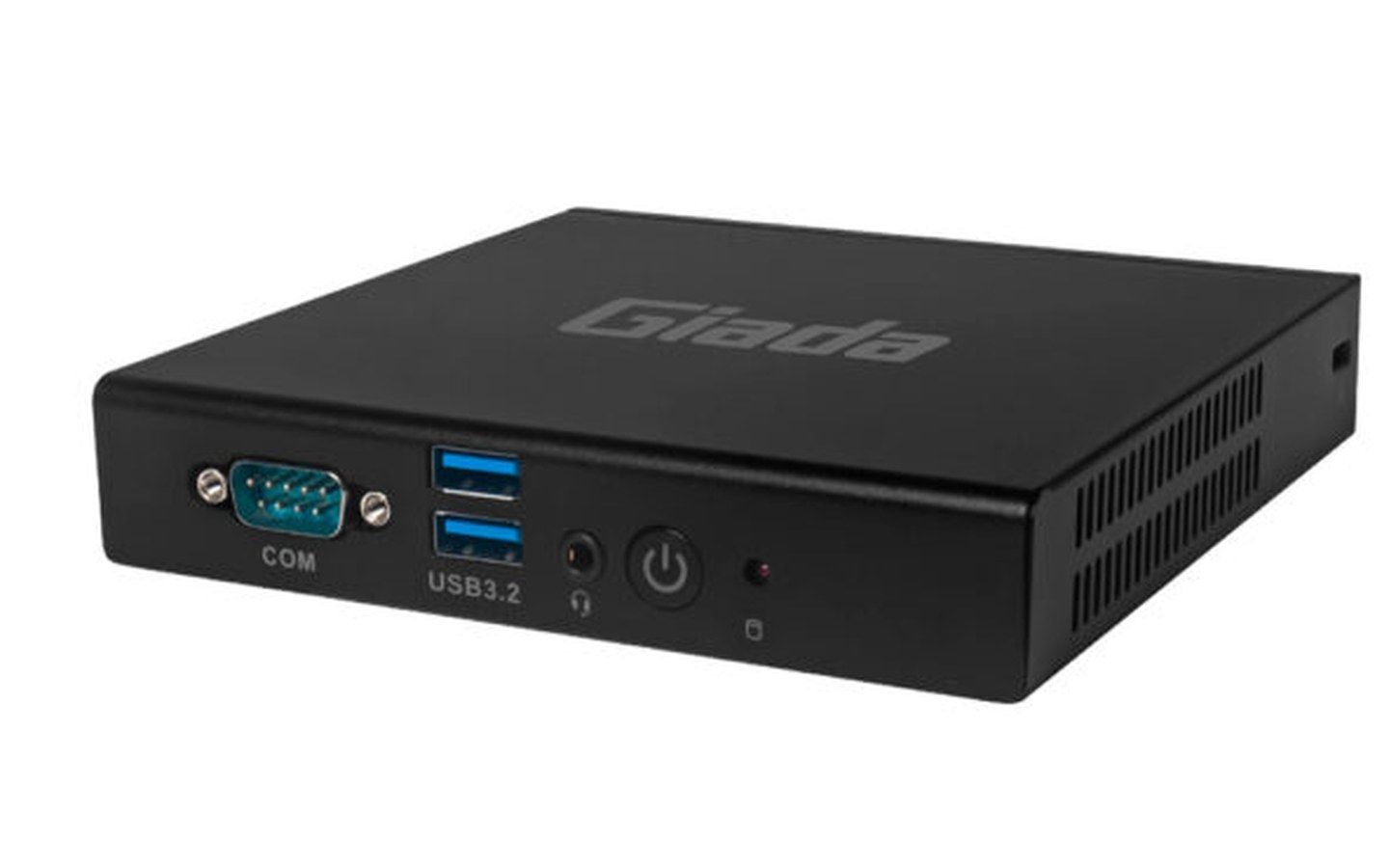
According to CNX Software, Giada’s latest embedded PC, the DK320, takes Intel’s new Wildcat Lake silicon and packs it into a thin, actively cooled metal chassis. It’s designed for digital signage, edge computing, and automated decision-making in retail or monitoring environments.
A thin active-cooled Wildcat Lake player
At just 130 x 129.3 x 25.4 mm, the DK320 is noticeably thinner than most fanless competitors. That slimness comes with a trade-off: active cooling via a smart fan, which suits temperature-controlled settings up to 45°C but not dusty outdoor cabinets. Inside, buyers choose between two 15W processors:
- Intel Core 3 304 – 5 cores (1 P-core + 4 LPE-cores), 1-core Xe3 GPU with 9 TOPS and a 15 TOPS NPU
- Intel Core 5 315 – 6 cores (2 P-cores + 4 LPE-cores), 2-core Xe3 GPU with 18 TOPS and the same 15 TOPS NPU
- Both share a 15W PBP and 6 MB Intel Smart Cache
That NPU is the star for edge AI. Local object detection, people counting, or anomaly detection can run entirely on the device, avoiding cloud dependencies and reducing latency.
Memory, storage, and connectivity
Giada ships the DK320 as a barebone, so integrators add their own parts. A single SO-DIMM slot officially supports up to 48GB DDR5-6400—though CNXSoft notes that 64GB modules will likely work—and storage goes through an M.2 2242/2280 PCIe 4.0 x4 NVMe socket. The base I/O is practical:
- Dual HDMI 2.1 ports, each driving 4096 x 2304 at 60 Hz for dual 4K displays
- 2.5GbE via an Intel i226-V controller
- Four USB 3.2 ports: one Gen 2 (10 Gbps) and three Gen 1 (5 Gbps)
- A legacy RS232 COM port
Wireless is optional, with three module choices:
- WiFi 5 via RealTek RTL8852BE
- WiFi 6 via Intel AX211
- WiFi 7 via Intel BE200
Both Windows 11 64-bit and Ubuntu Linux 64-bit are supported, making it flexible across IT and embedded deployments.
Where the DK320 fits among Wildcat Lake boxes
The DK320 is the fourth Wildcat Lake embedded PC to surface, following the fanless Avalue EPC-WCL, the Arbor ARES-2100, and the even smaller UP WCL Edge. Its main differentiator is depth: at 25.4 mm it is about half as thick as those alternatives, but it gives up passive cooling to get there. For digital signage installations that already have controlled airflow—think retail shelves, kiosks, or back-of-house media players—that trade is often acceptable.
Giada hasn’t published pricing, and distributors listing the DK320 don’t show public figures. Still, with an integrated 15 TOPS NPU, dual 4K output, and a compact footprint, the DK320 points to a practical future where local AI inference becomes a standard feature in signage players rather than a specialty add-on.