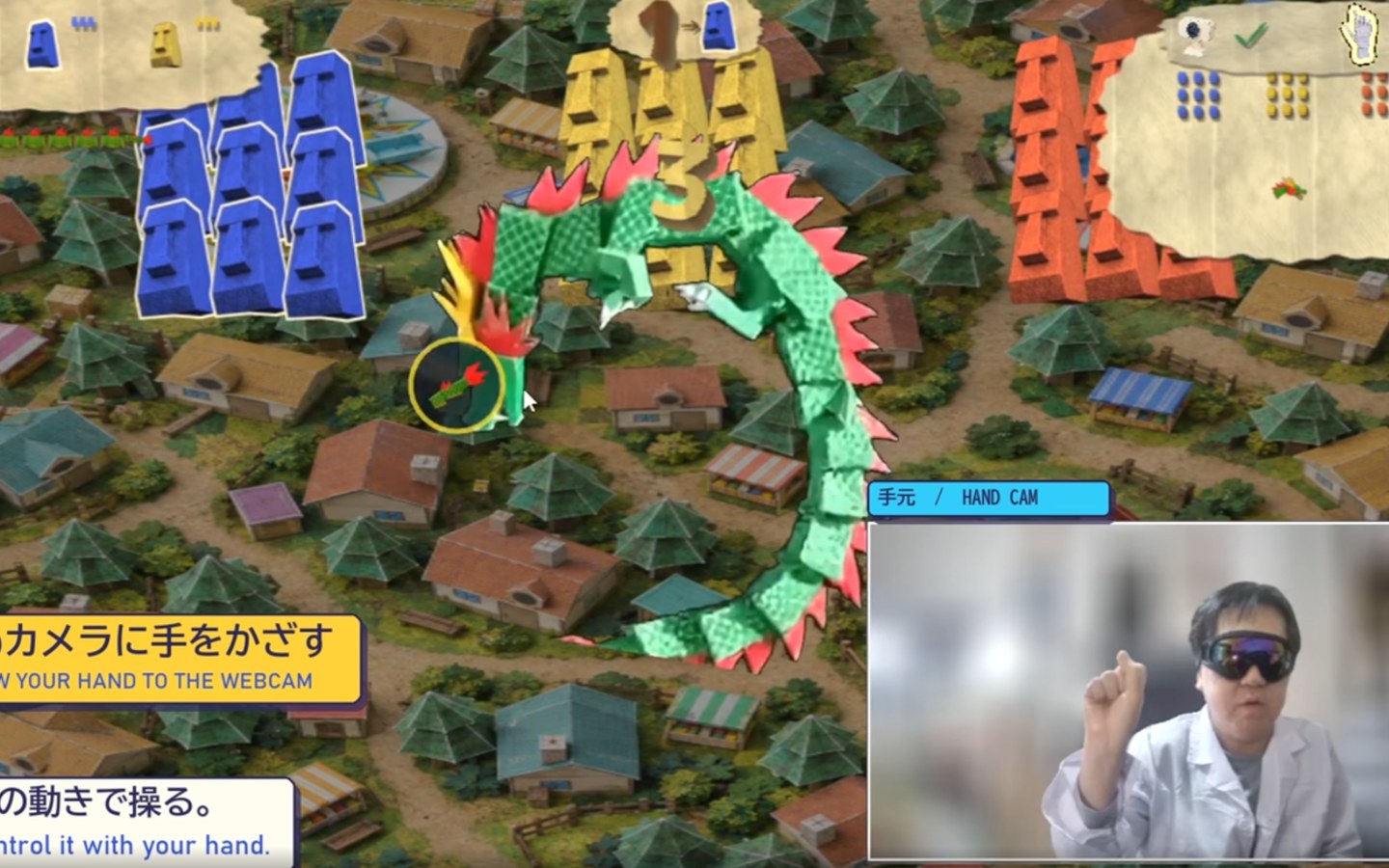
A 2002 webcam experiment, revived for a dragon game
In 2002, Takahiro Yonemura and collaborators built a gesture input system around a single webcam-like camera. At the time, the goal was ambitious: automatically identify a user's fingers and head so people could draw characters in the air and pass those shapes to a standard PC. Hackaday notes this was nearly a decade before Microsoft Kinect, and even many modern VR and gesture setups still rely on more than a plain camera. The modern iteration narrows the problem to what a simple camera can handle reliably: detecting whether a hand is open, closed, or off-screen.
Three hand states, one button-like click
The current version uses those three states to drive a small game where the player controls a dragon whipping its tail around a map. The control mapping is deliberately minimal:
- Open hand – the default state for moving the dragon around the map.
- Closed hand – closing and opening a hand generates a click, serving as the primary action button.
- Off-screen hand – pauses the game, acting as a natural break control without an extra button or menu.
That's the entire input vocabulary. The system doesn't need depth data, controllers, or wearable sensors. The trade-off is a restricted gesture set, but for a casual game it feels enough. The Steam page video shows Takahiro Yonemura having fun with the dragon.
Why camera-only input keeps reappearing
The project is not open source, which limits outside experimentation. Still, Hackaday points to other camera-only gesture projects, including one that lets users move and interact with 3D objects in virtual space. The broader idea keeps resurfacing because a single camera is cheap, low-power, and already present in laptops, phones, and embedded devices. A camera-only interface can work for:
- Media controls on a laptop or TV, where a hand wave or open/closed palm can replace a remote.
- Public kiosks that need touchless input without expensive depth sensors.
- Portable and edge-AI devices where a wearable glove or Kinect-style depth camera would add cost and bulk.
The original 2002 experiment was ahead of its hardware. The modern dragon game shows that three robust hand states are still enough to make a camera-only gesture interface feel playful.