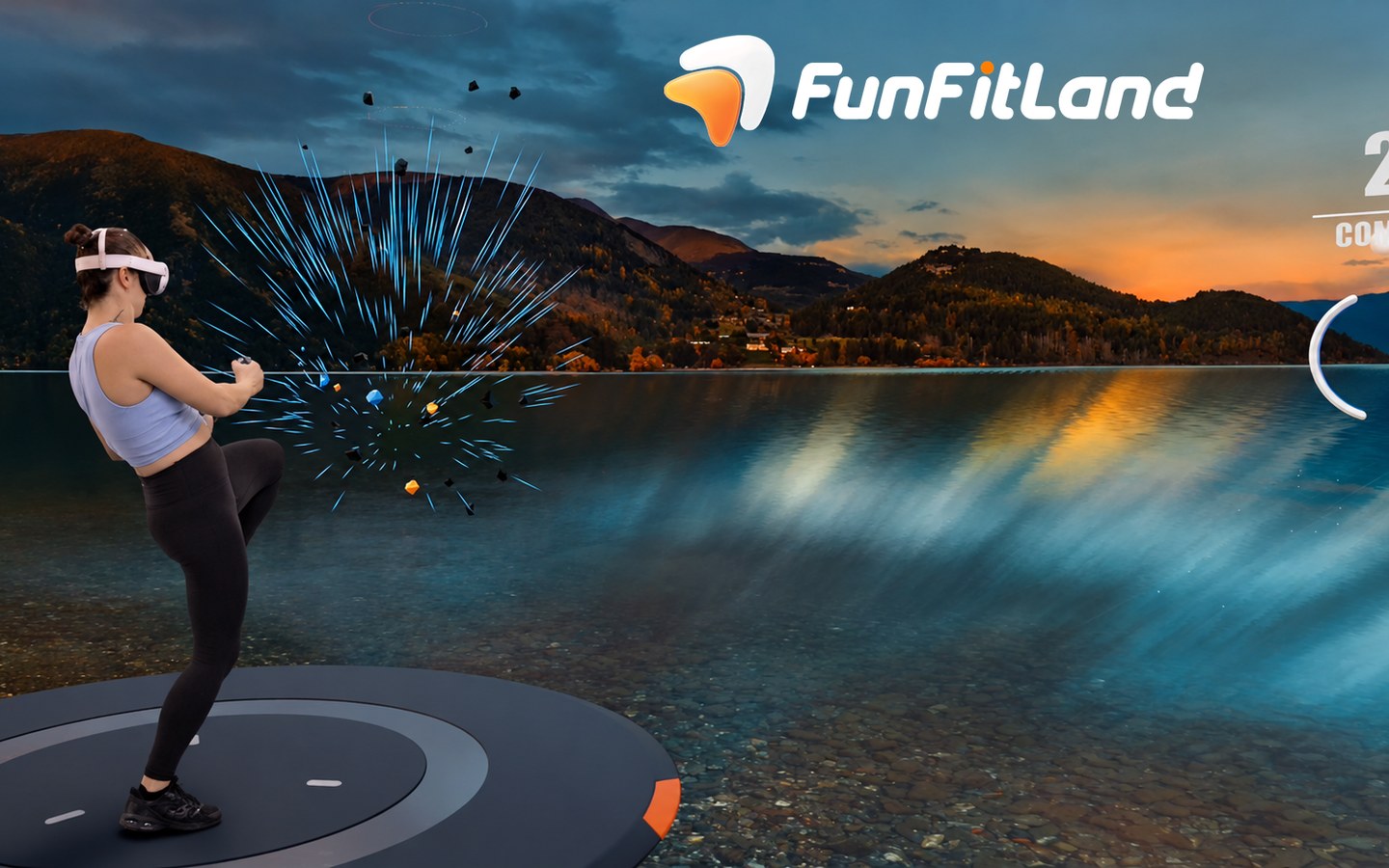
A Percussive New Move for CombatFit
FunFitLand's CombatFit workout series has a new layer: knee strikes built around a two-handed "grab and smash" mechanic. As UploadVR describes after beta testing through two rounds of iteration, you grab an overhead target, pull it downward, and drive your knee up into it. The move is harder to explain in writing than to perform, but the payoff is a demanding abdominal workout and the layered visual, audio, and controller-haptic feedback that FunFitLand has become known for.
The studio's founder, Meng Zhang, says the tutorial for knee strikes will play automatically the first time a user selects a workout containing them. It can be replayed anytime, and users can also disable the move entirely in settings. UploadVR's hands-on testing found that the two-handed grab is the key design insight: bracing against the pulled-down target keeps you stable, whereas a standalone leg lift feels far less controlled.
Why SwingFit and FlowFit Won't Get Knee Strikes
Zhang was explicit that knee strikes are staying out of SwingFit and FlowFit. The reason is rhythm. Those modes depend on continuous, flowing movement, and a percussive knee strike would interrupt that flow. Beta testers apparently agreed, with feedback aligning with the team's internal view.
That narrow positioning is notable. Instead of spreading a new mechanic across every workout style, FunFitLand is treating knee strikes as a CombatFit-specific tool. It is an opinionated design choice about how different training modes should feel:
- CombatFit gets explosive, percussive hits, now including knee strikes.
- SwingFit keeps its fluid, continuous movement patterns without knee interruptions.
- FlowFit also remains untouched, preserving the meditative, flowing quality users expect.
UploadVR does not report any plans to revisit that split, and the beta feedback suggests the community is comfortable with the boundary.
Space Sessions Land on Apple Vision Pro
Separately, FunFitLand's Space sessions—a set of immersive environments designed for cooldowns and relaxation—are now available on Apple Vision Pro. Combined with the recently released mobile app, which adds heart rate tracking inside the VR workout, this update closes a feature gap between the Vision Pro build and the earlier Meta Quest version.
The subscription price stays at $9.99 monthly or $99.99 annually, with the app available on both Meta Quest and Apple Vision Pro. UploadVR frames the move as part of a broader parity push: platform-specific gaps are narrowing as the studio brings Quest features to Apple's headset and ties in mobile heart rate data.
The Space expansion does not change the workout formula itself, but it gives Vision Pro users the same cooldown and relaxation layer that Quest players already had. For a subscription fitness app, that kind of feature parity matters more as headsets compete for daily-use time.