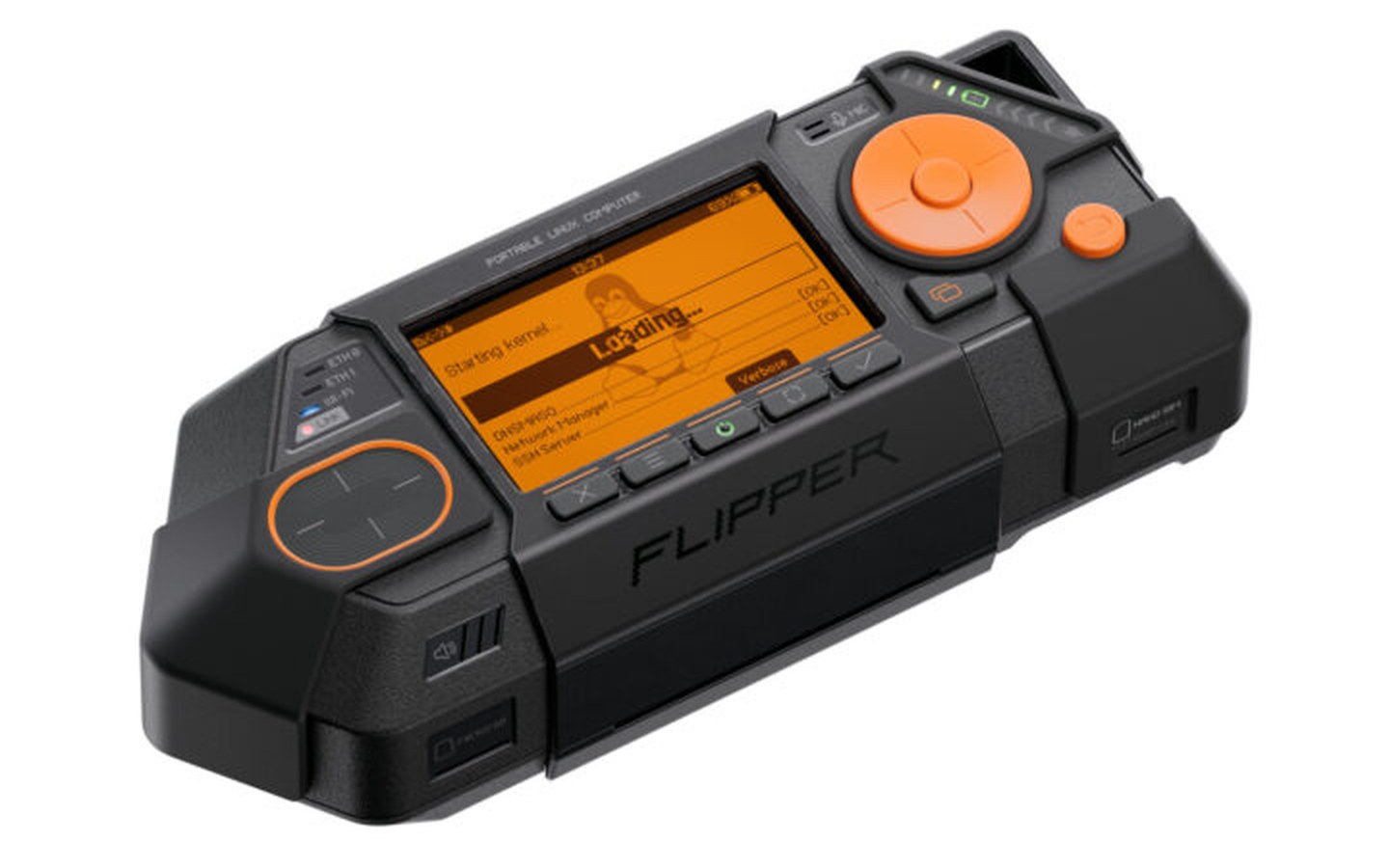
Not a Flipper Zero successor
Flipper Devices has just launched the Flipper One on Kickstarter, and it is not a replacement for the STM32-based Flipper Zero. Instead, it is a full portable Arm Linux computer and networking multi-tool that moves up the stack. The device pairs a Rockchip RK3576 octa-core SoC with a Raspberry Pi RP2350 microcontroller for low-level control. Within the first 12 hours, the campaign raised close to $10 million from around 19,000 backers. Pricing starts at $399 for the Kickstarter Special; bundles with LoRa at $439, SDR at $539, 5G at $599, and all modules at $759. Shipping is not included, and deliveries are expected to start in July 2027.
Hardware and open Linux core
The RK3576 provides four Cortex-A72 cores up to 2.2 GHz, four Cortex-A53 cores up to 1.8 GHz, and an Arm Cortex-M0 at 400 MHz. Graphics come from a Mali-G52 MC3 GPU supporting OpenGL ES 3.2, OpenCL 2.1, and Vulkan 1.2. The integrated NPU delivers 6 TOPS of INT8 performance and handles INT4, INT8, INT16, BF16, and TF32 mixed operations. The VPU decodes H.264, H.265, VP9, AV1, and AVS2 up to 8K at 30fps or 4K at 120fps, and encodes H.264/H.265 up to 4K at 60fps. Storage includes 64GB UFS 2.2 and a microSD card slot.
Networking is the main event: dual Gigabit Ethernet ports use Realtek RTL8211F-CG controllers; Wi-Fi 6 (802.11ax) 2x2 MIMO and Bluetooth 5.2 arrive via a MediaTek MT7921AUN module; optional 4G LTE or 5G works through an M.2 module with eSIM or a Nano SIM (a Quectel RM520 module promises up to 1Gbps downlink with four antennas); optional LoRa supports Meshtastic, MeshCore, or Reticulum; and an optional SDR module covers 24–1700 MHz with 10 MHz bandwidth. USB includes one USB 3.1 Type-A host port, one USB 3.1 Type-C host port, and one USB 3.1 Type-C host/device port with DisplayPort Alt mode and 5V–12V USB PD input. An M.2 Key-B socket supports PCIe 2.1 x1, USB 2.0/3.1, SATA3, serial audio, and UART/I2C/SIM for 2242/3042/3052 modules. A 20-pin GPIO header brings out MCU and CPU signals. Power comes from a 7,000 mAh battery (capacity not final) with USB PD up to 20V, a TI BQ25792 charger, and a BQ28Z610 fuel gauge.
Flipper Devices partnered with Collabora to upstream RK3576 support for a mainline Linux kernel with no binary blobs, though wireless and cellular radios will likely still require firmware blobs for regulatory compliance. Software includes a Debian-based Flipper OS, the FlipCTL UI framework, and open repositories on GitHub.
Crowdfunding and modular toolkit
The Kickstarter is already on track to become one of the most successful hardware campaigns in crowdfunding history. Backers can choose from:
- Base Flipper One: $399
- With LoRa module: $439
- With SDR module: $539
- With 5G module: $599
- All modules: $759
Shipping is limited to the United States, Canada, United Kingdom, Australia, all 27 EU countries, Switzerland, Norway, Singapore, and Hong Kong. The Flipper One is aimed at network analysis, edge AI, and hardware tinkering rather than the Flipper Zero's RF hacking focus. A developer portal provides hardware docs, firmware, Linux build scripts, RP2350 firmware, testing tools, and a live status of mainline Linux support.