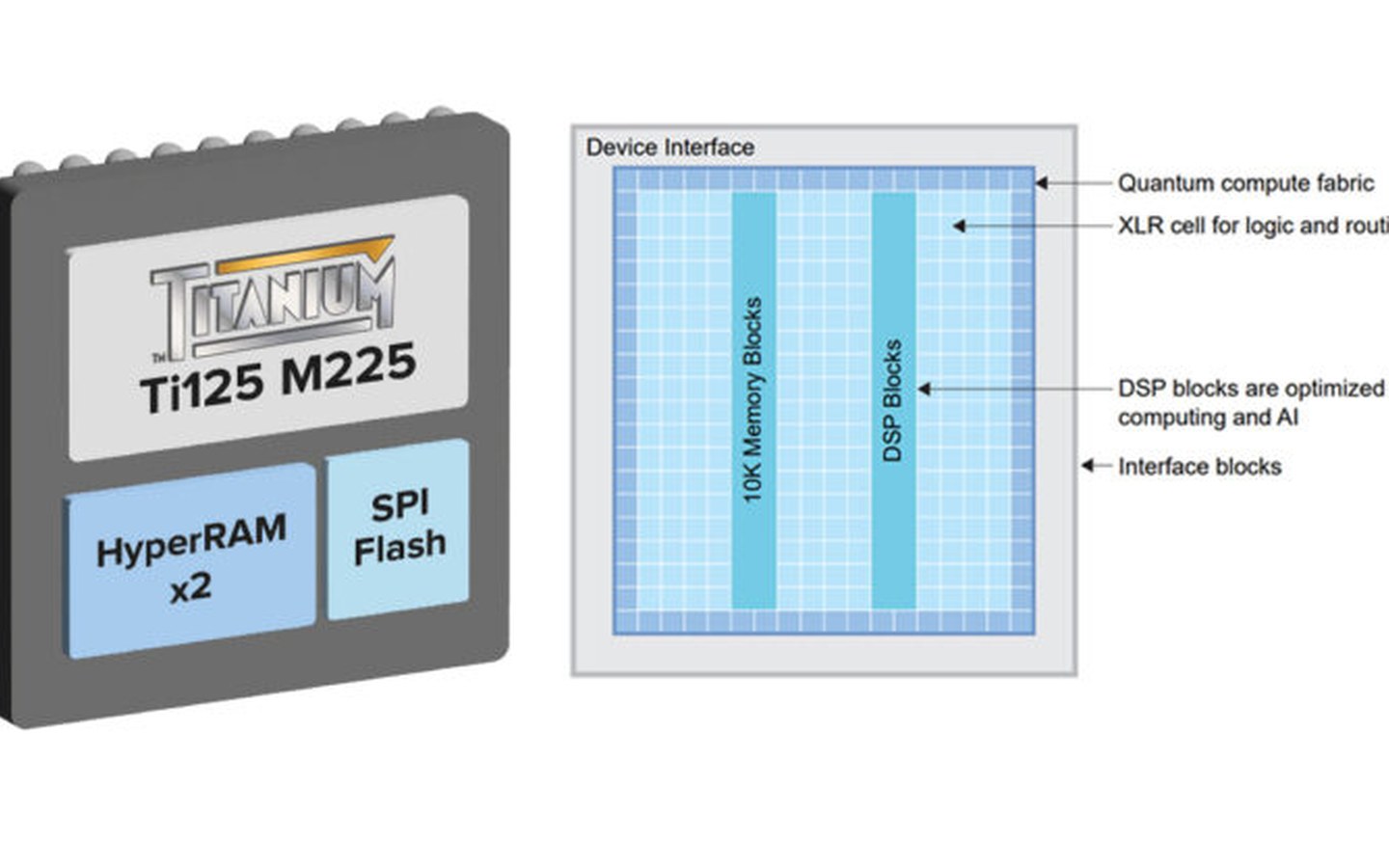
Efinix is making a decisive push into battery-operated embedded vision and AI with its new Titanium Edge FPGA family. Built on the same Quantum architecture as the company’s higher-end Titanium devices, the Edge series strips out unnecessary bulk to deliver roughly 50% lower static power consumption—directly targeting always-on detectors, smart cameras, and portable instruments that can’t afford to burn milliwatts on idle logic.
Lower Power, Smaller Footprint
The family opens with four devices—Ti125, Ti95, Ti70, and Ti40—scaling from approximately 39,000 to over 122,000 logic elements. The flagship Ti125 packs 288 DSP blocks and a mix of high-speed I/O banks, including up to 84 HSIO2 pins and 36 HVIO pins capable of DDR3L at 1,333 Mbps. What really sets the Edge line apart is the System-in-Package (SiP) option. The Ti125 SiP crams the FPGA die, 512 Mbit HyperRAM, and SPI boot flash into a single 8 × 8 mm FBGA package, shrinking the overall PCB footprint by up to 60% compared to a discrete equivalent. A Ti70 SiP with 256 Mbit HyperRAM is planned for later this year, giving designers a clear migration path from low-end to mid-range integration.
Edge AI and Vision at the Core
Every device in the family comes with configurable MIPI D-PHY I/O lanes that can operate as CSI-2 or DSI up to 2.5 Gbps, a speed grade Efinix says was optimized in the latest Efinity IDE release. Parallel interfaces are not forgotten: the HSIO2 banks are tuned for low-swing, lower-power signaling, helping keep dynamic power in check when shuttling pixels from an image sensor to a neural network accelerator implemented in the fabric. The DSP blocks and logic elements are sized for common edge-AI workloads—think lightweight object detection, facial recognition, or sensor fusion—without the overhead of an external processor. For developers, the Efinity IDE v2026.1 provides a full RTL-to-bitstream flow with device-specific pinout spreadsheets, interface user guides, and primitive documentation, making it straightforward to start a custom board design.
Reliability and Security for Harsh Environments
Efinix has baked in a hardware single-event upset (SEU) detection and correction engine that continually scrubs the configuration SRAM, a feature usually reserved for rad-tolerant space-grade parts. This makes Titanium Edge attractive for industrial, medical, and outdoor systems where momentary bit flips can’t be tolerated. On the security front, select variants will offer post-quantum signature authentication via CRYSTALS-Dilithium (ML-DSA-65), alongside conventional AES-256-GCM, RSA-4096, and EC-DSA-384 blocks, plus a physical unclonable function (PUF) and true random number generator. Sampling is underway now for the Ti125 and Ti95, with the Ti125 SiP expected in August 2026 and hardened security variants in Q4 2026. Pricing hasn’t been disclosed, but the combination of low static power, tight package options, and robust I/O positions Titanium Edge as a serious contender for the next wave of portable AI hardware.