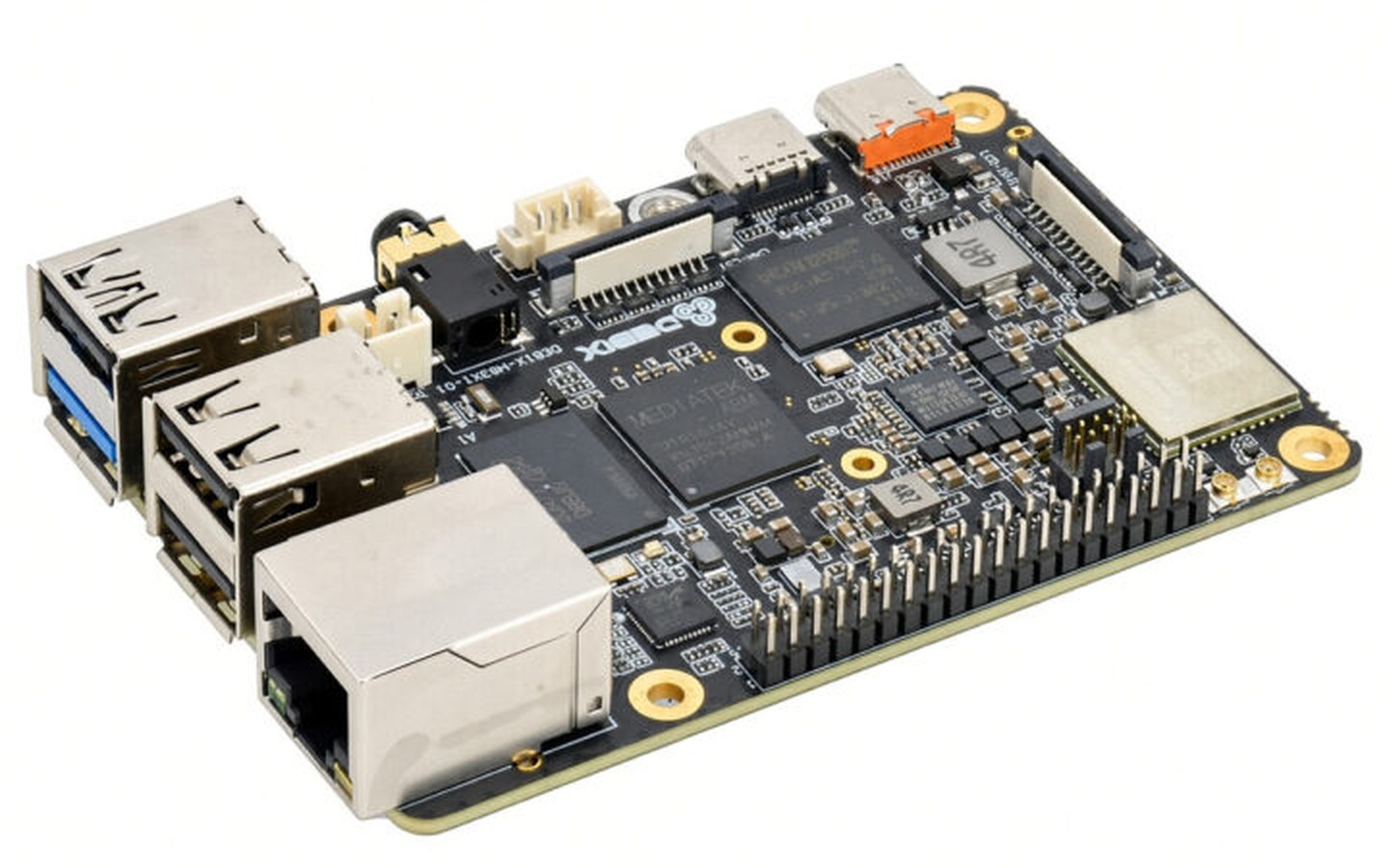
CNX Software reports that DEBIX, a maker known for NXP and Texas Instruments boards, has unveiled the DEBIX M8391-01, its first compact industrial SBC to run on MediaTek silicon. The board pairs the MediaTek MT8391 (also known as Genio 720) with a hybrid CPU cluster: 2x Arm Cortex-A78 cores up to 2.6 GHz in commercial parts (2.4 GHz industrial) and 6x Cortex-A55 cores up to 2.0 GHz. An Arm Mali-G57 MC2 GPU handles graphics, while an NPU850 accelerator delivers 9 TOPS for on-device AI.
Dual displays, camera input, and embedded headers
The M8391-01 is credit-card sized and inspired by the Raspberry Pi form factor, but its feature set targets industrial edge workloads. A 4-lane MIPI CSI connector supports image sensors up to 32MP at 30fps, making it well suited for computer vision. For output, the board offers eDP 1.4 over USB Type-C up to 4K@60 and a 4-lane MIPI DSI interface up to 2.5K; both can operate simultaneously for dual-display use cases. The 40-pin header brings out 2x UART, 2x I2C, I2S, 3x SPI, and PWM, while USB connectivity includes stacked Type-A ports and a Type-C port with OTG. Networking covers Gigabit Ethernet with PoE (an external PD module is needed), Wi-Fi 6 2T2R, and Bluetooth 5.4 with dual antenna connectors.
Memory, storage, and ultra-low power draw
DEBIX configures the M8391-01 with 4GB LPDDR4 by default, with 8GB and 16GB options available. Storage starts at 32GB eMMC, expandable to 64GB, plus a M.2 Key-M 2242 socket for PCIe 2.0 NVMe SSDs and a microSD slot. Power is supplied over 5V/3A USB-C, and DEBIX claims maximum draw of only 1.74W commercial or 1.57W industrial—remarkably low for a board with this NPU class. Temperature ratings run 0°C to 70°C commercial, with industrial versions rated -20°C to 70°C and -40°C to 85°C. Software support lists Android, Yocto Linux, and Ubuntu, but CNX Software cautions that documentation is currently thin, there is no announced price, and the board is available only by inquiry for now. That sub-2W envelope puts local vision and small-model inference within reach of battery- or PoE-powered installations where a mini PC would be overkill.