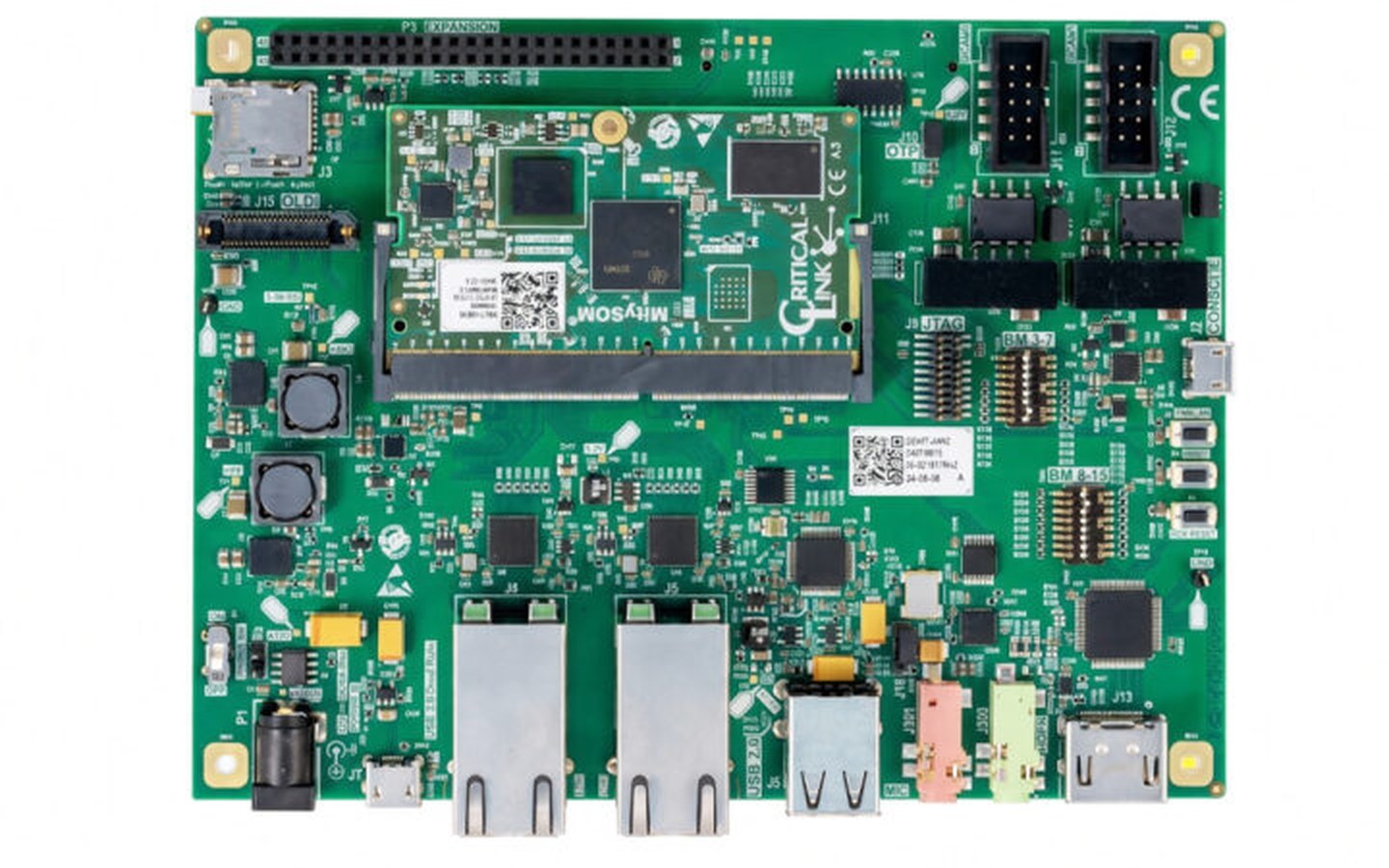
Critical Link is giving embedded teams a way to scale edge compute without touching the carrier board. The new MitySOM-AM62x/A/P family, reported by CNX Software, takes Texas Instruments’ Sitara AM62 silicon and wraps it in industrial 260-pin SO-DIMM system-on-modules. Three distinct module personalities share one connector footprint, so a product line can move between real-time control, AI vision, and rich graphics without a board redesign.
Three compute profiles, one footprint
The base MitySOM-AM62x is the general-purpose option. It pairs up to a quad-core Arm Cortex-A53 cluster running at 1.4 GHz with a 400 MHz Cortex-M4F and dual programmable real-time units (PRU-SS) at up to 333 MHz. A 3D GPU rated above 8 GFLOPS appears on AM625x variants and supports OpenGL ES and Vulkan, but there is no NPU.
The MitySOM-AM62Ax is the AI-focused member. It keeps the same quad A53 cluster but swaps the GPU for a C7x DSP with Matrix Multiply Accelerator rated up to 2 TOPS, alongside a single Cortex-R5F at 800 MHz. Hardware video encode/decode and ISP acceleration are included; the DSP is the accelerator, not a separate neural engine.
The MitySOM-AM62Px targets multimedia. Built on the AM62P54CVMHIAMHR, it carries two Cortex-R5F cores at 800 MHz—one integrated with the MCU channel and one for device management—and an Imagination IMG BXS-4-64 GPU rated up to 50 GFLOPS with OpenGL ES 3.2, Vulkan 1.2, and OpenCL 1.2 EP. AI inference on this variant runs on the A53 cores or the GPU.
Memory scales with ambition:
- AM62x: up to 4 GB DDR4 at 800 MHz; eMMC up to 128 GB at HS200
- AM62Ax: up to 16 GB LPDDR4 at 1866 MHz (~14.9 GB/s burst); eMMC up to 128 GB at HS200
- AM62Px: up to 8 GB LPDDR4 at 1600 MHz; eMMC up to 256 GB at HS400
Shared industrial I/O and unanswered pricing
All three modules expose dual Gigabit Ethernet MACs, three CAN-FD interfaces, two USB 2.0 ports, a 4-lane MIPI CSI-2 camera input at up to 2.5 Gbps per lane, and McASP audio through the 260-pin edge connector. That common peripheral set means the module choice becomes mostly about compute profile—real-time control, vision inference, or graphics—rather than connectivity.
Pricing and availability were not disclosed, which leaves cost comparisons open. Still, the family’s design point is clear: one carrier footprint, three accelerators, and enough headroom to move from a basic HMI to a 2 TOPS vision system without re-spinning the baseboard.