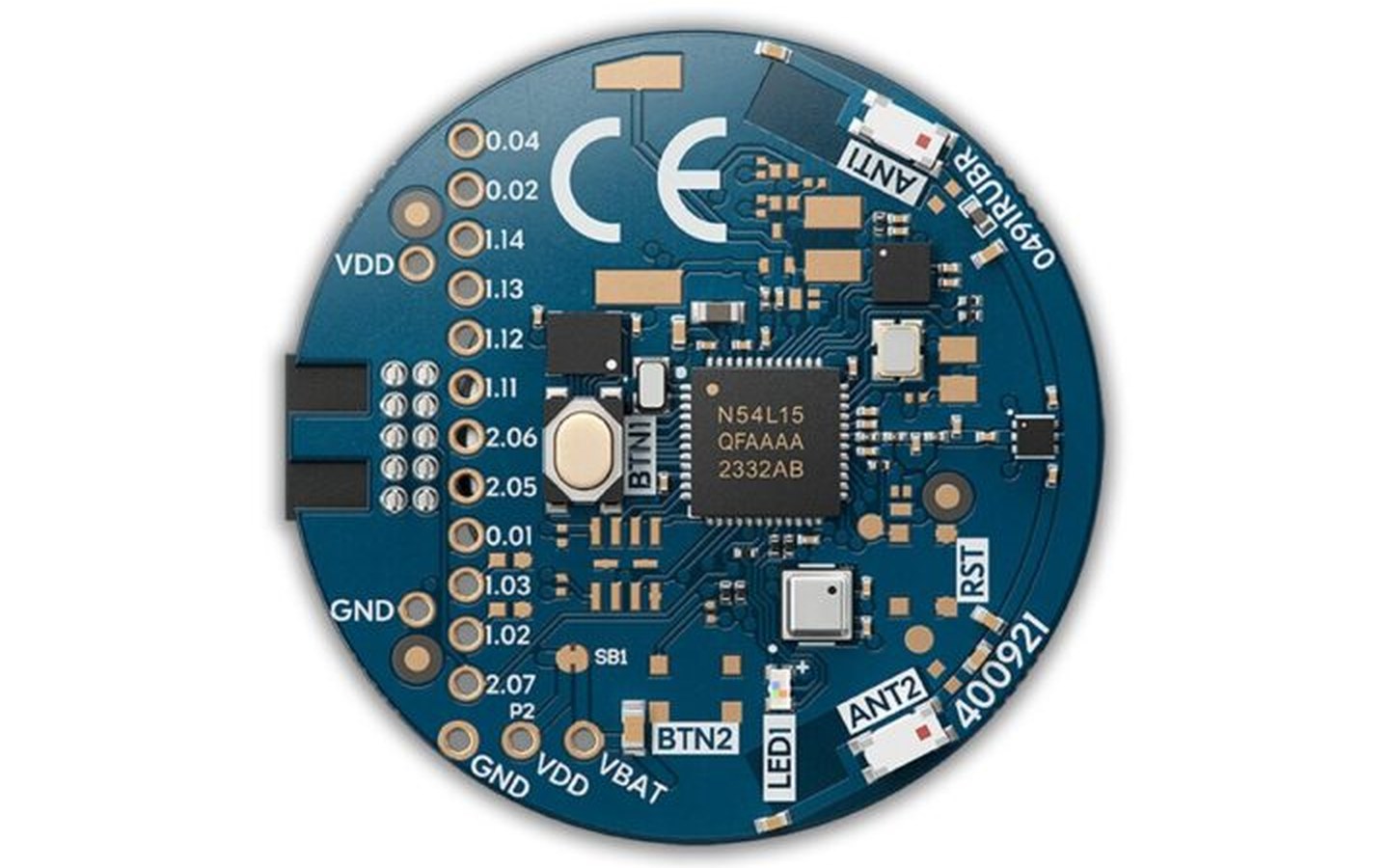
A tiny tag with real wireless muscle
Nordic Semiconductor’s new nRF54L15 Tag shrinks a surprising amount of processing and sensing into a 33 mm-diameter disk that runs on a coin cell. At its heart sits the nRF54L15 wireless SoC, an Arm Cortex-M33 clocked at 128 MHz paired with a RISC-V coprocessor for software-defined peripherals. Developers get 256 KB of SRAM and 1.5 MB of non-volatile memory, with pads for external storage if needed.
The tag’s radio can switch among an unusually broad set of protocols: Bluetooth LE 6.0 (including the new Channel Sounding for fine-grained distance measurement), Thread, Zigbee, Matter, Amazon Sidewalk, NFC, and even a proprietary 4 Mbps mode. Two onboard chip antennas boost reliability for position tracking. For teams building find-my-gear solutions, prebuilt firmware samples cover compatibility with Apple Find My and Google Find Hub ecosystems.
Preloaded firmware lets the tag announce itself as a Bluetooth device straight out of the box. A smartphone app can read button presses and toggle the RGB LED—enough to test connectivity without writing a line of code. When you are ready to write custom logic, any nRF54, nRF53, or nRF91 development kit can program the tag through its debug-out header, and over-the-air updates are supported.
Sensors that turn motion into insight
Where the nRF54L15 Tag gets interesting for portable AI is its sensor lineup. A high-accuracy 6-axis IMU provides raw data for edge inferencing and sensor fusion. Nordic makes it easy to run nRF Edge AI workloads—gesture recognition, vibration monitoring, and motion anomaly detection are all outlined in the SDK. A separate low-power accelerometer stays alert while the main SoC sleeps; it wakes the tag only when it detects movement, preserving battery life for months of intermittent tracking.
Environmental sensing is covered by a single integrated device that measures temperature, humidity, air pressure, and gas (including CO₂). That opens prototyping paths for:
- Smart weather stations
- Indoor air quality monitors
- Connected home sensors tied into Matter fabrics
Twelve GPIO pads make it simple to wire in extra sensors, buttons, or a buzzer. With the IMU and environmental data flowing into edge AI models, the tag can prototype wearables, industrial anomaly detectors, and asset trackers that do more than just report location.
From Matter to Find My: a connectivity Swiss Army knife
The tag doesn’t stop at Bluetooth short-range. Matter over Thread support means it can join smart home networks as a native endpoint, tapping into the same ecosystem that works with Apple, Google, and Amazon hubs. Aliro compatibility—the emerging standard for smart locks and access control—also appears on the spec sheet.
Priced at about $30 and distributed through Farnell, Rutronik, and Braemac, the nRF54L15 Tag comes with full hardware documentation, schematics, BOM, and Gerber files. That makes it a practical stepping stone to custom board designs. For teams iterating between cloud-connected trackers, edge AI sensors, and multi-protocol smart objects, a coin-cell reference platform that spans Bluetooth Channel Sounding, Thread/Matter, and Edge AI all at once is a compact prototyping Swiss Army knife.