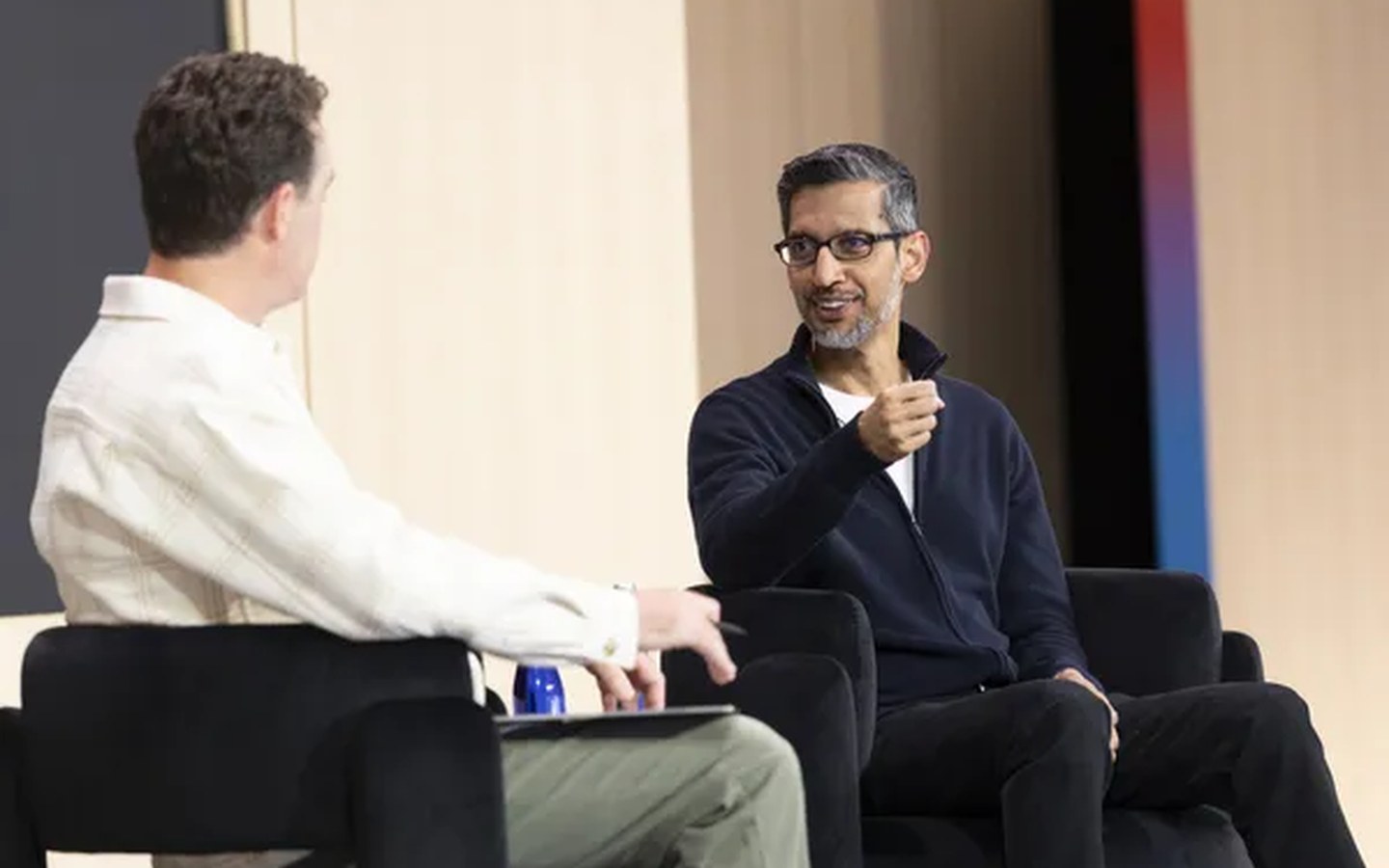
Google's I/O 2026 keynote grabbed headlines with product launches, but the Dialogues stage offered something quieter and in some ways more revealing: a series of unscripted conversations mapping where Google's leadership believes AI is genuinely heading. The official recap from Google highlights six conversations that spanned AI agents, quantum computing, scientific discovery, robotics, and creative storytelling.
The Dialogues stage at a glance
Across the event, Google paired senior executives with outside voices and journalists. The lineup included:
- Sundar Pichai and Matt Berman unpacking the strategy behind the keynote's biggest announcements.
- Josh Woodward, Koray Kavukcuoglu, Liz Reid, and Jeff Dean joining Logan Kilpatrick to discuss how proactive AI agents are reshaping productivity.
- Hartmut Neven and James Manyika examining the intersection of quantum computing and AI.
- Demis Hassabis speaking with Axios' Mike Allen about AI's role in complex scientific problem-solving.
- Kanishka Rao and Alberto Rodriguez digging into embodied physical AI with Jacklyn Dallas.
- Director Doug Liman and creators Jed Weintrob and Julina Tatlock exploring AI's impact on cinematic storytelling alongside Google's Mira Lane.
AI agents were the clearest portable signal
The standout theme for anyone tracking portable AI was the agent conversation. Google's panel on AI agents made clear that the company is pushing beyond reactive assistants toward systems that can anticipate intent, take multi-step actions, and operate across apps and services. Josh Woodward, Koray Kavukcuoglu, Liz Reid, and Jeff Dean framed this shift as a productivity transformation, not just a chatbot upgrade.
That matters because proactive, context-aware agents are exactly the kind of software layer that makes lightweight wearables useful. A device that can understand a spoken request, reason about the user's calendar, location, and preferences, then complete a task on their behalf is more than a voice remote. The Dialogues stage didn't announce glasses, but the emphasis on agentic AI hints at the direction Google's hardware experiments are likely to follow.
Beyond software: quantum, science, robotics, and creativity
The remaining sessions showed Google trying to connect AI to longer-horizon bets. Hartmut Neven and James Manyika framed quantum and AI as complementary, not competing, technologies. Demis Hassabis kept the focus on scientific impact, arguing that AI's most durable value may come from accelerating discovery in biology, materials, or climate modeling.
On robotics, Kanishka Rao and Alberto Rodriguez discussed the leap in embodied physical AI—systems that combine perception, planning, and physical action. That conversation has direct implications for robots that operate in real-world environments rather than just generating text. The creativity panel, featuring Doug Liman, Jed Weintrob, and Julina Tatlock, rounded out the stage by examining how AI tools are changing filmmaking workflows, from pre-visualization to post-production.
Taken together, the Dialogues stage painted a picture of AI that is becoming more proactive, more physically present, and more deeply embedded in creative and scientific work. Google's recap doesn't promise a single product roadmap, but the conversations offer a useful map of what the company thinks is next.