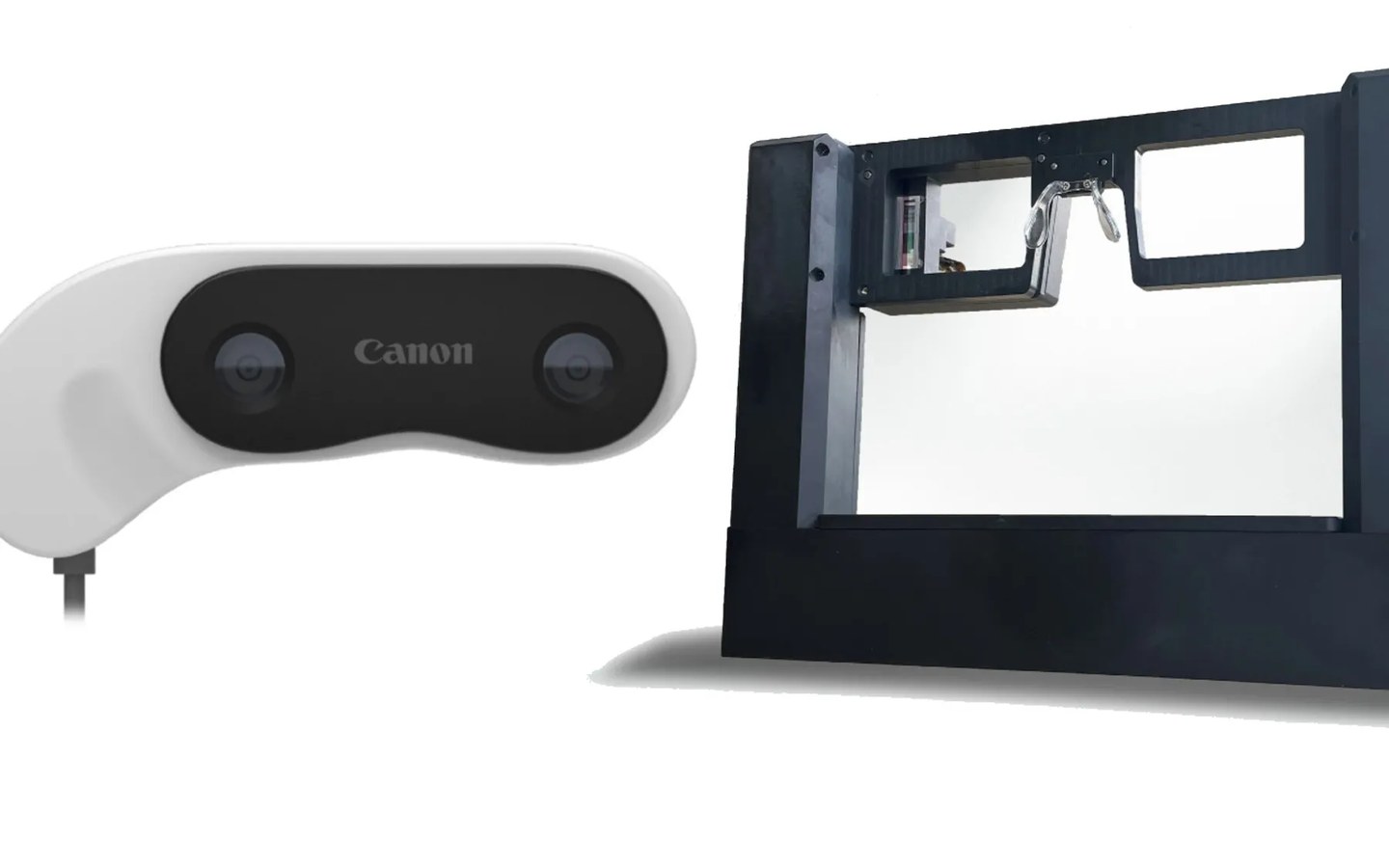
At this year’s Augmented World Expo, Canon stepped up with a trio of enterprise XR offerings that signal serious intent in portable mixed reality. The imaging giant pulled back the curtain on a concept handheld MR viewer, a pair of high-efficiency waveguide prototypes for AR glasses, and a collaboration suite called MREAL Collaborator. While none of these are shipping products yet, each one fills a gap Canon has been quietly carving out since its early MREAL headset days.
A palm-sized MR viewer that stays tethered
The star of the show was Canon’s “Concept Model of a Pocket-Size, High-Image-Quality MR Device.” The name says it all—this is a handheld, tethered mixed reality viewer designed to slip into a pocket when not in use. Canon isn’t sharing full specs, but the company emphasises high-definition visuals and seamless compatibility with existing XR applications. The device is clearly aimed at enterprise users who need a portable, high-fidelity window into spatial data without a full headset.
Canon’s US division demoed the concept at AWE, hinting at ambitions beyond the Japanese market, where handheld viewers already enjoy some traction in industrial settings. The company is actively seeking partners to bring the device to market, so a commercial launch is plausible—though there’s no timeline yet.
Waveguides that push the brightness barrier
Next to the handheld MR concept, Canon showed off its “High-Efficiency Waveguide for AR Glasses,” a prototype optical engine available with microLED or microOLED displays. The specs are where things get interesting: a 30-degree field-of-view, an optical coupling efficiency exceeding 15,000 nits per lumen, and over 85% transmittance.
That coupling figure is unusually high for waveguide optics and translates to a much brighter image for a given light source—a critical advantage for outdoor readability. The 30-degree FOV is modest, placing this waveguide firmly in the smart-glasses or lightweight AR assistant category rather than cinematic mixed reality. But if Canon’s efficiency numbers hold, it could enable vastly more compact, power-sipping glasses that still punch through daylight.
Collaboration software that speaks OpenXR
Rounding out the AWE announcements, Canon previewed MREAL Collaborator, a new XR collaboration tool for manufacturing designers. The pitch is elegantly simple: it lets teams without 3D graphics expertise manipulate spatial data and share views across different XR devices. Built on OpenXR, the software promises cross-platform interoperability and remote collaboration out of the box. Canon plans to launch a free trial in early July, signalling the software is close to release.
For enterprises already invested in Canon’s MREAL ecosystem—or any OpenXR-compatible hardware—MREAL Collaborator could lower the barrier to immersive design reviews and factory-floor planning. And by pairing it with the handheld MR concept or future waveguide glasses, Canon is sketching a full-stack vision: capture, visualise, and collaborate on 3D assets without leaving the manufacturing floor.