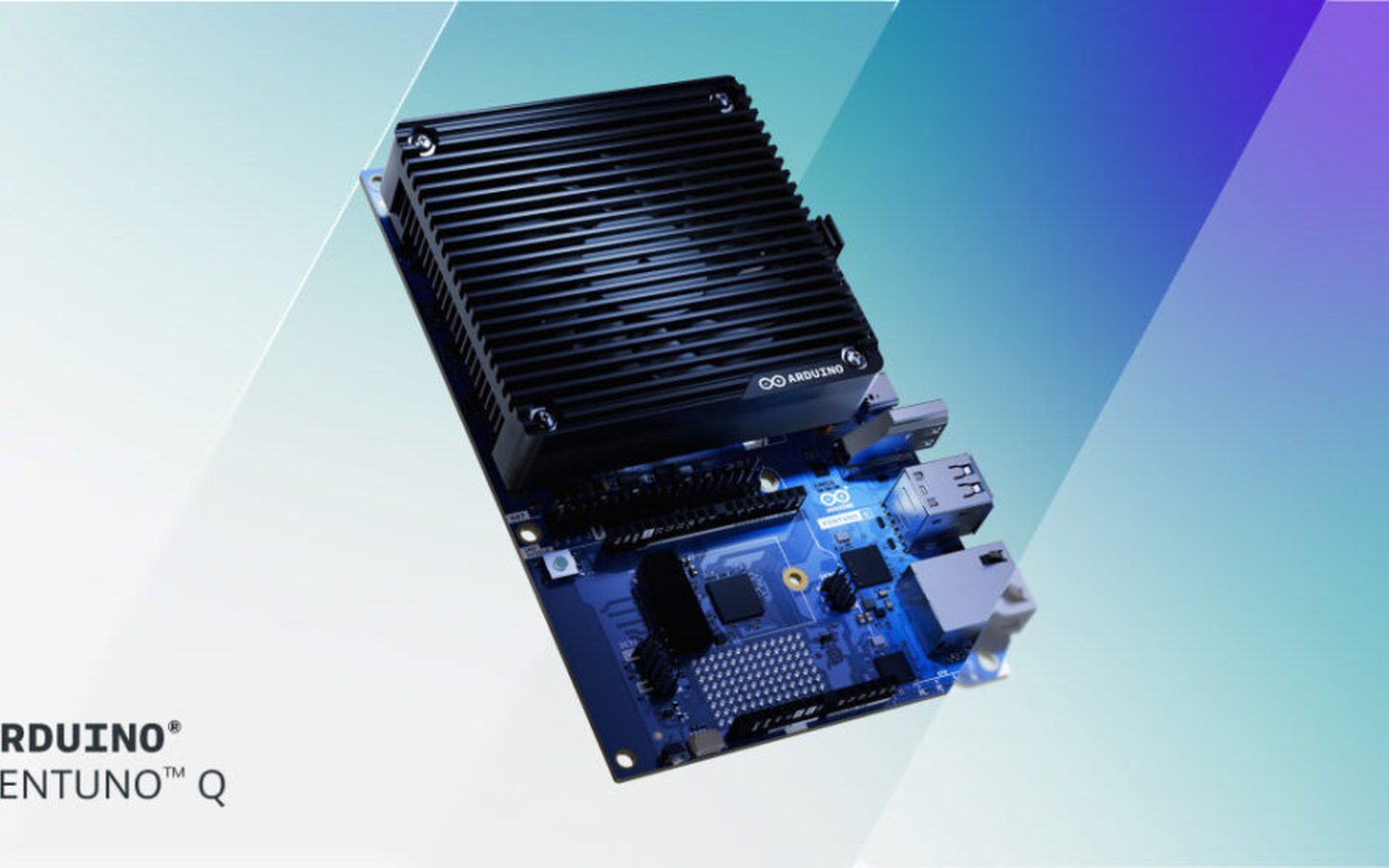
Moorcheh's hardware profile on the Arduino VENTUNO Q poses a pointed question: can a $399 single-board computer index millions of technical documents, video frames, and audio logs while still hosting a local 8B-class LLM and a deterministic real-time control loop? The Arduino Blog post, written by Moorcheh CEO Tara Khani, offers a vendor-authored answer grounded in physical hardware benchmarks.
The memory wall in edge vector search
The VENTUNO Q uses a dual-brain design: a Qualcomm Dragonwing IQ-8275 with an 8-core Kryo CPU, Adreno GPU, and a Hexagon NPU rated at up to 40 dense TOPS, paired with 16 GB LPDDR5 memory and an STM32H5 microcontroller for sub-millisecond control. That sounds generous, but conventional approximate nearest-neighbor indexes create a wall. With 1,536-dimension float32 embeddings, each uncompressed vector alone is about 6.14 KB. At one million vectors, the post says a standard HNSW index consumes 7.4 GB RAM and 13.2 GiB on disk, and graph construction takes 2 hours 58 minutes. On a board with 15.2 GB usable RAM, that leaves almost no room for local vision, speech, or KV cache.
Binarized retrieval and the benchmark shift
Moorcheh's approach compresses every embedding dimension to a single bit—reducing a 1,536-dimension vector to just 192 bytes—and runs exact bit-scan retrieval on the Kryo CPU with built-in shortlist reranking. That keeps the Hexagon NPU and most system memory free for neural inference. Its open-source Memanto layer handles agentic memory maintenance: superseding outdated information, pruning stale observations, and compiling context briefings before prompts reach the LLM.
The vendor's side-by-side results on physical VENTUNO Q hardware at 1 million vectors are stark:
- Index build time: 0 seconds, versus 2 hours 58 minutes for HNSW.
- RAM footprint: 737 MB, versus 7.4 GB.
- Disk footprint: 294 MiB, versus 13.2 GiB.
- Median query latency: 14.84 ms, with candidate reranking already included.
Because the retrieval layer remains under a gigabyte, the post budgets a concurrent multimodal AI stack on the same board:
- BGE-small embedding model: ~676 MB
- Qwen 2.5 3B or 7B Q4 LLM: ~2.1 GB to 4.7 GB
- Whisper small speech-to-text: ~750 MB
- Piper text-to-speech: ~470 MB
- YOLOv8n object detection at 1080p: ~300 MB
Total memory runs about 5.0 GB to 7.6 GB, leaving headroom for OS buffers, KV-cache expansion, and ROS 2 nodes.
Where this fits on the edge
The post highlights three practical scenarios. Air-gapped retail kiosks can transcribe spoken questions, search a million catalog entries and schematics in roughly 15 ms, and narrate grounded answers without cloud APIs. Autonomous mobile robots can use Moorcheh as an episodic memory engine to recall when and where a pallet or obstacle was last seen in video keyframes, all without leaving the edge. Field technicians with rugged inspection kits get cross-modal retrieval across engineering diagrams and maintenance clips in under 15 ms.
The results are compelling, but they come from the company behind the technology. Independent replication on the same board—or competing hardware—would strengthen the claim that million-record multimodal retrieval and local LLM inference can truly coexist on a $399 edge SBC.