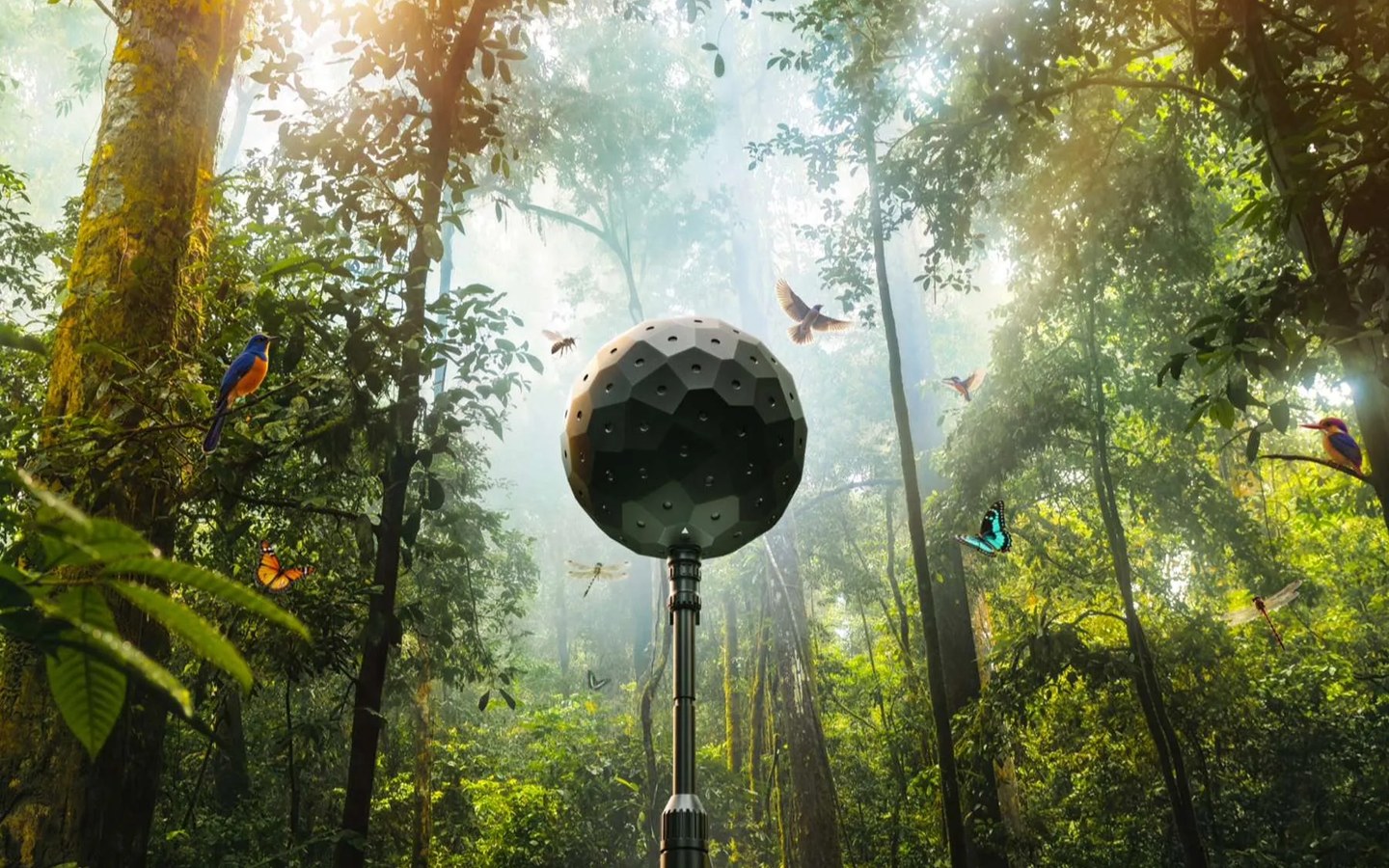
The hardware behind the headline
Road to VR reports that Blackmagic Design has announced the Blackmagic Ambisonic Microphone, a professional spatial audio capture device built around a dense array of 108 digital MEMS microphones. The capsules sit flush inside a solid, faceted metal body that Blackmagic says is small enough to fit in your palm or sit on top of a camera. An internal processor then runs Apple-licensed array geometry and ambisonic encoding filters, turning those 108 raw signals into 64 channels of 32-bit audio in real time. No external breakout box, no extra encoding software, and no driver installation — the mic is class compliant and connects over a single USB-C cable, which also supplies power.
At $1,695, this isn’t a consumer toy, but it is a dramatic simplification of pro ambisonic rigs. The design deliberately removes friction: one cable, one palm-sized unit, and spatial audio that’s ready to drop into an immersive timeline. For comparison, most ambisonic setups still involve multiple capsules, breakout boxes, and offline processing. Blackmagic is packaging that entire chain into a single metal puck.
How it fits into immersive production
The microphone is designed to pair tightly with Blackmagic’s URSA Cine Immersive camera, which was developed in collaboration with Apple for Apple Vision Pro content. When mounted on that camera, the Ambisonic Microphone records spatial audio directly into the camera’s immersive files — no post-sync, no separate recorder. But the ecosystem goes beyond a single camera. Road to VR highlights three additional workflows:
- Computer + Fairlight Live: connect the mic to a laptop or desktop for real-time recording and mixing inside Blackmagic’s Fairlight Live.
- iPhone via Blackmagic Camera app: record spatial audio straight to a phone using the company’s mobile app.
- Broadcast via USB-to-SMPTE-2110 converter: an optional converter opens the door to advanced broadcast environments, though Blackmagic hasn’t announced pricing for that accessory.
Blackmagic says availability is expected in December, though no exact ship date has been confirmed. CEO Grant Petty framed the project as a direct outgrowth of the Apple collaboration, saying the experience of hearing high-resolution spatial capture “was like hearing an acoustic reality.” Apple licensed the array geometry and encoding filters, while Blackmagic handled the engineering and industrial design. The result is a product that moves ambisonic capture from bespoke, multi-box rigs to a plug-and-play peripheral built for Vision Pro-grade content.
What shifts for portable and immersive audio
The Ambisonic Microphone doesn’t introduce a new recording format — it compresses the complexity of an existing one. That compression matters for creators who want spatial audio without operating a small broadcast truck. It also aligns with a broader pattern in the Vision Pro ecosystem: Blackmagic is turning what used to be specialized, expensive, and cumbersome into hardware that works the moment you plug it in.
For AI-Portable readers tracking edge devices, the interesting part is the signal-processing load. The mic performs real-time conversion from 108 capsules to 64 ambisonic channels using Apple-licensed filters, all inside a body that fits in a hand. That’s a nontrivial embedded compute task, and it suggests a direction where high-channel-count spatial capture becomes a standard peripheral rather than a studio-only luxury. Road to VR’s original report frames it as a companion to the URSA Cine Immersive, but the class-compliant USB-C design also makes it useful on laptops, phones, and future devices that support spatial audio. The microphone hasn’t shipped yet, so performance in real-world rooms, wind, and moving shots remains to be tested — but the announcement alone changes expectations about how small a pro ambisonic array can be.
Source: Road to VR