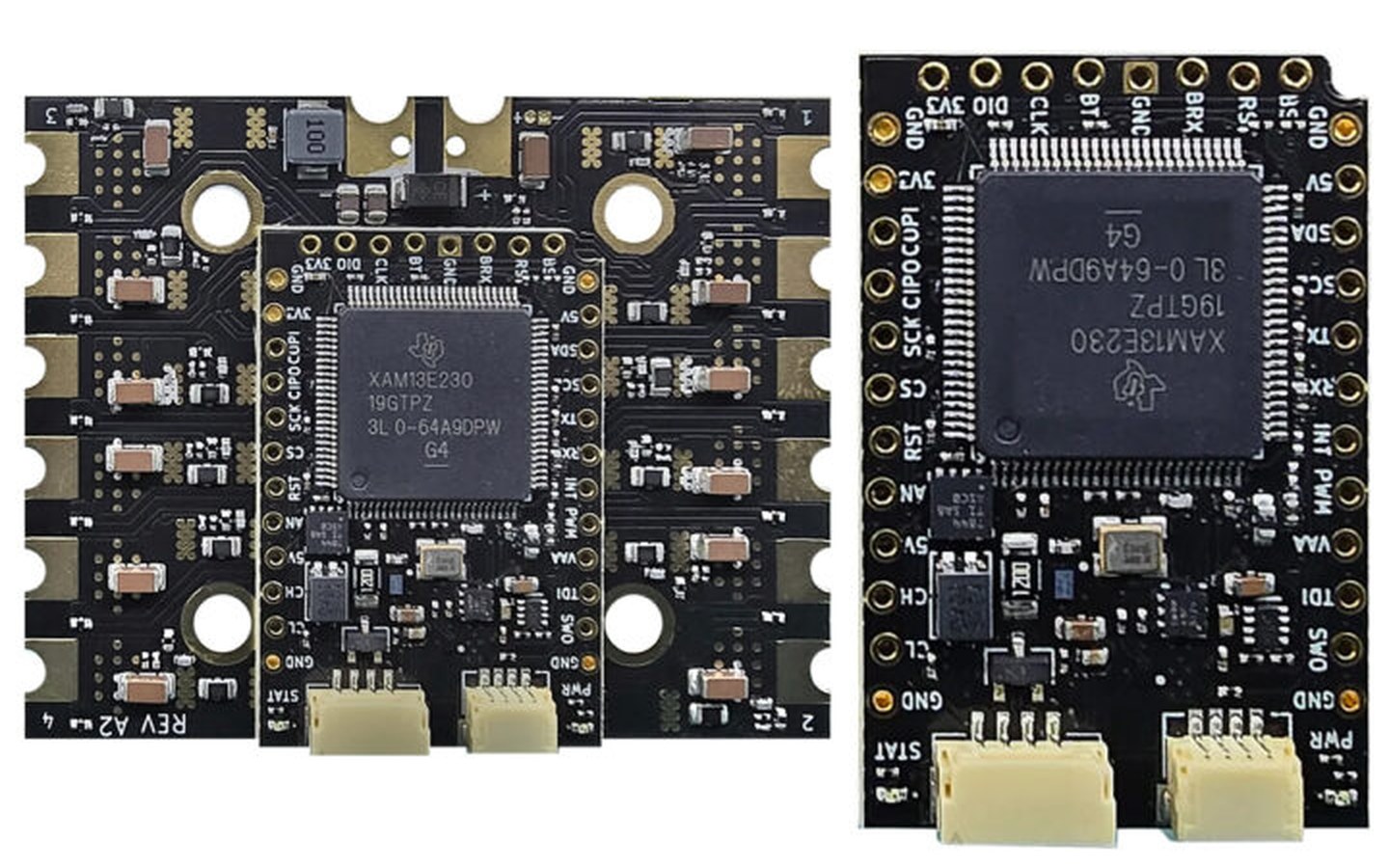
BeagleBoard.org is pairing a TinyEngine-equipped Cortex-M33 module with a quad BLDC carrier, and the result is a board that looks ready for robotics experiments even if the AI story is still mostly hardware promise. CNX Software reports that the new BeagleConnect QuadESC is an open-source 4-channel BLDC motor controller/carrier built around the BeagleConnect Torque system-on-module.
The Torque module: a small edge-AI motor brain
At the center is TI's AM13E23019 Arm Cortex-M33 running at 200 MHz with an FPU, 128 KB SRAM, 512 KB flash, a trigonometric math unit, and a TinyEngine neural-network accelerator. That NPU is the interesting part for edge inference. The module also packs three 12-bit ADCs, motor-control PWM, CAN FD through a TI TCAN844 transceiver, UART/SPI/I²C, a 100-pad LGA interface, a Qwiic connector for 3.3 V I²C accessories, and hardware security features including secure boot and cryptographic acceleration. It's a 25.4 × 38.1 mm four-layer PCB, so it's small but not a bare microcontroller.
- 200 MHz Cortex-M33 with FPU and trigonometric math unit
- 128 KB SRAM / 512 KB flash
- TinyEngine NPU plus three 12-bit ADCs and motor-control PWM
- CAN FD, UART, SPI, I²C, Qwiic expansion
The QuadESC carrier: four motors, lots of sensing
The QuadESC carrier board measures 60 × 48 mm and is aimed at robotics, drones, and other multi-motor systems. It accepts 3S to 6S batteries (9–25.2 V) and supports four independent three-phase BLDC channels. Each channel uses a TI DRV8323SRTAR gate driver, with 12 CSD88599Q5DC half-bridge devices in total across the board. Sensing is dense: 12 low-side phase-current channels, 12 phase-voltage channels, four NTC temperature sensors near the power stages, and battery-voltage monitoring. BeagleBoard lists design targets of 40 A continuous and 70 A burst per motor, but those are not verified operating ratings, and no burst duration is specified; real thermal limits will depend on cooling and load. An 8-pin flight-controller connector carries four DShot routes, telemetry, current reporting, and battery voltage, while a 10-pin debug header exposes SWD access.
Power path: the board has a 32 V design maximum, but it's not recommended as an operating voltage; the TI TPS54360B buck regulator and TI TPS7A4701 analog regulator handle controller and analog rails. The Torque module itself expects regulated carrier power, a separate analog reference for ADC measurements, and a 5 V supply for CAN.
Software state: SDK is there, firmware is not
TI provides a ROM bootstrap loader so firmware can be loaded over CAN, I²C, or UART, and the AM13E2X SDK includes drivers, examples, SysConfig, and FOC development tools. SWD debugging works through TI's XDS110 and Code Composer Studio; Zephyr RTOS and OpenOCD support are planned. But the QuadESC does not ship with ready-to-use motor-control firmware. Developers still need to write gate-driver setup, current sensing, fault handling, FOC, DShot decoding, telemetry, and any AI-based fault detection themselves. That keeps the platform genuinely open, but it also means the TinyEngine accelerator's value remains speculative until someone demonstrates an on-device model. BeagleBoard.org has released KiCad hardware designs, firmware sources, and documentation on GitHub, but pricing and availability for the QuadESC and Torque have not been announced.
This is a hardware-ready board for edge robotics experimentation, but the AI half is an invitation, not a shipped feature.