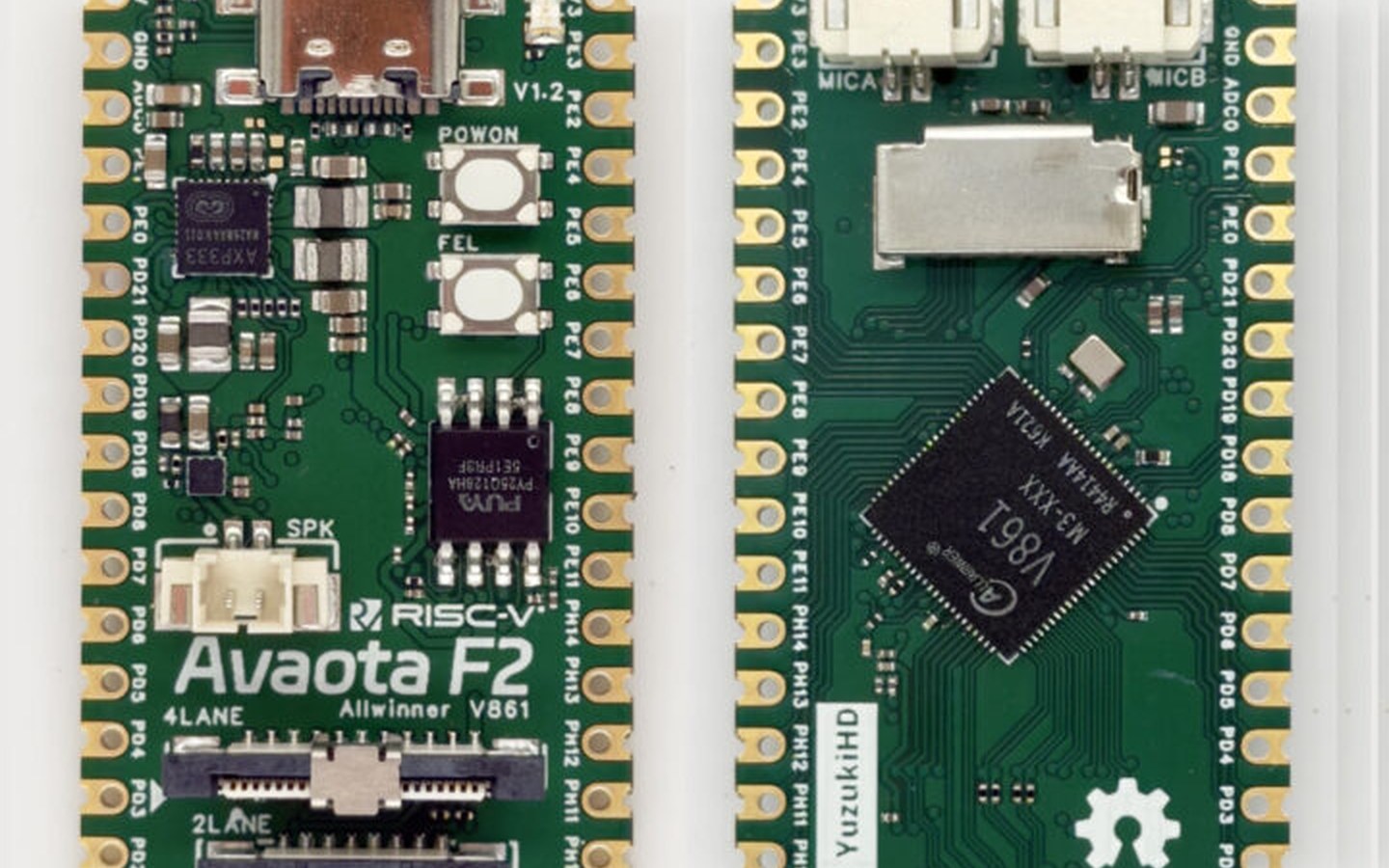
CNX Software reports that the Avaota F2 is the first single-board computer built around Allwinner's V861 dual-core 64-bit RISC-V SoC, a chip aimed squarely at intelligent camera applications. It follows the earlier Avaota F1, trading built-in WiFi for a stronger focus on motorized PTZ (pan-tilt-zoom) vision systems, broader camera support, and improved audio.
A tiny RISC-V vision engine
The board is remarkably compact at roughly 40 x 22 mm on a 6-layer PCB, yet it integrates a surprising amount of processing power. At its core are two RISC-V XuanTie C907 cores running up to 1.4 GHz with RVV 1.0 vector extensions, plus a single XuanTie E907 core at 800 MHz. On-chip memory includes 128 MB DDR3, and a dedicated 1 TOPS INT8 NPU marketed as “AI-ISP 2.0” handles real-time inference.
Video capabilities are equally focused on camera workloads. The VPU can encode H.264/H.265 at up to 4K 25 fps and MJPEG at up to 8192 × 8192, while decoding MJPEG at 1080p60. Two MIPI CSI connectors—one 4-lane and one 2-lane—support the GC2083 sensor at 1920 × 1080 30 fps and the GC8613 at 3840 × 2160 15 fps, giving developers a choice between Full HD smoothness and 4K resolution.
Expansion aimed at moving cameras
The F2 is more than a fixed sensor board. Its expansion options are clearly tuned for pan-tilt-zoom and portable robotics:
- Two 17-pin headers provide up to 28 GPIO for custom peripherals
- Eight castellated motor-control holes sit ready for direct PTZ motor wiring
- A speaker connector and two microphone connectors enable two-way audio and voice-triggered AI
- SPI display support includes a 3.5-inch 320 × 480 panel and a 1.54-inch 240 × 240 panel
- Storage comes from 16 MB NOR flash and a microSD card slot
Power comes from 5 V USB-C using an AXP333 power management chip that can also drive PTZ motors. Debugging is handled over UART and ADB USB, and a dedicated FEL button simplifies firmware flashing. The main trade-off against the older F1 is the loss of WiFi, which may matter for wireless deployments, but the motor-control and audio gains are significant for active camera rigs.
Open hardware with a software gap
The Avaota F2 is fully open-source hardware: PDF schematics, EasyEDA Pro PCB files, Gerber files, a 3D STEP model, BOM, and pick-and-place instructions are available on GitHub under a CC0 license. Software information is thinner. A developer screenshot shows OpenWrt 21.04 (fork) with Linux 6.6 running through Allwinner's Tina Linux SDK, but the documentation is currently Chinese-only, which could slow early adoption outside that language community.
The board is listed at $51.59 on AliExpress from “Chip Board House Store,” a seller known for marking up hardware. An optional Avaota Hypercard CKLink JTAG/serial debug board costs $27.89. For portable AI developers, the combination of a 1 TOPS NPU, 4K encoding, dual cameras, audio I/O, and PTZ motor control in a tiny open footprint is compelling—but software maturity and documentation will determine how quickly it moves beyond early adopters.