A Controller You Can Actually Read
Hackaday recently featured SPSO — Swimming Pool System Open — an open-source pool automation controller from maker [ingTacchelli]. The project starts from an unglamorous premise: a neglected pool quickly becomes a “fetid, bacterial soup.” The design goal is deliberately modest — simple, low-cost, and easy to understand — but the engineering underneath is more serious than the name suggests.
The heart of the system is a custom board built around an ESP32-S3 microcontroller. It reads pH and chlorine probes, plus temperature, filter pressure, flow, and tank level sensors, then drives dosing and filtration pumps to keep the water within safe chemical ranges. The real challenge is not reading a sensor or turning on a pump; it is making sure a software bug or sensor failure never results in an unsafe chemical condition. The project explicitly calls out careful attention to avoiding dangerous over-dosing, which puts it in the small category of home automation where a logic error can physically hurt someone.
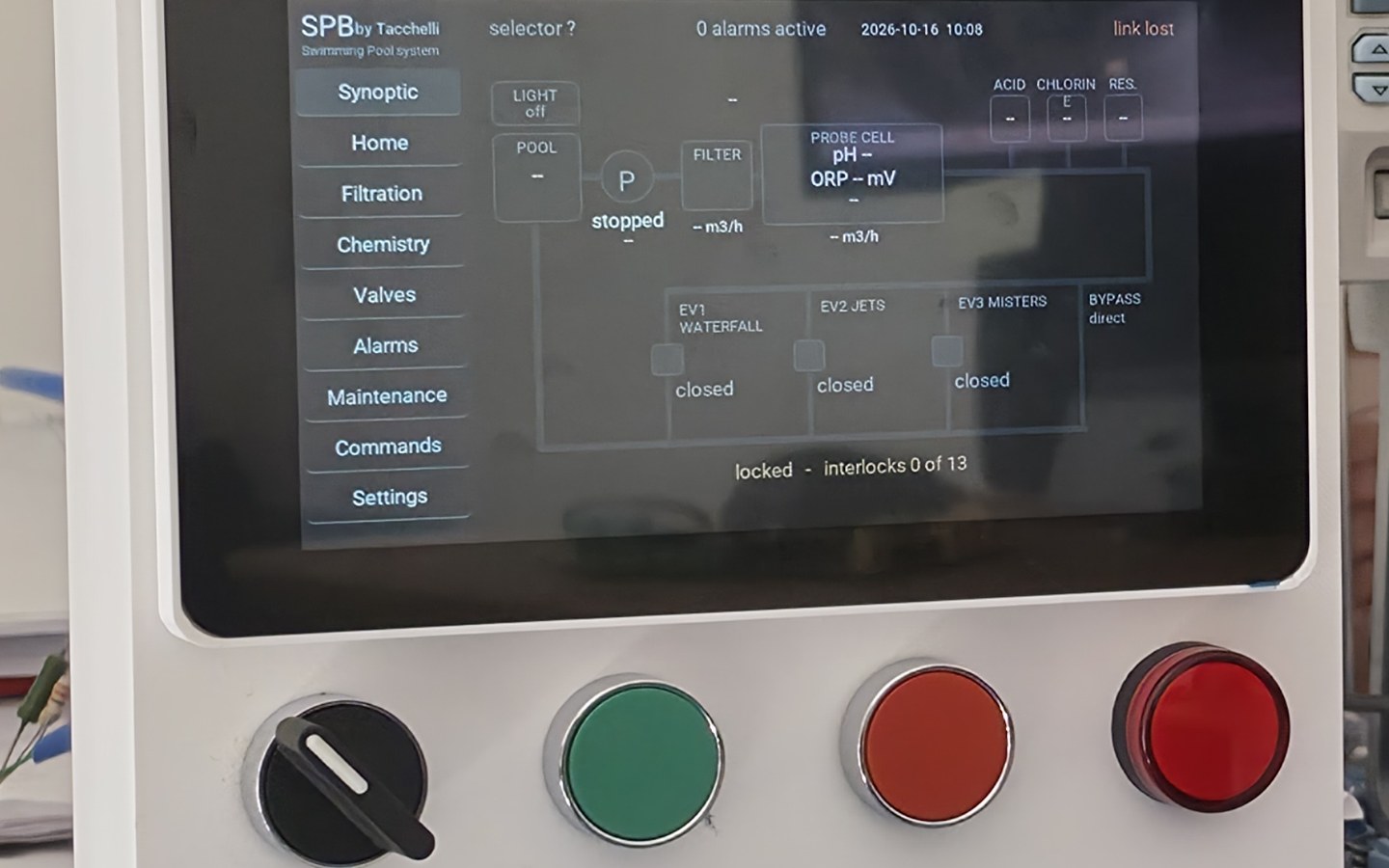
SPSO’s interface is a 7-inch Waveshare touchscreen mounted at the equipment pad. The system works without a phone, an account, or an internet connection, and Home Assistant support is offered as an option rather than a requirement. Design files are published on GitHub for anyone who wants to build or modify the controller. That local-first pattern — MCU, probes, pumps, touchscreen, optional hub bridge — has become the default among hobbyist automation builders who care about resilience.
Local Screen First, Cloud Optional
What Hackaday’s write-up makes clear is that SPSO is not an AI system. There is no model, no inference, no learning loop. It is sensor polling plus rule-based control, which is exactly what most real-world embedded automation still looks like. The relevance to the portable-computing conversation is architectural rather than algorithmic. A sub-$50-class MCU with a local display and an optional hub bridge is the same hardware stack that edge AI projects increasingly target. The safety-first, offline-capable design instincts transfer directly to any project where a failed cloud service or a hallucinated output could have physical consequences.
Hackaday notes the publication has covered similar builds before, and the pool, garden, and aquarium corner of the maker world keeps producing them. The recurring domains include:
- Swimming pool and spa chemical dosing
- Garden irrigation and nutrient delivery
- Aquarium and fish tank monitoring
- Hydroponic and greenhouse control
Each of these shares the same constraint: a small sensor-to-actuator loop that must keep working even when the network does not.
Why This Stack Matters Beyond Pool Decks
SPSO is a complete, reproducible local-first automation stack in a domain where failure has physical consequences. That is the same constraint set edge AI deployments face outside hobby projects. The design choices — local display, safety interlocks, optional cloud bridge, simple MCU — are not expensive or exotic. They are a reminder that reliable automation often means less software, fewer dependencies, and a direct path from sensor to action. For anyone building a portable or edge system that touches the real world, SPSO is a useful reference design, not because it is clever, but because it is boring in the right ways.