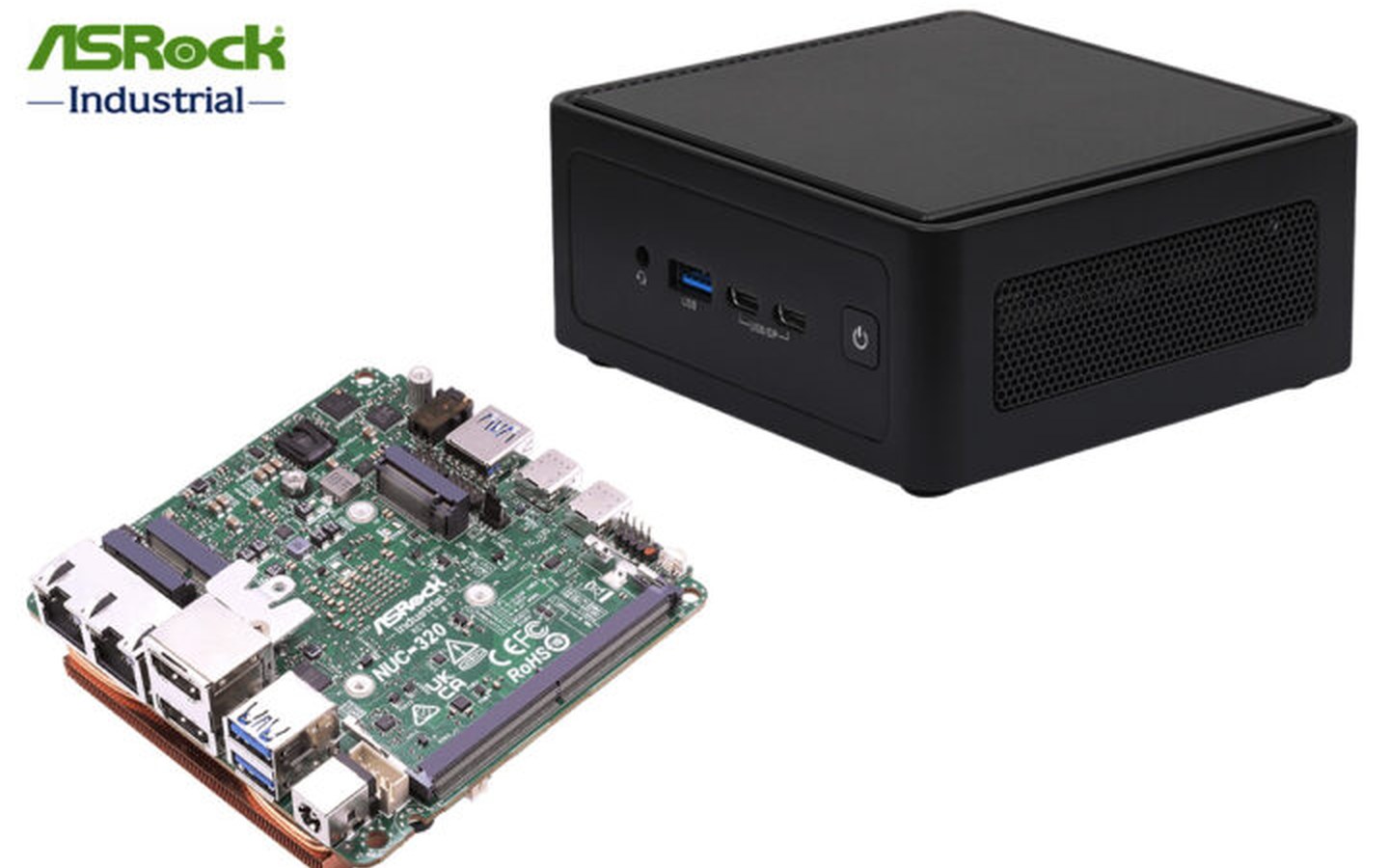
ASRock Industrial has introduced a new NUC Core 300 family aimed at compact edge AI and industrial systems. As CNX Software notes, the lineup includes two mini PC boxes—NUC BOX-320 and NUC BOX-304—and two corresponding bare motherboards, NUC-320 and NUC-304. All four are built around Intel’s Core Series 3 “Wildcat Lake-U” processors, but the two SoC choices split the family into a performance tier and a lower-cost tier.
Two chips, two form factors
The higher-end options use the Intel Core 5 320, a six-core part with two P-cores clocked up to 4.6 GHz and four low-power efficient cores up to 3.4 GHz. Its integrated GPU is a two-core Intel Xe3 unit rated at 20 TOPS, and the NPU contributes up to 16 TOPS for local inference. The more affordable Core 3 304 steps down to five cores—one P-core up to 4.3 GHz and four LPE-cores up to 3.3 GHz—with a single-core Xe3 GPU at 9 TOPS and a 15 TOPS NPU.
Both chips are soldered onto small boards. The fanned BOX models measure 117.5 × 110 × 49 mm and weigh about 1 kg, while the standalone boards are 104 × 102 × 38 mm. Every SKU supports up to 64 GB of DDR5-6400 through a single 262-pin SO-DIMM, with In-Band ECC enabled across the range. Storage is handled by two M.2 Key M slots: one PCIe Gen4 x1 (2242 length) and one PCIe Gen4 x2 (up to 2280). The BOX models can run RAID 0/1 across both slots, and the bare boards add a SATA 3.0 header.
I/O tuned for embedded duty
The NUC Core 300 series stresses practical connectivity over raw expansion. Both BOX and board versions include:
- Dual 2.5GbE: one port driven by an Intel I226-V controller and the other by a Realtek RTL8125BG, giving redundancy or link aggregation without an add-in card.
- Wi-Fi 6E and Bluetooth 5.3, with the wireless module pre-installed on the BOX units; the boards expose an M.2 Key-E slot for the same module.
- Triple 4K display support via two HDMI 2.1 ports and two USB-C ports with DisplayPort Alt Mode, all capable of 4Kp60.
- USB 3.2 Gen2x2 Type-C ports on the front with 5V/3A power output, plus three USB 3.2 Type-A ports and internal USB 2.0 headers on the board models.
Power input runs from 12 V to 24 V DC, with support for both AT and ATX power-on behavior, which suits vehicle or industrial power rails. The BOX systems include a 19 V / 90 W adapter and a VESA mount. Temperature ratings reflect the split: fanned BOX models are rated for 0°C to 40°C, while the bare boards stretch from -20°C to 70°C—handy for sealed or fanless builds. A COM header supporting RS-232/422/485 appears on the motherboards only.
Software and market position
ASRock lists Windows 10 and Windows 11 for the BOX systems, but leaves the bare boards without a specified OS. Linux is not officially certified, though CNX Software points out that Wildcat Lake already has upstream kernel, Mesa, and Intel NPU driver support, so a recent distribution should handle the platform well. That matters because the NPU is the main edge-AI hook here: 15–16 TOPS is enough for lighter vision and sensor-processing workloads without a discrete accelerator.
ASRock Industrial has not announced pricing. The BOX units are barebones—no RAM or storage included—so buyers will need to add those parts. The NUC Core 300 series slots beneath the company’s higher-end NUC(S) Ultra 300 boards based on Panther Lake, creating a more affordable path into compact x86 systems with an integrated NPU, dual network ports, and wide-voltage input.