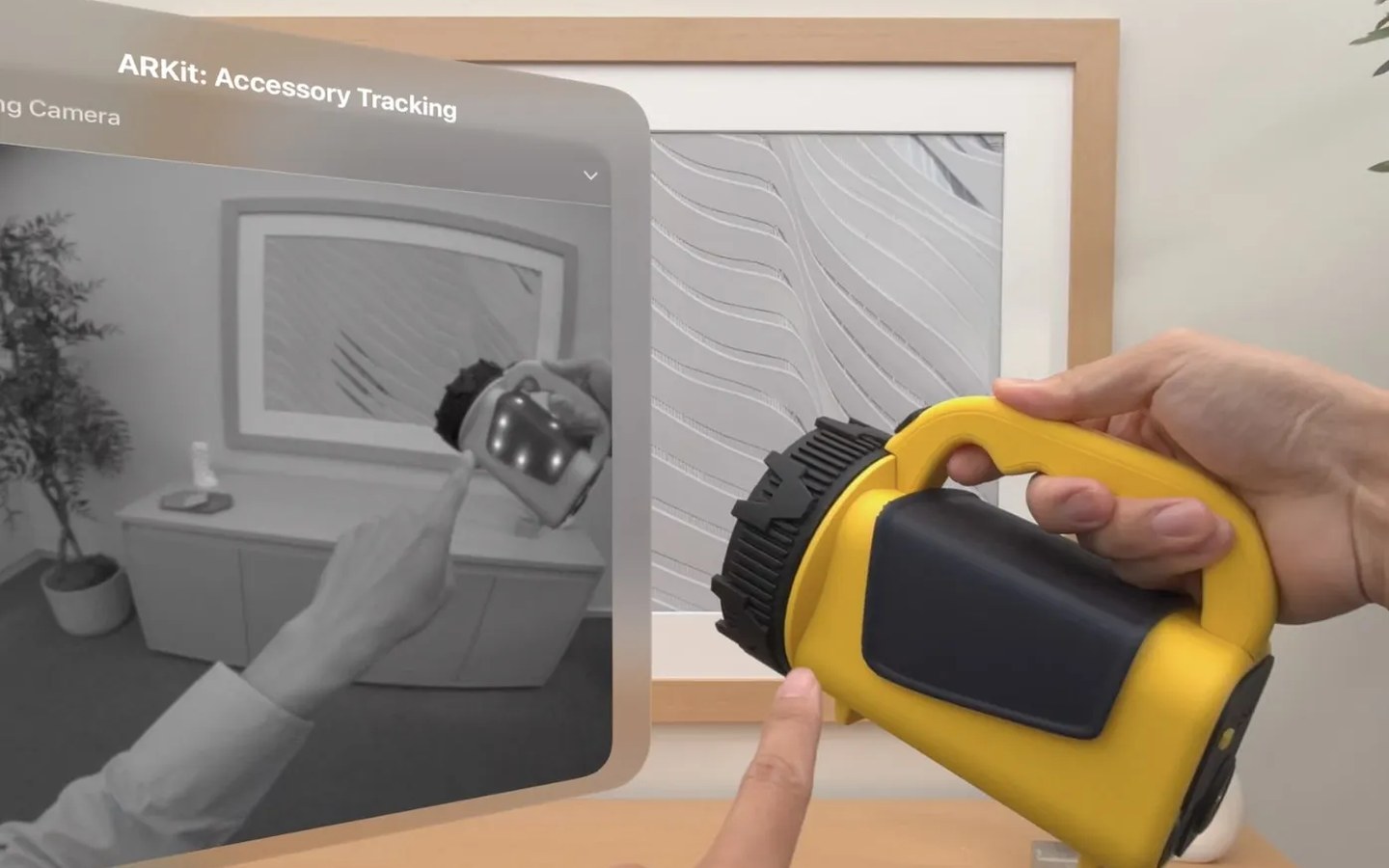
With the introduction of visionOS 27, Apple is opening the door for third parties to make their own high performance tracked controllers and accessories for Vision Pro.
VisionOS 27, available to developers starting today, adds new support for actively-tracked accessories like motion controllers, which Apple is calling ‘spatial accessories’. Prior updates to visionOS allowed for passively-tracked objects which were tracked by their appearance but did not actively communicate with the headset. On the other hand, visionOS 27 allows Vision Pro to track accessories based on known IR LED patterns and positional data streamed from an accessory’s on-board IMU via Bluetooth. Spatial accessories can also send input data from things like buttons and thumbsticks, as detailed in a newly released developer session from Apple .
The combination of IR LEDs and an IMU is the defacto standard for tracking VR motion controllers. This approach enables greater precision and lower latency than trying to passively track an object based on its geometric shape alone. The IR LEDs are more robust to various lighting conditions while the IMUs can provide hundreds of updates per second, increasing accuracy by offering more recent updates about the motion of the controller. Apple says spatial accessories will be able to track up to the display rate of the headset (nominally 90Hz, but possibly up to 120Hz).
While this news doesn’t mean that you’ll be able to connect any old VR controller to Vision Pro, it does mean that it’s possible for the companies that make controllers (or other tracked accessories) to add official Vision Pro support for their current or upcoming products. Apple says that a spatial accessory’s tracking profile can be included in a visionOS app which “registers your accessory system-wide, so any app on Apple Vision Pro can use it.” However, third-party tracked accessories made in this way won’t be able to support the full VisionOS interface like the PSVR 2 controllers and Logitech stylus that Apple made official Vision Pro accessories last year.
Apple also revealed that it has been working with companies DFRobot and MIKROE to create off-the-shelf trackers, which can be used as “reference hardware and development kits” for building Vision Pro compatible tracked accessories.
The trackers will be available “later this year,” though other details like pricing were not shared in the session.
In addition to adding support for actively tracked spatial accessories, VisionOS 27 also improves upon existing support for passively tracked objects. Apple says a new high frame-rate tracking mode and extended training for tracking models bring lower latency and more reliable object tracking to the headset.
Apple has completed a full come about on motion controllers for Vision Pro. When the headset first launched, the user’s hands (and technically their eyes too) were the only tracked input device. That flew in the face of nearly every major AR and VR headset that launched before Vision Pro, and ensured that most of the best regarded VR games at the time would have no chance of running on the headset. This surely wasn’t an oversight by Apple, but rather an intentional choice.