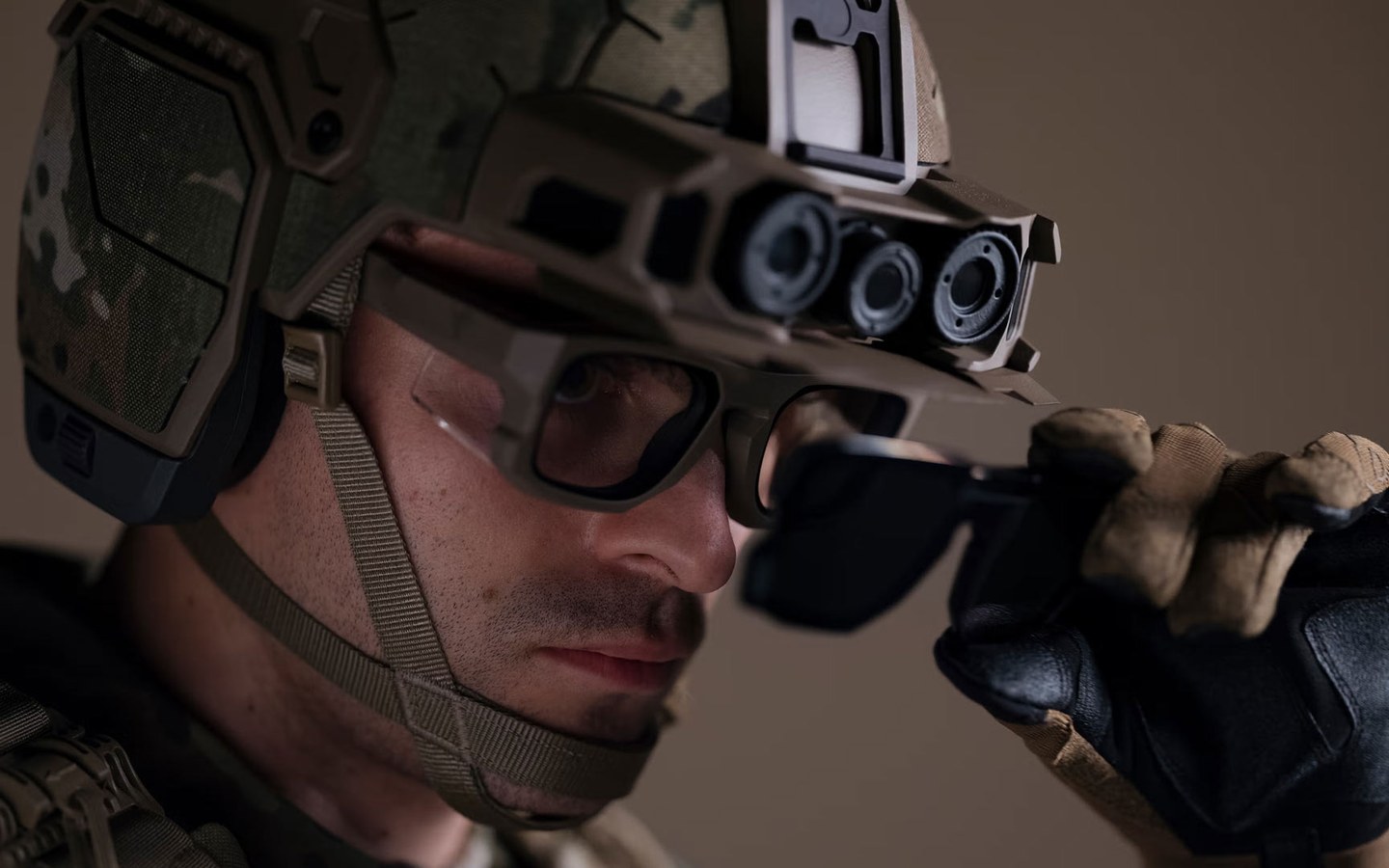
Anduril’s newest glimpse of its EagleEye XR glasses isn’t just a night-vision demo—it’s a window into how wearable computing will fuse real-time data, AI, and natural interactions into a single, lightweight package. The defense startup founded by Palmer Luckey recently showed off EagleEye’s 84-degree field of view digital night vision, alongside stereo thermal fusion and a 4K display, underscoring a generational leap over traditional binocular systems like the PVS-31. But what makes it relevant beyond the battlefield is the thoughtful integration of sensors, AI, and minimalist controls that quietly sketches a blueprint for the next wave of portable AI.
Side-by-side footage comparing EagleEye to a standard PVS-31 makes the difference stark: one looks like peering through soda straws in green-tinted monochrome, the other opens a wide, high-resolution window that layers thermal imagery over low-light detail. Anduril achieves this by moving the heavy lifting—low-light and thermal sensors—off the headset and onto a helmet-mounted sensor suite, then streaming processed data to a pair of AR glasses that also provide ballistic and laser protection. This split architecture keeps the glasses light while delivering rich information to the wearer’s eyes.
On the software side, EagleEye taps into Anduril’s Lattice AI network, a mesh of surveillance nodes and defense devices that can inject object labels, route overlays, and threat cues directly into the user’s view. The result is a fusion of analog reality and digital intelligence that feels less like a gadget and more like an extended perceptual layer. For a soldier on patrol, that might mean seeing a heat signature of a hidden figure outlined in the dark, with a discreet icon flagging it as "unknown contact," all without taking a hand off a weapon.
That hands-free philosophy extends to input. Anduril has described an interaction model built on plain-language commands, eye tracking, and subtle taps—a triad that sidesteps the clumsy, attention-sucking menus that plague current AR efforts. For portable AI, this is a critical detail. When a system knows what you’re looking at and can accept a whispered instruction or a finger tap, the barrier between thought and action shrinks dramatically. Imagine a field technician glancing at a piece of equipment and murmuring, “Show me the last maintenance log,” or a warehouse worker navigating a pick list with nothing more than eye movements and a tap on the temple.
The business context reinforces the momentum. Anduril took over the U.S. Army’s troubled $22 billion IVAS contract from Microsoft earlier this year, and is now competing for the Soldier Borne Mission Command project with a coalition of partners that includes Meta, Oakley Standard Issue, Qualcomm, and Gentex. This mix of consumer tech muscle and defense-hardened engineering suggests a faster, less exotic path to production than the fully custom hardware of the past, with potential trickle-down into civilian wearables.
Yet the system also surfaces a key tension for portable AI: information overload. As one former Marine noted in the original Road to VR coverage, “More data doesn’t mean more clarity—it can mean more confusion if it’s not filtered well.” EagleEye’s promise hinges on the Lattice AI’s ability to prioritize only the most relevant signals, maintaining a calm, uncluttered interface even when the underlying data streams are frantic. Get that right, and you have a template for any wearable that aims to be a helpful companion rather than a distraction engine. Get it wrong, and users will simply disconnect.
What Anduril is demonstrating with EagleEye—wide-field sensor fusion, AI-driven reality editing, natural multimodal input—isn’t fundamentally military. It’s a portable computing idea that will eventually live in safety glasses on a construction site, in goggles for search-and-rescue, and perhaps one day in the smart specs we all wear. The first version may be for soldiers, but the long-term heirs will be anyone who needs to keep their hands free and their attention on the world, with an invisible AI assistant whispering useful context into their ear.