From exclusive sessions to bounded volumes
UploadVR reports that Android XR has moved beyond exclusive OpenXR sessions with support for the OpenXR Spatial Container extensions, now available on devices at Spatial API Level 4 or higher. The catch: it applies only to apps running in Full Space mode, not the system's Home Space multitasking environment.
Spatial Containers are effectively 3D windows. Android XR controls their chrome and placement, while an app can render volumetric content inside a bounded volume or transition to an unbounded immersive mode when needed. Once a container has focus, users interact directly with the 3D scene through:
- Hand tracking
- Eye gaze
- 6DoF controllers
This breaks the old binary where 3D content had to own the headset or stay locked away. Developers can now combine Jetpack Compose UI, standard 2D Android activities, and OpenXR-based 3D scenes in one application. Rendering can come from Unity, Godot, or native OpenXR code — exactly the "multi-engine experiences" Google previewed at I/O earlier.
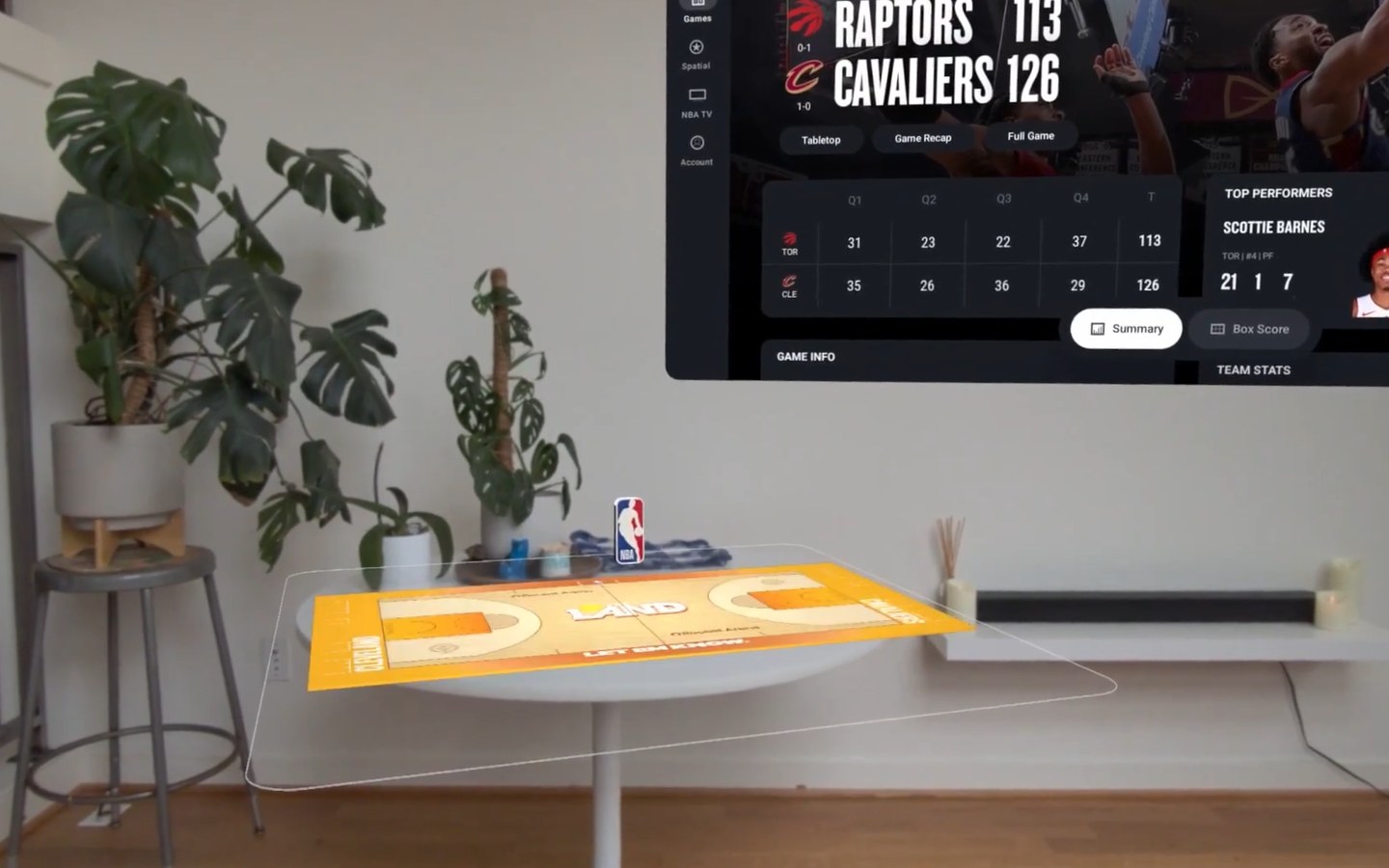
NBA's Court View shows the practical payoff
The first high-profile demonstration is the NBA app. Its main interface is built with Jetpack Compose, but select games now show a volumetric 3D court scene rendered in Unity. The feature is called Court View, and it mirrors the Tabletop mode the NBA app introduced on Apple Vision Pro. For viewers, this turns a game into a miniature arena that can be inspected from different angles while the rest of the app stays in ordinary Android UI.
That is the meaningful shift: 3D no longer has to be an app's entire reason for existing. It can be a component — a scene, a model, or an interactive diorama — inside software that still looks and behaves like an Android app. Google's earlier phrasing, "multi-engine experiences," is more accurate than "spatial multitasking."
A narrower step than the standard suggests
The limitation is architectural. Spatial Containers on Android XR require Full Space Managed mode, not Home Space. In practice, a single app can open several Spatial Containers and place volumetric content inside them, but those containers cannot appear alongside windows from other apps. UploadVR notes a demo of the hello_xr sample hiding Chrome and Files windows entirely once the session starts.
That leaves Android XR short of the cross-app spatial model found elsewhere:
- visionOS uses Shared Space and RealityKit so windowed and volumetric apps can run together and transition into Full Space.
- Pico OS 6, coming on the Pico Space Pro, is positioning itself as a full spatial multitasking environment.
- Android XR's current implementation enables multi-engine apps, not concurrent 3D content from multiple apps.
So this is real progress: the windowing model for 3D content now exists on Android XR, and the NBA app proves it can ship. But for now, the standard's potential outruns the platform's actual multitasking behavior. Spatial Containers are a foundation, not yet the finished spatial computing layer.