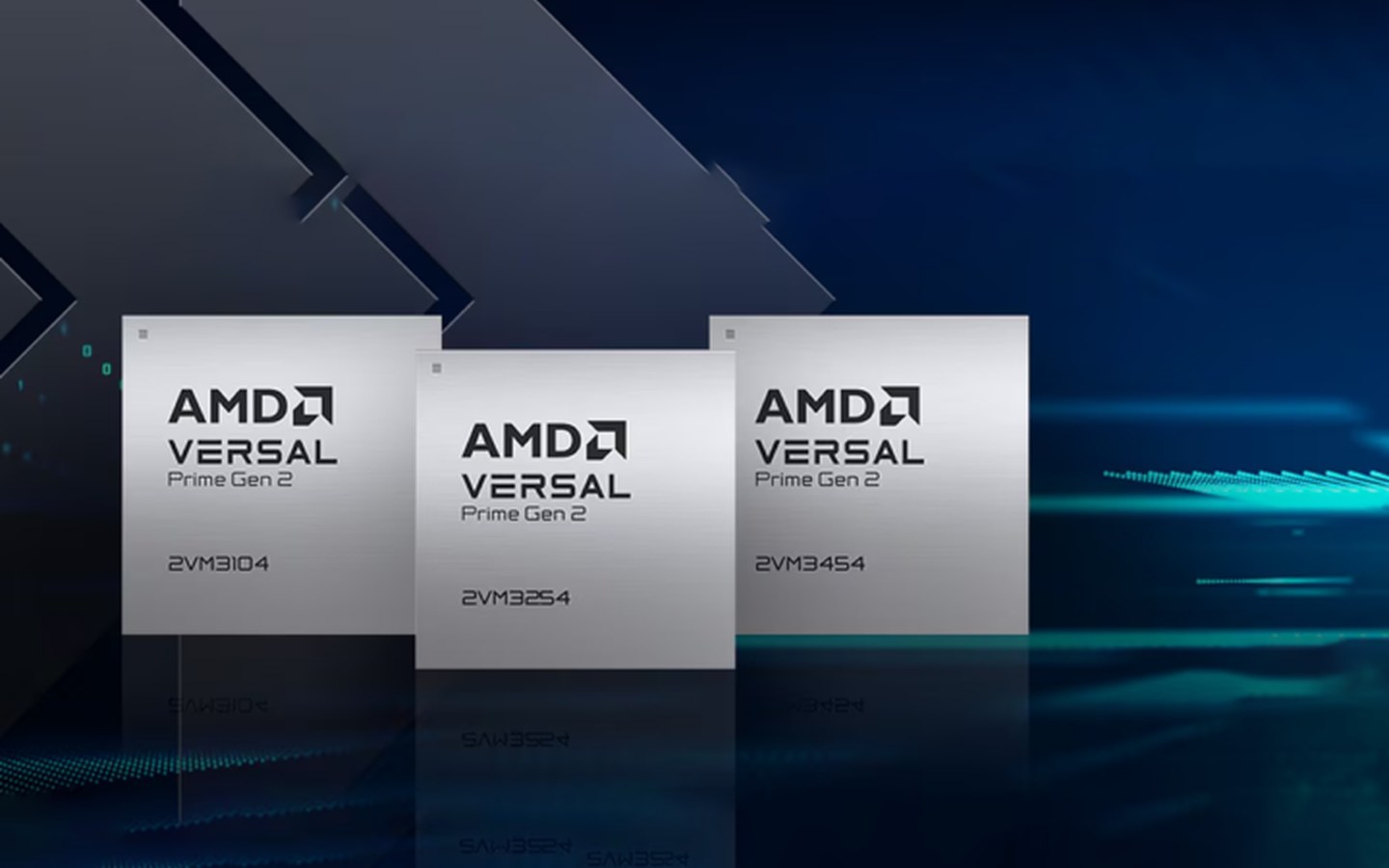
The quest for more processing power in ever-smaller packages just took a significant leap. AMD has quietly added three new members to its Versal Prime Series Gen 2 family—the 2VM3454, 2VM3254, and 2VM3104—and they’re designed explicitly for reality where every millimeter matters. With packages dropping as low as 23×23 mm, these chips target space-constrained applications that still demand heavy computational muscle: think professional AV gear, broadcast equipment, and industrial IoT devices that need to run machine learning or complex sensor processing at the edge.
The numbers tell a striking story. Despite their diminutive footprints, these SoCs pack a quad-core Arm Cortex-A78AE application processor alongside a hexa-core Cortex-R52 real-time cluster, pushing scalar compute to a claimed 100K DMIPS—roughly a fivefold jump over previous-generation AMD adaptive SoCs. That kind of headroom means a single chip can now handle both the heavy lifting of Linux-based applications and the deterministic, low-latency tasks that usually require a separate microcontroller or safety controller. And for applications where video is central, the 2VM3254 and 2VM3454 integrate a hardened video codec unit that handles HEVC and AVC encode/decode at up to 4K60, 4:4:4, 12-bit—no external accelerator required.
But the real differentiator here is the programmable logic fabric. The top-end 2VM3454 offers up to 564,760 system logic cells and 1,140 DSP engines, which means developers can weave custom hardware pipelines for image processing, neural network inference, or sensor fusion directly into the silicon. Because the logic is reconfigurable, algorithms can evolve over time without a board respin—a crucial advantage in fields where standards shift or where on-device learning is becoming a requirement. The smaller siblings trim that fabric proportionally, but even the entry-level 2VM3104 retains enough programmable logic to make a meaningful difference in a 23×23 mm package.
Memory and connectivity are equally forward-looking. Support for DDR5 up to 6400 Mb/s and LPDDR5X up to 8533 Mb/s gives developers bandwidth headroom that was once reserved for larger form factors. Up to two 100G Multirate Ethernet MACs on the 2VM3454 and built-in PCIe Gen5×4 controllers on the higher-end models ensure these devices can sit at the center of data-intensive pipelines without choking on throughput. And crucially, the chips carry built-in safety features up to ASIL D/SIL 3, which eliminates the need for an external safety controller and further shrinks the overall system footprint.
What makes this launch particularly interesting for the portable AI audience is the combination of that compact size with the heterogeneous compute architecture. Edge devices often need to perform real-time sensor processing, run lightweight AI models, and manage connectivity—all within a strict power and thermal envelope. A chip that merges an Arm Mali-G78AE GPU (for display or graphics acceleration), the real-time cluster, and the programmable logic offers a single-package solution that can replace several discrete components. Developers get a unified toolchain through Vivado and Vitis, while Linux support via AMD’s Yocto-based Embedded Development Framework provides a production-ready BSP with drivers for video, GPU, and high-speed memory.
Sampling timelines matter, too. Early access design tools are already available for the previously released 2VM3654, and the 2VM3454 is expected to sample later in 2026, with the smaller 2VM3254 and 2VM3104 following in 2027. Because these new chips share the same footprint as the 2VM3654, they can be dropped into existing board designs with minimal rework, offering a path to lower cost or lower power without a layout overhaul.
For teams building the next wave of compact, intelligent devices—whether that’s a portable medical imager, an autonomous drone controller, or a multi-function broadcast camera—these new Versal Prime Gen 2 chips lower the barrier to high-performance adaptive computing. They’re a reminder that the most interesting advances don’t always come from chasing the absolute pinnacle of transistor counts; sometimes, it’s about fitting exactly the right compute where it’s needed most.