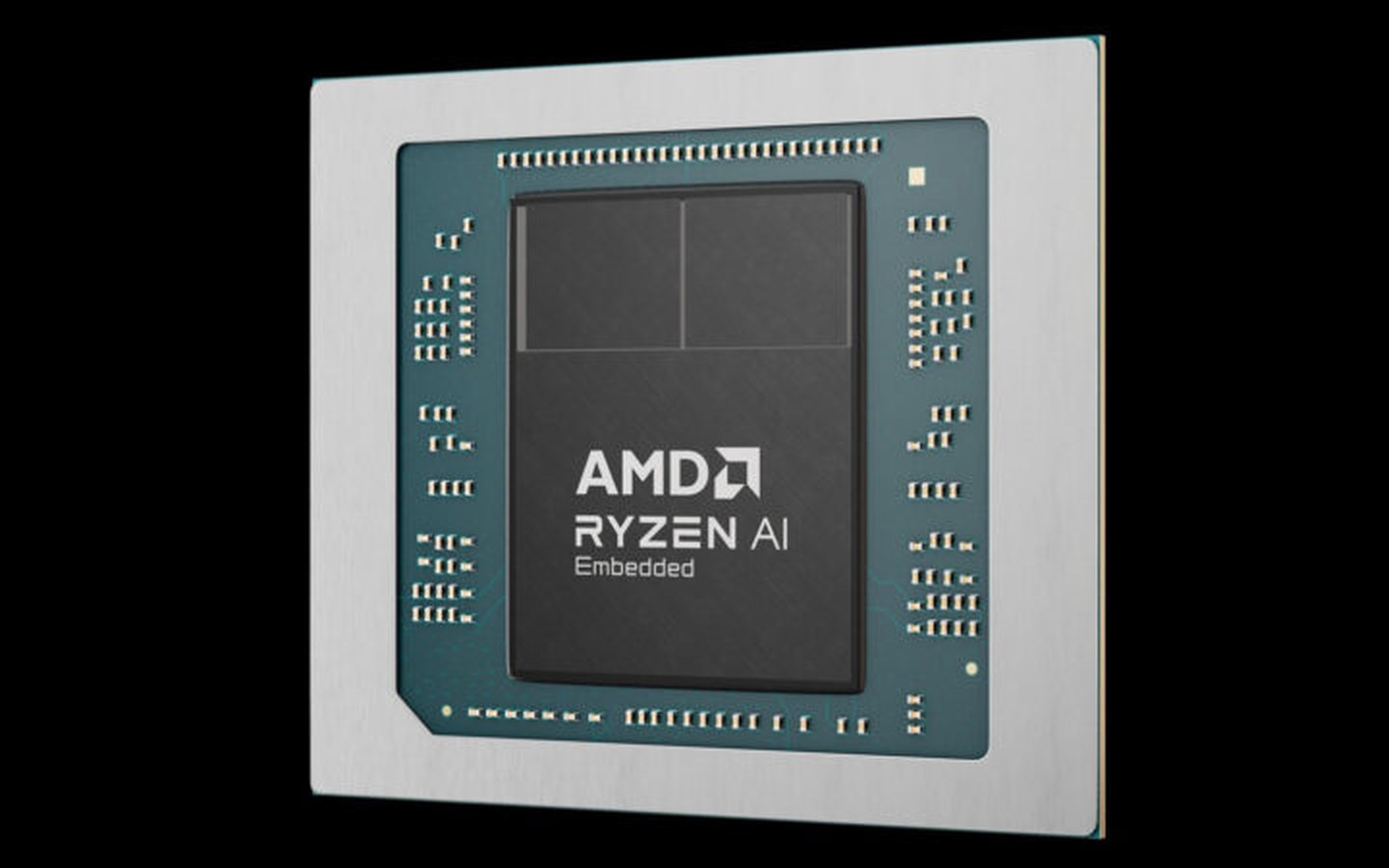
AMD has fleshed out its embedded AI lineup with a family of processors, a system-on-module, and a developer kit that squarely target physical AI and robotics. Announced at the company’s Advanced AI 2026 event, the new Ryzen AI Embedded X100 Series processors, Kria AI SOM, and Kria AI Robotics Developer Platform are built for workloads that fuse real-time sensor processing, computer vision, and AI inference at the edge.
Processors Packed for Physical AI
The Ryzen AI Embedded X100 family consolidates the company’s latest IP into a 55-watt thermal envelope. Six models span consumer and industrial temperature ranges, all assembling Zen 5 CPU cores, an RDNA 3.5 integrated GPU, and an XDNA 2 neural processing unit rated for up to 50 TOPS of AI performance. Memory support reaches LPDDR5x-8533 across up to eight channels with Link-ECC, video engines handle encode/decode at 4K60, and display pipes drive up to five independent outputs at 8K60.
- AMD Ryzen AI Embedded X199 / X199i – 16 cores, max freq 5.1 GHz, 40 GPU CUs, 0–105 °C (X199) or -40–105 °C (X199i)
- AMD Ryzen AI Embedded X188 / X188i – 12 cores, max freq 5 GHz, 32 GPU CUs, same temperature options
- AMD Ryzen AI Embedded X168 / X168i – 8 cores, max freq 5 GHz, 32 GPU CUs, same temperature options
AMD claims a 2.1× multithread CPU lead over Intel Core Ultra Series 3 processors (CoreMark), a 1.7× graphics boost in GFXBench 5.0, and 3.5× higher token generation throughput with a 1.4× faster time-to-first-token on LLM inference. Against the NVIDIA Jetson Thor T5000, peak FP32 performance is 3× higher, and on medical beamforming workloads the integrated GPU outperforms a discrete NVIDIA RTX 4000 Ada by an average of 1.7×. These numbers position the X100 family for robotics, industrial automation, healthcare imaging, UAVs, and interactive media. Mass production is slated for Q4 2026, with silicon sampling since June 2026 and a planned availability window stretching to 2037.
A Module and Dev Kit Built for Robotics
Alongside the processors, AMD introduced the Kria AI SOM, a COM-HPC module that drops a 16-core X100 (likely the top-end X199) into a compact form factor with 64 GB or 128 GB of unified LPDDR5x memory. Unlike earlier Kria modules, the SOM itself contains no FPGA; instead, the accompanying Kria AI Robotics Developer Platform integrates a Spartan UltraScale+ FPGA on the carrier board, handling deterministic I/O and low-latency control paths.
The developer platform embraces high-bandwidth vision and connectivity:
- Up to 8 camera inputs via FAKRA connectors supporting GMSL2/3 links
- 2× 5GbE and 2× 1GbE Ethernet ports (the latter with EtherCAT/TSN)
- 10GbE via QFSP cage, optional Wi-Fi, and multiple USB4/USB 3.2 ports
- M.2 slots for NVMe SSD and Wi‑Fi/BT, plus Pmod and OCuLink expansion
Real‑world benchmarking with the mimik Agentix suite suggests the SOM can sustain 234 concurrent agents, while a Bosch Rexroth controller test demonstrates 8,000 decisions per second. The platform is sampling now with early-access partners and will be generally available in Q4 2026. ODM partners like Arbor, Congatec, iBase, IEI, Sapphire, and Seavo are preparing their own SOM variants. While AMD has not disclosed pricing, the developer kit is expected to compete with the NVIDIA Jetson AGX Thor Developer Kit, likely placing it above $5,000.
Software Stack and Migration Tools
The X100 family and Kria SOM are backed by an open software ecosystem: Linux, the ROCm stack for accelerating iGPU workloads, and support for PyTorch, ONNX, and TensorFlow. The Xen Hypervisor enables virtualization, and AMD offers tools to help developers port codebases from CUDA to ROCm, lowering the barrier for teams transitioning from other AI platforms.