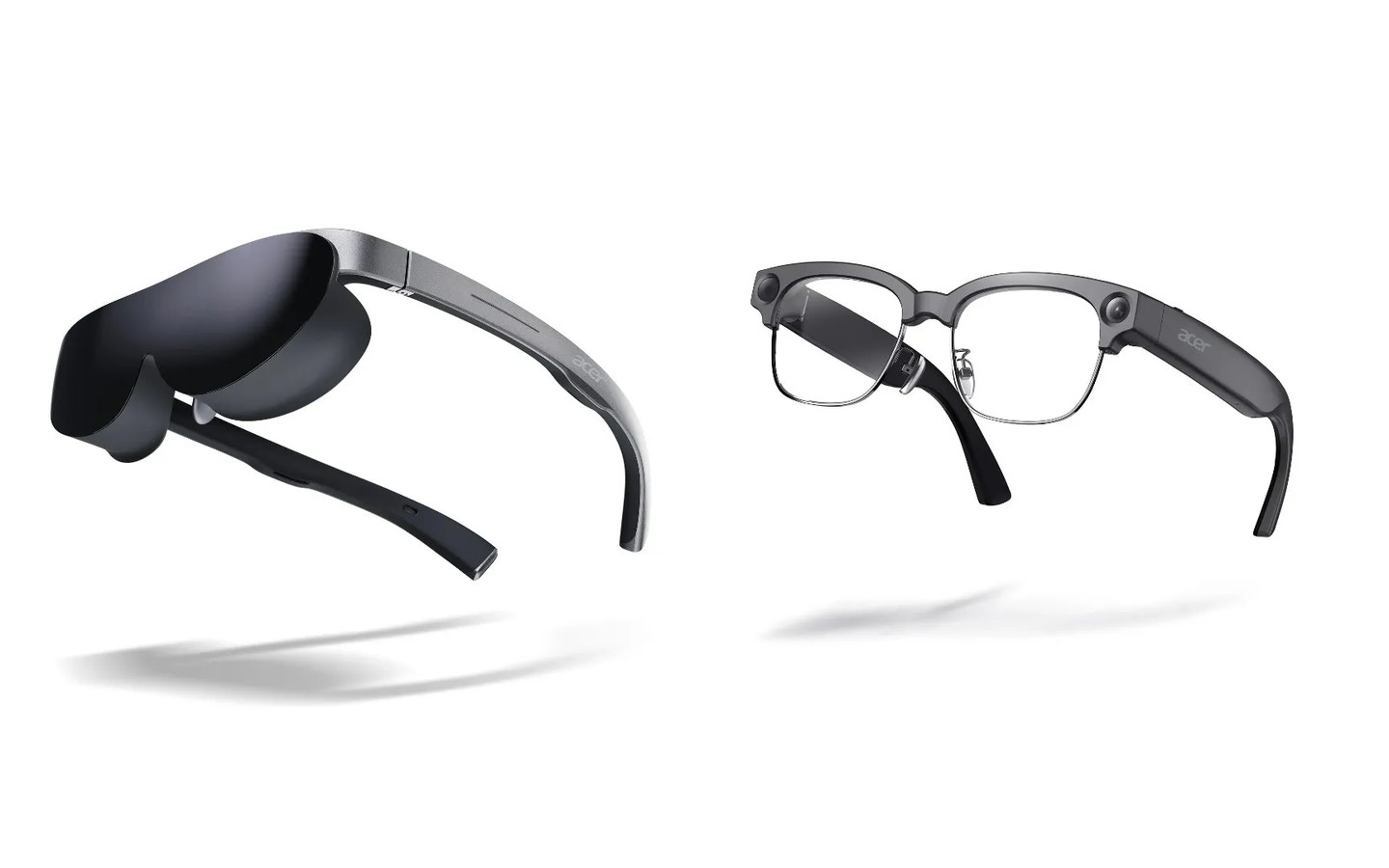
Acer Returns with Two Distinct Wearables
After a conspicuous seven-year hiatus from XR hardware, Acer is stepping back onto the scene with a pair of glasses that target both tethered AR and smartphone-connected AI companion use cases. The company's last headset, the business-focused OJO 500 released in 2019, marked the end of its earlier Windows PC VR push. Now, with the AR Vision GR0 and GI0 AI Glasses, Acer is squarely aiming at the lightweight wearable market dominated by names like XREAL, VITURE, and Meta’s Ray-Ban line.
AR Vision GR0: A Competitor to XREAL and VITURE
The AR Vision GR0 is a tethered display device that connects via cable to iOS, Android, and Windows machines. At its heart are dual 1,920 × 1,080 microOLED panels paired with bird bath-style optics—an approach similar to current rivals. Acer says the experience equates to a “172-inch screen viewed from 6 meters,” though it has not published an official field-of-view specification. That omission will be a key point for potential buyers accustomed to comparing FOV numbers directly.
The glasses are pitched for gaming, on-the-go productivity, and keeping work data private in public settings. While they lack the standalone AI smarts of the companion model, the GR0 focuses purely on delivering a large personal display that can mirror or extend your device’s screen. Availability details place it in North America soon starting at $500 USD; it’s also slated for EMEA in Q4 2026 at €600 and Australia in Q3 2026 for $1,000 AUD.
GI0 AI Glasses: Google Gemini Powers Acer’s Answer to Meta
The GI0 AI Glasses are the more intriguing entry for portable AI. These camera-equipped smart glasses lean on Google Gemini for voice interactions, real-time image analysis, and translation—much like the Ray-Ban Meta glasses but without a display. A built-in 12MP camera captures stills at 3,024 × 4,032 resolution and video at 1,920 × 1,080 / 30 fps, a step below the 3K, 30 fps video of the Ray-Ban Meta (Gen 2).
Interestingly, the glasses require the Acer AspireSync companion app, which pairs via Bluetooth 5.0 and Wi-Fi 5 with your Android or iOS phone. That dependency suggests most of the AI heavy lifting happens on the phone, with the glasses acting as a front-end sensor and microphone array. Acer hasn’t clarified whether the GI0 runs Android XR, but the tight Gemini integration points toward a Google-centric software stack.
Pricing is aggressive: $300 USD in North America, €400 in EMEA (Q4 2026), and $600 AUD in Australia (Q3 2026). At that price, the GI0 undercuts many rivals’ entry points and could attract buyers looking for a voice-and-camera assistant without the premium cost.
Both devices signal Acer’s cautious but deliberate re-entry into XR, leveraging its brand and supply chain to compete on price while relying on established platform partners like Google for AI. Whether they can challenge the incumbents will depend on real-world latency, comfort, and the polish of the companion software—details that remain to be tested once units ship later this year and into 2026.