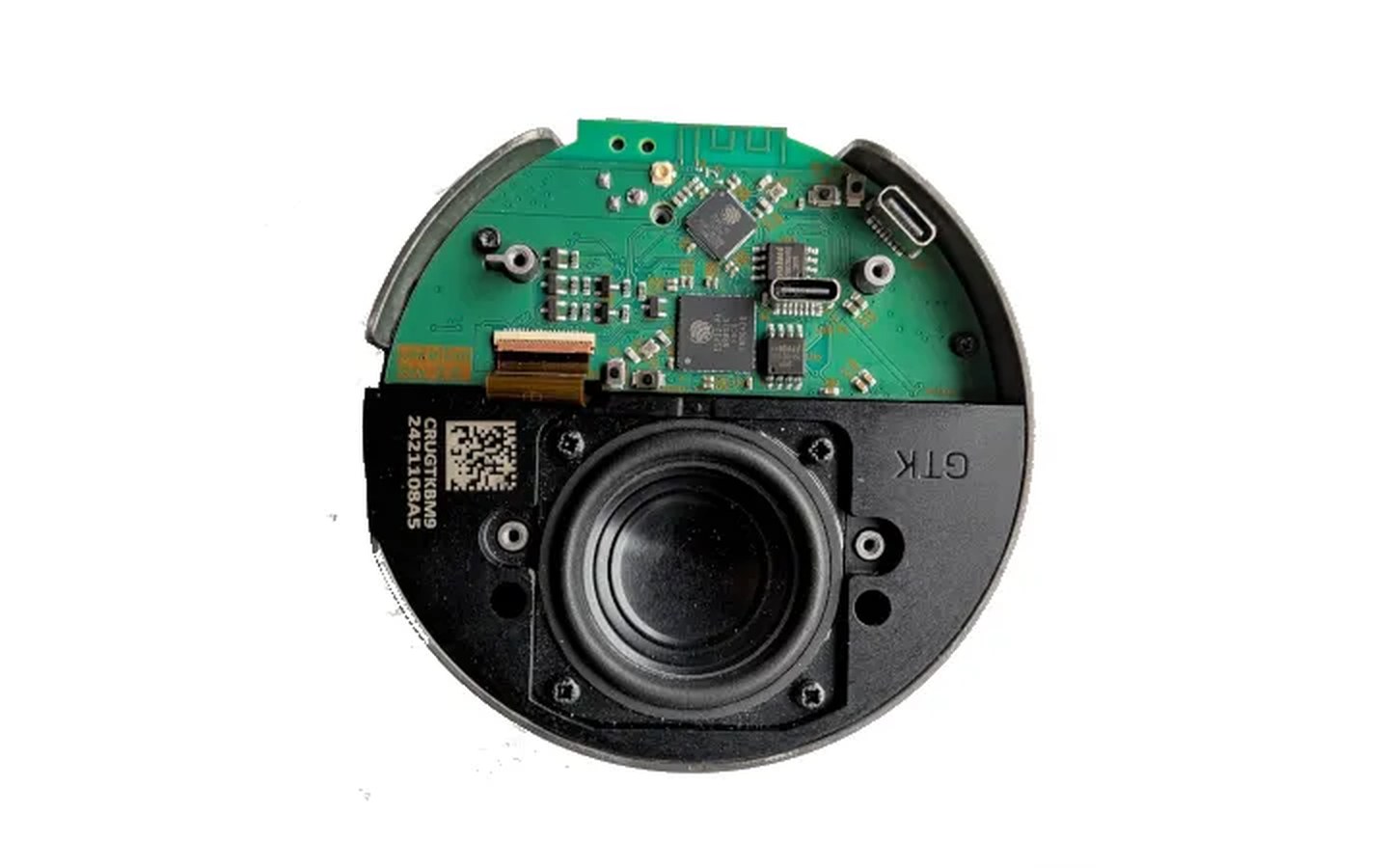
Hackaday recently highlighted a build by [ale1800] that should appeal to anyone who likes the size and microphone quality of an Amazon Echo Dot but doesn’t want every utterance routed through a corporate data center. The project takes a third-generation Echo Dot, removes the stock electronics, and installs a custom PCB that turns the familiar puck into a local voice assistant for Home Assistant.
Reusing the Dot’s Senses
The retrofit doesn’t try to reinvent the smart speaker. Instead, it keeps the parts that already work well:
- The original enclosure, which is compact and designed for far-field voice pickup.
- The microphone array, so wake-word detection and voice capture don’t start from scratch.
- The physical interface, including buttons and the familiar LED ring, making the device feel like a normal Echo Dot.
The new brain is where things get interesting. Rather than a simple microcontroller, [ale1800] used an ESP32-P4 application processor paired with an ESP32-S3 companion for connectivity. The P4 handles the heavier processing without needing a full single-board computer, while the S3 manages wireless duties. Hackaday notes that P4 projects are still gathering steam, and this one stands out because it doesn’t rely on a screen; it leans on the Dot’s existing audio and button interface. A YouTube demo shows the converted speaker responding to voice commands that are processed locally and sent to a Home Assistant server.
Cloud-Free Voice, Kept Practical
The appeal here is straightforward. A stock Echo Dot is inexpensive and has excellent microphone hardware, but its value depends on Amazon’s cloud. By swapping the PCB, [ale1800] keeps the hardware and removes the data-center dependency. The device becomes a client for a self-hosted smart home system, which fits neatly with Home Assistant’s local-first philosophy.
For portable AI and edge computing watchers, this is a useful signal. It shows that newer embedded processors like the ESP32-P4 are becoming practical for voice interfaces, not just screen-driven gadgets. It also demonstrates a retrofit path: instead of building an entirely new local assistant speaker, makers can repurpose the acoustic design and microphone layout of a mass-produced product. That lowers the barrier for privacy-focused voice hardware.
The catch is that this is still a maker project. You need a running Home Assistant server, some familiarity with the ESP32 toolchain, and patience for firmware quirks. It isn’t a drop-in consumer product. But as a proof of concept, it makes a compelling case that the next generation of microcontrollers can power local voice assistants inside recycled smart speaker shells.
Hackaday’s take is predictably enthusiastic: “What’s not to like?” The combination of a familiar interface, stronger local processing, and cloud-free operation is exactly the kind of project that pushes edge voice assistants from niche experiments toward everyday hardware.