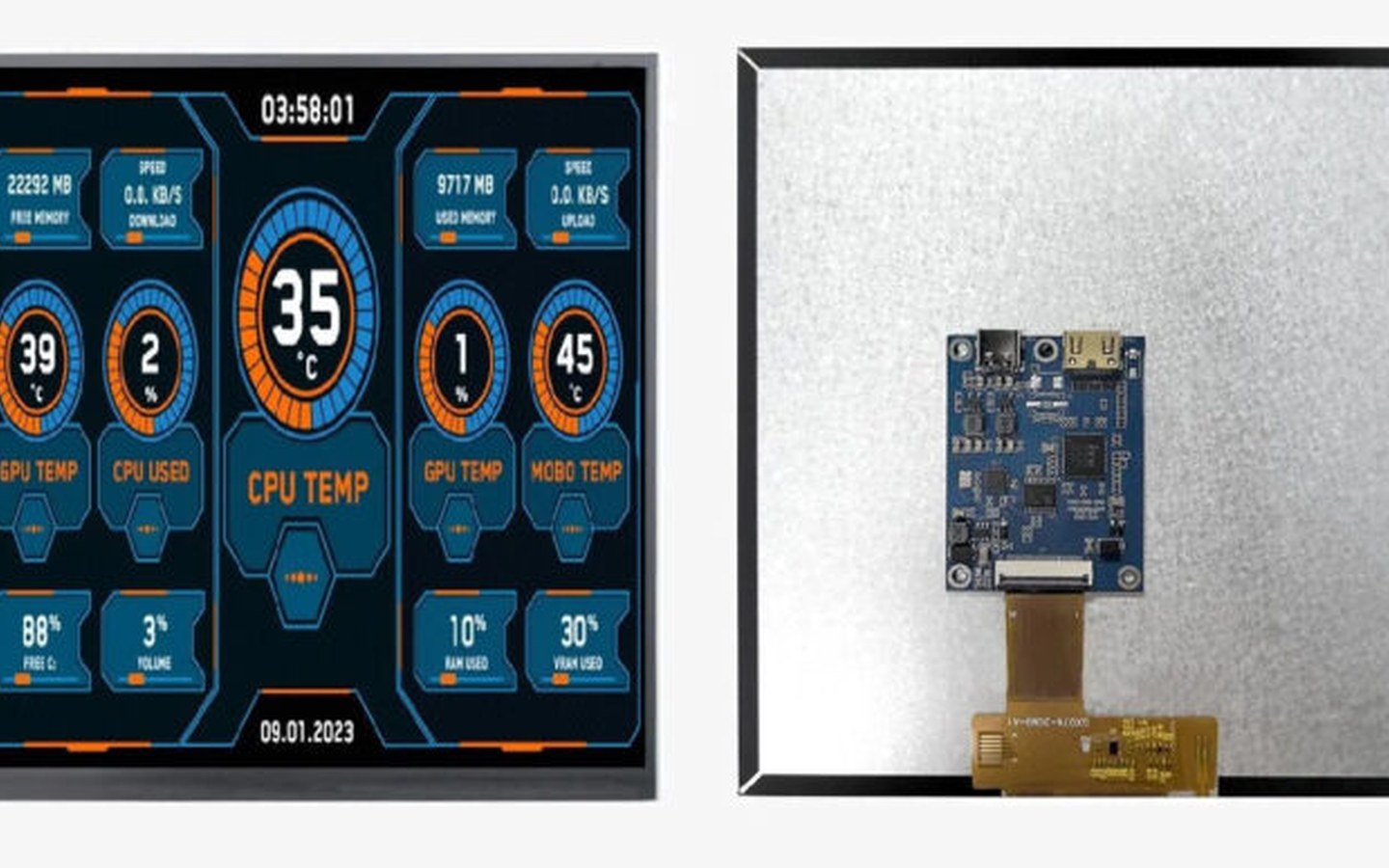
A Square Leap Beyond 4-Inch Displays
Until now, makers looking for a square display had to settle for 4-inch panels. VIEWE changes the game with two 7.6-inch IPS screens: the UEDX12120076-HMD-RB-A at 1200×1200 and the UEDX80800076-HMD-RB-A at 800×800. These aren't just scaled-up versions—they’re purpose-built for embedded systems, instrument clusters, and secondary stats screens where a classic landscape format won’t do. The larger active area (135.36 mm square) instantly makes dashboard interfaces and custom HMI layouts more readable, while the crisp resolution puts pixel density in a different class than the earlier 720×720 4-inch modules.
Under the Hood: Specs and Connectivity
Both displays hide a MIPI DSI panel behind a straightforward Mini HDMI 1.4 input and a USB-C port that carries both power and touch data. The touch controller is likely a FT6336U, supporting 5-point capacitive touch. The industry-standard IPS technology stays readable off-axis, and brightness tops 1,000 cd/m²—plenty to fight glare in bright environments.
- 800×800 model (UEDX80800076) – driven by an ILI9881C, priced at $85.29 on AliExpress.
- 1200×1200 model (UEDX12120076) – likely uses an HX8279 driver, currently $131.78.
The video pathway relies on an ITE HDMI-to-MIPI bridge, making these screens effectively plug-and-play with any HDMI source. VIEWE explicitly targets Raspberry Pi single-board computers, NVIDIA Jetson developer kits, and even Windows machines running monitoring tools like AIDA64. The USB-C port simplifies cabling: one connection for display power and touch input, so you won’t need a separate PSU.
Setup and Caveats
Getting a square pixel map on a Raspberry Pi requires a few lines in config.txt. VIEWE publishes snippets for the 800×800 version; the 1200×1200 setup should be identical except for the resolution value. The company’s documentation, however, shows signs of haste: some links point to the wrong manual, dimensions erroneously refer to the 4-inch predecessors, and the PDF for the high-res variant redirects to the lower-resolution model. Early adopters will want to verify every step.
The rugged temperature range (-20 to 70 °C operating, -30 to 80 °C storage) hints at industrial or outdoor use, though waterproofing isn’t mentioned. With a simple Mini HDMI cable and a USB-C connection, these displays can serve as a discrete status panel for a server, a square arcade marquee, or a mini photo frame that actually fits a 1:1 aspect ratio. At these prices, the biggest hurdle remains the patchy documentation—but if you’re comfortable tweaking a config file, the screen real estate and resolution are hard to ignore.