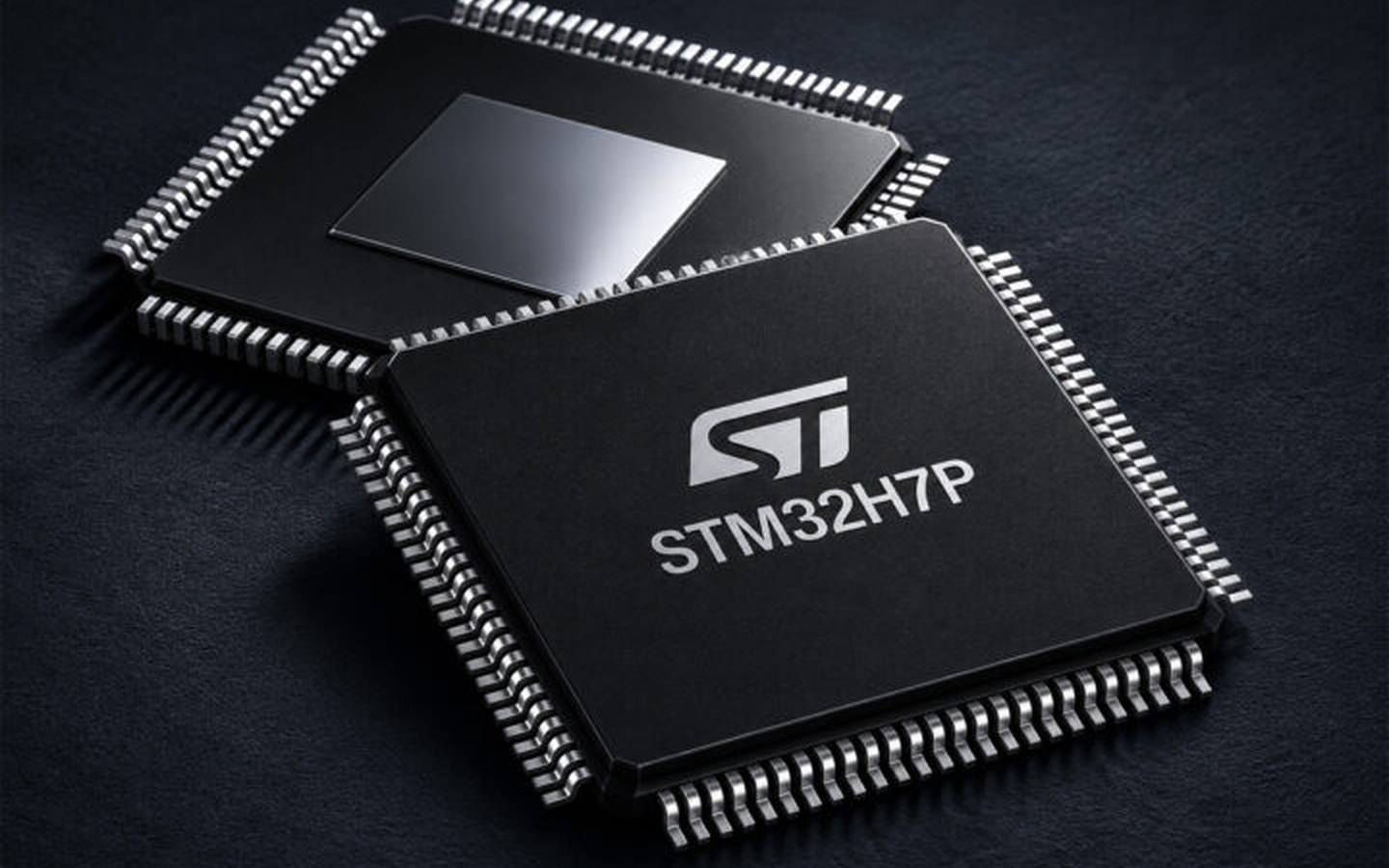
STMicroelectronics is expanding its high-performance MCU line with two parts that push signal-processing math and optional neural inference onto a single Cortex-M7 die, according to CNX Software. The STM32H7P4 and STM32H7P5 both run an Arm Cortex-M7 at up to 520 MHz, include double-precision FPU and DSP instructions, and deliver 2,773 CoreMark (5.33 CoreMark/MHz). But the real story is the set of coprocessors next to the CPU.
A dual-track Cortex-M7 launch
Both microcontrollers target digital power, motor control, industrial sensing, and edge AI. They carry:
- Up to 2 MB dual-bank flash with ECC
- 736 KB SRAM split across ITCM (192 KB), DTCM (128 KB), AXI (320 KB), AHB (96 KB), and 4 KB backup
- External memory through Octo-SPI (PSRAM, NOR, HyperRAM, HyperFlash) and FMC (SDRAM, NAND, PSRAM)
Peripherals lean industrial: four 12-bit ADCs at up to 5 MSPS with 44 channels, two high-resolution timers with 1.9 ns resolution and up to 24 PWM outputs, three advanced motor-control timers, three CAN FD interfaces, USB OTG Full-Speed, and two USB Type-C Power Delivery controllers. Security hardware includes readout protection, tamper detection, secure firmware upgrade, HASH acceleration for MD5/SHA/HMAC, and a NIST-compliant TRNG.
Signal processing and AI on the same die
The common hardware accelerator is ST's Hardware Signal Processor (HSP), which offloads matrix/vector operations, FFT/IFFT, filtering, and convolution from the Cortex-M7. ST says the HSP can execute FFT operations up to five times faster than a software implementation on the CPU alone. The STM32H7P5 adds a Neural-ART NPU running at 520 MHz, rated at 85 GOPS (0.085 TOPS) for TinyML inference. According to ST, this NPU runs an arc-fault circuit interrupter (AFCI) model up to 40 times faster than a Cortex-M7 software implementation.
That distinction matters: the H7P4 is the signal-processing workhorse, while the H7P5 is the only variant with dedicated neural acceleration. Developers get STM32CubeH7P firmware with HAL and LL drivers, STM32CubeMX for configuration, STM32CubeIDE for debugging, and X-CUBE-MCSDK or X-CUBE-DPOWER for motor control and digital power.
Development boards and where the trade-offs sit
ST also unveiled two H7P5 boards. The NUCLEO-H7P5II Nucleo-144 board includes onboard ST-LINK and expansion connectors. The STM32H7P5I-DK Discovery kit adds an OLED display, Octo-SPI flash, a MEMS microphone, microSD slot, and a motor-control expansion connector.
The main caveat is the NPU's modest 85 GOPS rating. It is not a smartphone-class accelerator, and it appears only in the H7P5. The H7P4 still relies on the HSP, CORDIC, and FMAC accelerators for signal-heavy workloads. But for a battery-powered motor controller, compact industrial sensor, or handheld instrument, the ability to keep sensing, control, and light inference inside one low-power MCU may outweigh raw TOPS. CNX Software notes that this is the first time ST has paired HSP and Neural-ART IP blocks with a Cortex-M7 core, after earlier appearances on Cortex-M55 and Cortex-M33 parts.